
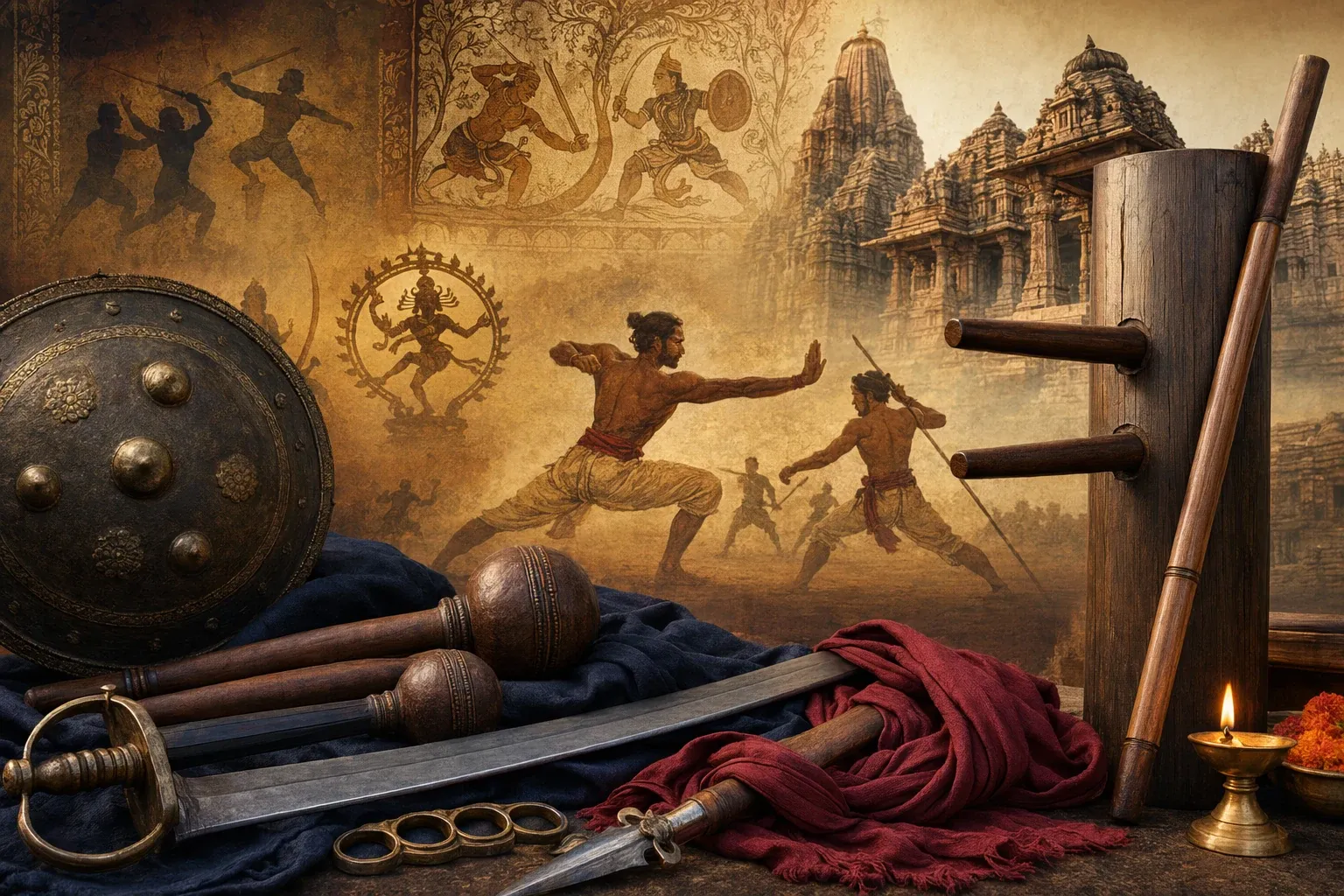
The age of Indian martial arts cannot be answered with one neat date. India has very old references to wrestling, weapons, armies, body training and warrior communities, but today’s named traditions each have their own layered history.
This guide gives a careful timeline: ancient clues, regional martial cultures, medieval and early modern patronage, colonial disruption, public performance, sport forms, cinema influence and modern revival.
The simple meaning
This topic becomes easier to understand when we separate three things: the name of the practice, the place or community connected with it, and the purpose of training. Some traditions focus on wrestling or body strength. Some use staffs, swords, shields, or other weapons in controlled settings. Some are practiced as cultural display, fitness, spiritual discipline, self-control, or heritage education.
A beginner-friendly way to remember Indian martial arts is: region plus practice plus discipline. Region tells us where the tradition is rooted. Practice tells us what the body actually does. Discipline tells us the attitude behind it: patience, restraint, courage, respect, and responsibility.
Tradition, interpretation, and historical context
In tradition, martial arts are preserved through gurus, ustads, akharas, kalaris, community groups, family memory, public demonstrations, and local festivals. These memories are valuable because they keep living links with older ways of training and teaching.
In interpretation, we ask what these practices teach today. The answer is not only fighting. They can teach focus, body awareness, courage, self-control, respect for elders, teamwork, cultural pride, and the dharmic idea that strength should be guided by responsibility.
In historical context, we need careful language. India has old references to weapons, wrestling, armies, warrior communities, and training, but each modern style has its own story. Some traditions changed under kings, temples, colonial rule, modern sport, cinema, tourism, and revival movements. Respectful history does not pretend that every claim is equally proven.
Key points for beginners
- Ancient and classical Indian sources mention wrestling, archery, weapons, military training, and warrior ideals.
- Regional styles developed through local needs, rulers, communities, festivals, and training lineages.
- Colonial rule, changing warfare, policing, and social shifts affected many traditions differently.
- Modern revival often mixes preservation, performance, sport, identity, and fitness.
Examples you may recognise
- akhara wrestling culture
- regional sword and stick traditions
- temple and festival performance settings
- revival schools and cultural demonstrations
Why “how old” is hard to answer for living traditions
The first step is to define the subject without flattening it. How Old Are Indian Martial Arts? A Short History for Beginners is connected to Indian martial culture, but Indian martial culture is not one uniform system. It includes regional names, teacher lineages, public demonstrations, fitness training, traditional weapons, wrestling spaces, festival settings, and modern schools.
The angle here is simple: A careful beginner history that separates ancient references, medieval warrior cultures, colonial-era change and modern revival without overclaiming one exact origin date. This matters because many people first meet Indian martial arts through a short video, a movie scene, or a dramatic claim. A calmer explanation gives the subject more dignity.
Ancient and classical references to training, wrestling, weapons and warrior disciplines
Tradition is the memory carried by teachers, families, communities, practice spaces, and regional language. Interpretation is how today’s readers understand meaning, discipline, courage, restraint, and identity. Historical context asks what can be shown through evidence, what belongs to oral memory, and where we should avoid exaggerated certainty.
This is especially important when comparing old and modern practice. A style may carry ancient memories while also using modern teaching methods, uniforms, competitions, or stage formats. That does not make it fake; it means living traditions adapt.
Regional kingdoms, akharas, temple/festival settings and community practice
Examples help because the topic becomes real only when we name practices. Kalaripayattu, Gatka, Silambam, Thang-Ta, Mardani Khel, Paika Akhada, and Kushti do not all look the same. Each has its own body language, setting, and cultural world.
A useful exercise is to pick one tradition and ask four questions: Where is it rooted? Who teaches it? What does training include? What values does it expect from students? These questions are better than asking only which style is “best”.
Colonial restrictions, social change and partial decline
Safety is part of the culture, not an extra warning pasted at the end. Real training usually begins with basics, warmups, posture, respect for the teacher, and control. Weapons, sparring, throws, locks, and intense conditioning belong under proper supervision.
For weapons and combat topics, the safest public explanation is cultural and educational. It is fine to understand why sticks, swords, shields, or spears appear in history. It is not wise to treat articles or videos as permission to imitate risky training alone.
Modern revival, sports, performance and heritage education
For young readers, the practical lesson is balance. Be proud of Indian heritage, but do not turn pride into careless claims. Learn names, learn context, respect teachers, and remember that discipline is more important than looking dangerous.
The modern value of these traditions is not limited to self-defence. They can connect young people with language, region, physical health, performance arts, community discipline, and a healthier relationship with courage.
Common mistakes to avoid
- Do not treat all Indian martial arts as one single style.
- Do not make dramatic origin claims without careful evidence.
- Do not copy weapon movements from videos without a qualified teacher.
- Do not reduce living traditions to movie stunts or celebrity trivia.
- Do not confuse respect for heritage with blind exaggeration.
Questions people ask
How old is Indian martial arts?
Indian martial traditions are old and layered, but not all have one shared origin date. Colonial rule, changing patronage, policing, and modern revival affected different practices in different ways.
Are there Indian martial arts?
A careful answer should name the specific tradition, region, training context, and safety limits. That keeps the topic useful without turning living heritage into a vague action-movie idea.
Which martial art is used in India?
A careful answer should name the specific tradition, region, training context, and safety limits. That keeps the topic useful without turning living heritage into a vague action-movie idea.
Why are Indian martial arts connected with regional history?
Indian martial traditions are old and layered, but not all have one shared origin date. Colonial rule, changing patronage, policing, and modern revival affected different practices in different ways.
Why it still matters
Indian martial arts matter because they show culture through the body. A text can teach ideas, but practice teaches rhythm, balance, endurance, breath, alertness, and humility. Even watching a good demonstration can remind us that heritage is not only something kept in books; it can be trained, performed, and passed on.
They also ask us to think about power in a dharmic way. Strength without restraint becomes danger. Skill without humility becomes ego. Pride without truth becomes noise. The best martial traditions keep strength connected with discipline and community responsibility.
The safest answer is not a flashy date. Indian martial traditions are best understood as old, layered, regional, and still changing.
Keep learning with context
For broader context, you may also like Sambhaji Maharaj as warrior-scholar context and dharma and responsibility in action, because martial traditions make more sense when we connect body discipline with culture, responsibility and public memory.