
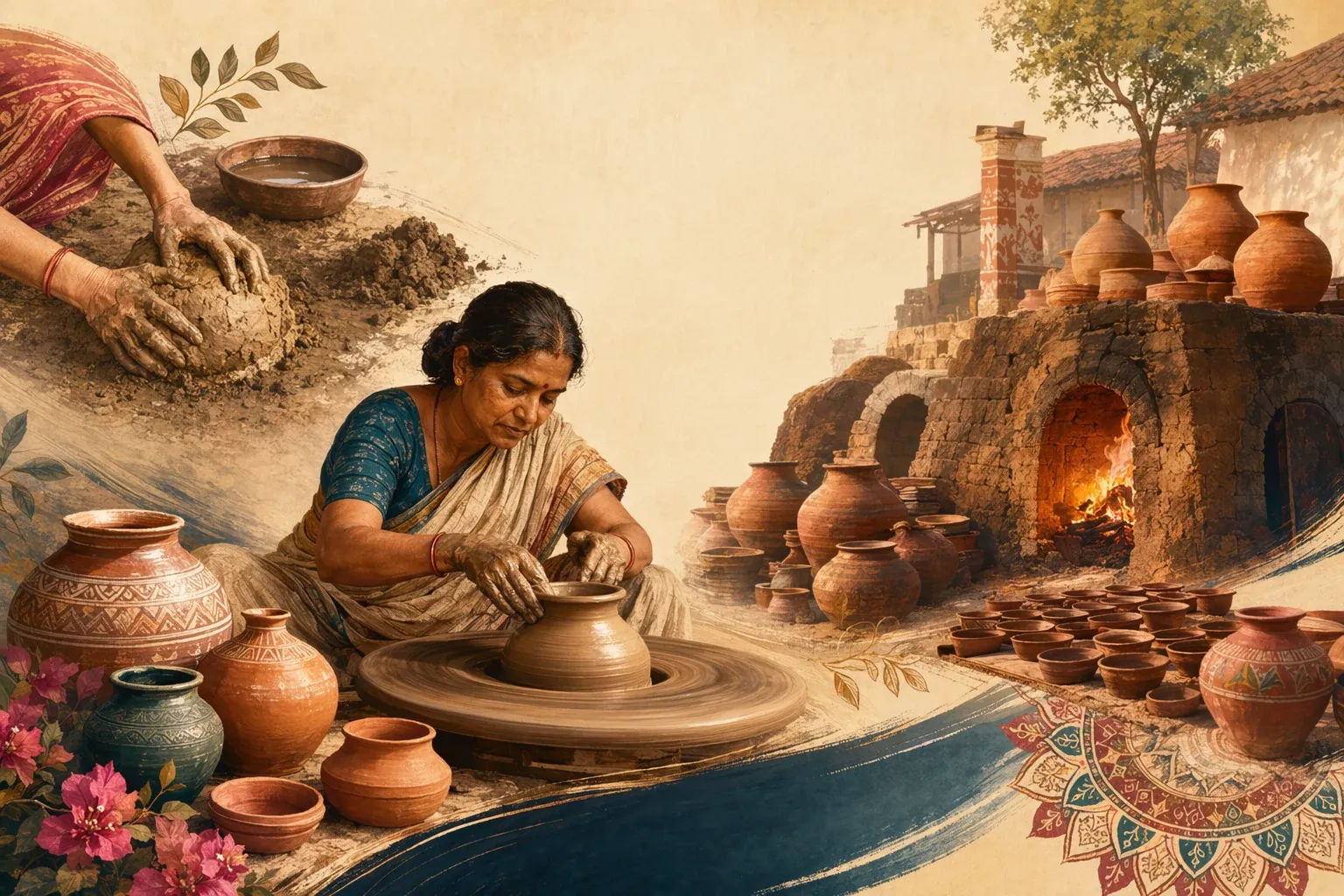
From river clay to a ready pot
Indian pottery looks simple when we see a matka in a courtyard or a terracotta horse in a craft shop. But behind that finished object is a careful chain of choices: where the clay comes from, how it is cleaned, how much water is added, whether the pot is shaped by hand or on a wheel, how slowly it dries, and how the firing changes soft earth into a usable object. That is why pottery is one of the oldest and most practical arts of India. It is craft, science, design, and everyday culture held in the same palm.
For the wider background of this clay craft, read What Is Indian Pottery? Meaning, History, and Why It Matters. To connect the making process with history and fired-clay traditions, see Ancient Indian Pottery: What Clay Vessels Tell Us About History and Indian Terracotta Pottery: Meaning, Uses and Cultural Value.
A potter does not begin with a romantic idea of “mud”. The work begins with clay that can hold shape. In many Indian villages, potters traditionally knew which local soil became strong after firing and which soil split too easily. Riverbeds, ponds, tanks, fields, and local deposits all mattered. The best clay for a water pot, a cooking handi, a lamp, or an image was not always the same. Some clay needed sand or older crushed pottery mixed into it so that the vessel would shrink more safely while drying and firing.
Preparing the clay: the quiet work before shaping
Before a pot reaches the wheel, the clay is cleaned, soaked, kneaded, and brought to an even texture. Stones, roots, and hard lumps are removed because a tiny hidden impurity can create a weak point. Kneading also pushes out air pockets. If air remains trapped inside a thick wall, the pot can split when heat expands that pocket. This preparation is not glamorous, but it decides the life of the vessel.
The moisture level is equally important. Too dry, and the clay tears under the hand. Too wet, and it collapses. Experienced potters learn this through touch. They can feel when clay is ready the way a musician feels when an instrument is tuned. This is one reason traditional craft knowledge should be respected as knowledge, not dismissed as only labour. It is observation repeated across years.
Wheel-thrown, hand-built, and moulded forms
Many common Indian vessels are made on a wheel. The potter places a lump of clay at the centre, spins the wheel, wets the hands, presses the clay down, opens it from the middle, and slowly lifts the wall upward. A matka, surahi, diya, kulhad, bowl, or storage pot may begin as this rising shape. The wheel gives symmetry, speed, and graceful curves, but the human hand still controls thickness, balance, and rim shape.
Not every Indian pottery form is wheel-thrown. Some are hand-built, pressed into moulds, or assembled from slabs and coils. Terracotta plaques, ritual figures, votive horses, toys, lamps, and decorative panels often need modelling rather than wheel work. The Bankura horse of West Bengal, Molela clay plaques of Rajasthan, Aiyanar terracotta horses of Tamil Nadu, and Longpi pottery of Manipur remind us that “Indian pottery” is not one technique. It is a family of regional methods shaped by local materials, rituals, markets, and community memory.
Drying is where patience protects the pot
After shaping, the pot is not immediately fired. It must dry slowly. Fresh clay contains water between its particles. If the outside dries too quickly while the inside remains wet, the wall pulls unevenly and splits. Potters often keep new pots in shade first, then move them into stronger light. Thin lamps dry faster than large water pots. Thick sculptural pieces need more care because hidden moisture can cause damage in the fire.
At the leather-hard stage, the pot can be trimmed, smoothed, joined with handles, burnished, painted with slip, or decorated with incised lines. A simple village pot may be left plain because its purpose is storage, cooling, or cooking. A ceremonial or market piece may receive patterns, natural colours, or a polished surface. The final look depends on use as much as beauty.
Open firing, kiln firing, and the colour of clay
Firing is the great transformation. Heat drives out remaining water, hardens the clay body, and changes its colour. Traditional firing may happen in an open clamp, a pit, or a kiln, using fuels such as wood, straw, husk, leaves, or dung cakes depending on the region. The arrangement matters: pots must receive heat, but not be crushed; flame must move, but not shock the vessels. A badly fired pot may remain weak, blacken unevenly, or break.
Colour is not only paint. Red, buff, grey, and black tones can come from clay minerals, oxygen, smoke, and firing control. In an oxygen-rich atmosphere, iron in clay often gives reddish terracotta. In a smoky or reducing atmosphere, darker surfaces may develop. Some traditions polish or smoke the surface for a particular finish. Glazed pottery, such as Khurja ware or Jaipur blue pottery, follows different material logic because glaze and body must mature together.
Indian examples you can actually recognise
If you want to identify pottery around you, begin with familiar forms. A matka cools water through slow evaporation from porous clay. A kulhad is a small unglazed cup used for tea, lassi, or curd in many places. A handi is a rounded cooking vessel associated with slow heat. Diyas carry oil or ghee during worship and festivals. Terracotta horses, elephants, plaques, and toys often connect craft with ritual or seasonal celebration.
Regional examples add richness. Bankura horses are known for long necks and stylised ears. Khurja pottery is famous for bright glazed tableware. Jaipur blue pottery is not ordinary clay pottery; it is usually discussed as a quartz-based ceramic tradition. Longpi pottery is hand-shaped from a stone-and-clay mixture and has a dark, burnished look. These examples show why a single definition is never enough for India.
What pottery teaches about culture
Pottery is useful because it sits between home and heritage. It stores grain, cools water, cooks food, carries offerings, decorates walls, teaches children shapes, and gives archaeologists clues about old settlements. A shard from an ancient site may tell experts about trade, diet, firing skill, or daily habits. A living potter in a village or town tells us how craft survives through family training, local markets, and changing demand.
The dharmic lesson is also simple. Good craft asks for right material, right timing, right heat, and right intention. Rush any one part, and the vessel suffers. That is true for clay, and it is true for learning. When we understand how Indian pottery is made, we stop seeing it as a cheap object and begin seeing the intelligence of hands that turn earth into culture.
Questions people ask about this topic
How to make Indian pottery?
Indian pottery is made by preparing suitable clay, shaping it by hand, wheel, mould, or coil, drying it slowly, and then firing it so the clay becomes hard enough for use.
How is Indian pottery made?
Many Indian pots are made on a spinning wheel, but ritual figures, plaques, toys, and some regional traditions are hand-built or moulded instead.
Indian pottery wheel?
A traditional pottery wheel is a rotating platform that lets the potter centre clay and lift it into an even round form using steady hands and water.
Traditional Indian pottery wheel?
Traditional wheels may be hand- or stick-spun and need rhythm, strength, and balance. Modern electric wheels exist, but the skill of centring and shaping remains essential.
Indian clay pottery?
Indian clay pottery includes everyday matkas, handis, diyas, kulhads, storage jars, terracotta figures, regional craft pieces, and glazed ceramic traditions.
Related reading
For broader context on Bhaktilipi, continue with Ancient Indian Pottery: What Clay Vessels Tell Us About History and How Were Jyotirlingas Formed? Swayambhu, Temple Legends, and What Tradition Says.