
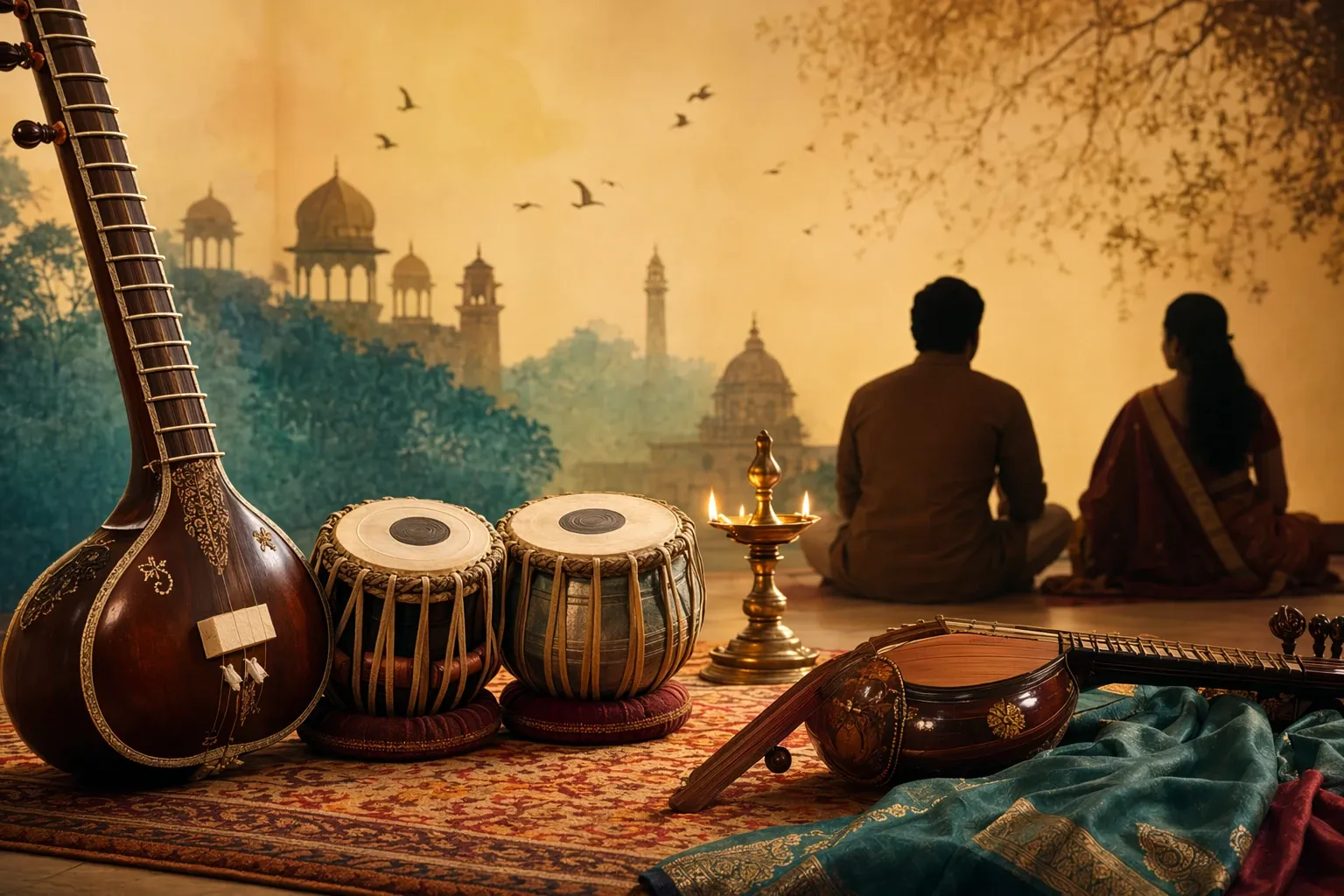
Indian classical music is a family of art-music traditions built around melodic and rhythmic frameworks, disciplined training, composition and improvisation. Its two major present-day traditions are Hindustani music, associated mainly with northern India, and Carnatic music, associated mainly with southern India.
A beginner does not need to memorise hundreds of terms. Start with three ideas: raga shapes melodic movement, tala organises recurring time, and attentive listening reveals how a performer creates within those structures.
Two major traditions: Hindustani and Carnatic
The Ministry of Culture identifies Hindustani and Carnatic as the two major traditions of the Indian classical music system. These are broad families rather than rival teams or perfectly sealed regions.
Hindustani music is associated mainly with northern, western and central India. Its concert forms include dhrupad and khayal, alongside instrumental traditions. A performance may give extended space to gradual raga development.
Carnatic music is associated mainly with southern India. Its concert culture is rich in composed forms such as varnam and kriti, while also giving improvisation a central role. Raga, tala and expressive ornamentation remain fundamental.
Both traditions include vocal and instrumental music, teacher-led transmission, composed material and improvisation. Their terminology, repertoire, ornamentation, concert sequence and rhythmic practice can differ, so a short north-versus-south formula is only a first map.
What is a raga?
A raga is more than a scale. It is a melodic framework with characteristic movements, important tones, recurring phrases and a recognisable identity. Two ragas can use similar notes yet sound different because they approach, emphasise and connect those notes differently.
Associations with mood, season or time appear in parts of the tradition, but they should not be flattened into a claim that every raga mechanically causes one emotion. The performer, composition, school, context and listener also matter.
What are tala, laya and swara?
Tala is an organised rhythmic cycle. Laya refers to tempo or rhythmic flow. Swara refers to a musical tone or note in the system. In performance, tala is not merely a background beat: melody and percussion can approach, delay, subdivide and return to structurally important points in the cycle.
The Government of India’s Utsav portal likewise describes Carnatic music through raga and tala, while the Sangeet Natak Akademi explains that fixed compositions coexist with improvisation inside structured notes and time cycles.
Improvisation is freedom within training
Improvisation does not mean playing anything at random. A performer learns repertoire, technique and the grammar of a raga and tala over years, then makes choices in the moment. The balance between inherited form and individual imagination is central to both major traditions.
An unmetered or slowly unfolding passage may introduce a raga before percussion enters. In other settings, a composition provides the centre for melodic or rhythmic elaboration. The form depends on the tradition, genre and performance.
Voice, drone and instruments
The voice is central, and many instruments cultivate vocal-like slides and ornamentation. The Ministry of Culture documents a wide range of Indian instruments and their different roles.
- Hindustani settings may include voice, sitar, sarod, sarangi, bansuri, shehnai, tabla, pakhawaj and tanpura.
- Carnatic settings may include voice, violin, veena, venu, nagaswaram, mridangam, ghatam, kanjira and tanpura.
The tanpura’s sustained drone gives performers and listeners a tonal reference. Percussion articulates and responds to rhythmic structure rather than simply adding volume.
How the music is learned
Indian classical music has long valued oral, teacher-led learning: close listening, imitation, correction, repertoire and regular practice. The Sangeet Natak Akademi describes the guru relationship and oral transmission as important to the tradition. Today, learners may also study through universities, conservatories, group classes and online lessons.
Recordings and books can build context, but they cannot fully replace feedback on pitch, rhythm, posture, breath, fingering or stylistic detail. A beginner choosing a teacher should look for clear progression, respectful conduct and realistic practice expectations rather than grand claims about instant mastery.
How to begin listening
- Choose a clearly labelled performance with the artist, tradition, raga and form named.
- First notice the drone and the main melodic voice or instrument.
- Listen for repeated phrases and a note that feels like a point of rest.
- When percussion enters, notice where the musical phrases return.
- Hear the same raga from another artist before trying to define it.
- Compare one Hindustani and one Carnatic concert without treating either as the standard for the other.
You do not need technical mastery before enjoying the music. Feeling the pacing, colour and tension is a legitimate beginning; terminology can sharpen what repeated listening already reveals.
A seven-day listening plan
- Day 1: hear ten minutes without multitasking.
- Day 2: focus on the drone and melodic centre.
- Day 3: notice when rhythm begins and cycles return.
- Day 4: compare vocal and instrumental performances.
- Day 5: read a short note about one raga, then listen again.
- Day 6: try the other major classical tradition.
- Day 7: write down what changed in your hearing.
Common misconceptions
- It is all devotional music: devotion is important in much repertoire, but the traditions also include courtly, aesthetic and other themes.
- A raga is just a scale: characteristic movement and phrase matter, not only a pitch collection.
- Improvisation has no rules: trained freedom depends on musical grammar.
- Only experts can listen: knowledge deepens appreciation, but curiosity and attention are enough to begin.
- Classical music is frozen: it carries inherited disciplines while performers, institutions, media and audiences continue to change.