Indian pottery is one of the easiest cultural arts to notice, but one of the easiest to underestimate. A clay pot may look simple at first: round body, narrow neck, maybe a painted line. Look a little longer and it becomes evidence of food habits, trade, technology, local soil, ritual, and everyday beauty. For students, pottery is useful because it connects history to something we can imagine holding in our own hands.
In India, pottery has never been only one thing. Archaeologists study ancient potsherds from cities and villages. Museum visitors see terracotta toys, storage jars, ritual vessels, lamps, and painted bowls. Families may still use a matka for cool water, a diya during festivals, or a clay handi for cooking. Craft communities continue to shape clay on wheels, by hand, and in moulds. So when we say “Indian pottery”, we are talking about both old material culture and living craft.
If you are building a school project or museum note, begin with What Is Indian Pottery? Meaning, History, and Why It Matters, then compare the archaeology angle in Ancient Indian Pottery: What Clay Vessels Tell Us About History, the cultural uses in Indian Terracotta Pottery: Meaning, Uses, and Cultural Importance, and the making process in How Is Indian Pottery Made? Clay, Wheel, Hands, and Firing Explained.
Why clay objects help us read the past
Clay survives when cloth, wood, food, and many painted surfaces disappear. That is why pottery is so important in archaeology. Even broken pieces can tell a story. A thick storage jar suggests grain, oil, water, or trade. A small lamp points to household worship or lighting. A toy cart or animal figure can show how children played and how adults imagined the world around them. Painted designs can suggest taste, skill, symbols, and sometimes contact between regions.
Students should remember that a pot is not a full history by itself. It becomes meaningful when we ask where it was found, what layer of soil it came from, what other objects were nearby, and how experts date it. A pot from a burial, a kitchen, a workshop, and a temple-like space may carry different meanings. The object is the clue; the context is the story.
Harappan terracotta and painted pottery
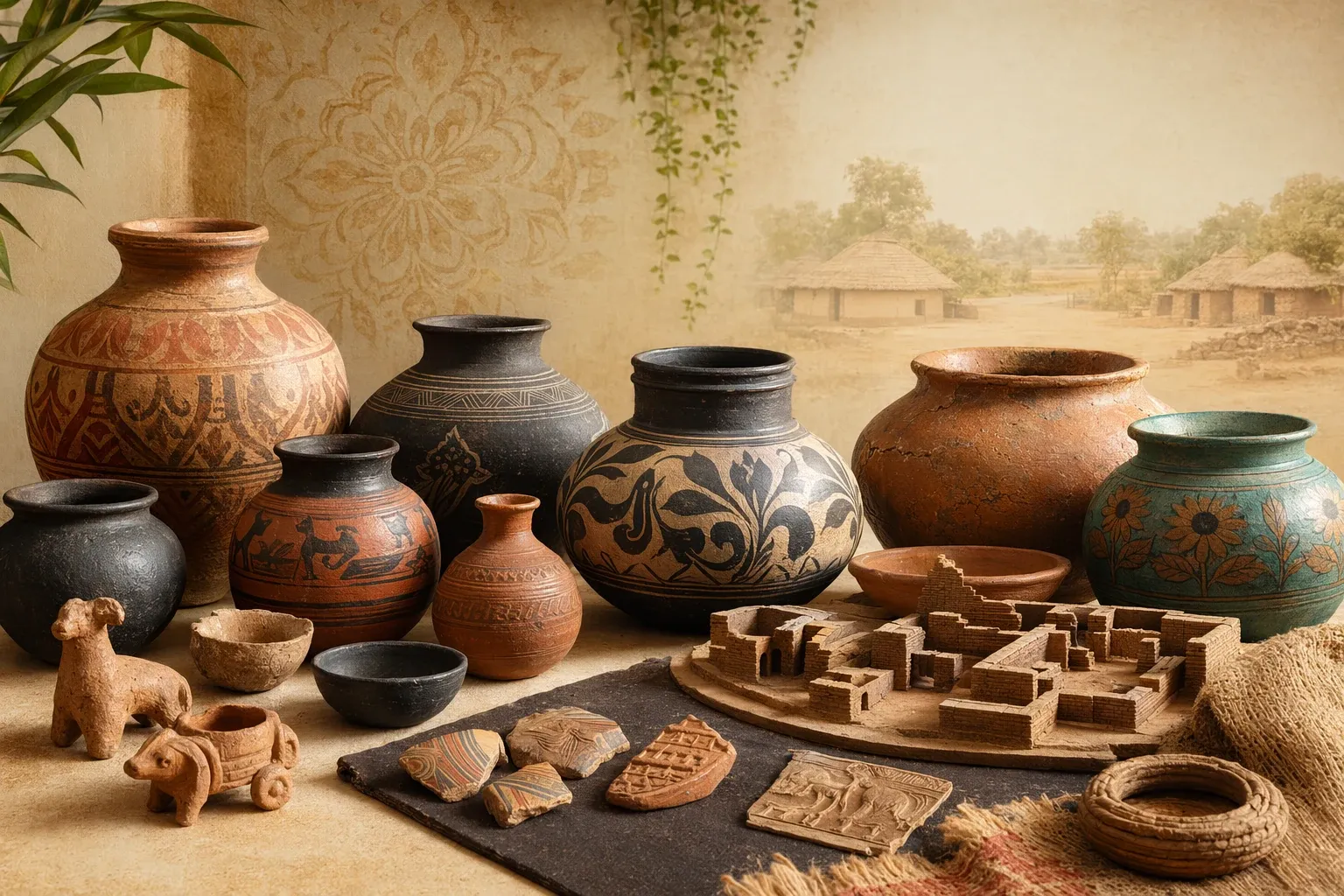
The Indus or Harappan civilisation gives some of the best-known early examples. Sites such as Harappa, Mohenjo-daro, Lothal, Kalibangan, Dholavira, and Rakhigarhi have yielded many clay objects. Students often see red pottery with black painted designs in textbook images. Some vessels have geometric bands, leaves, fish-like forms, intersecting circles, or animal figures. Terracotta toys, wheels, carts, beads, bangles, and figurines also appear in museum collections and online displays.
A famous student-friendly example is the terracotta toy cart. It is not just cute; it points to wheels, transport, play, and miniaturisation. A painted storage jar is not just decoration; it points to settled life, craft skill, and perhaps a sense that useful objects could also be beautiful. When looking at Harappan pottery pictures, notice the neatness of form, the balance of painted bands, and the repeated use of fired clay in daily life.
Everyday vessels: matka, handi, kulhad, and diya
Many students know pottery first through familiar objects. A matka cools water through evaporation; the tiny pores in fired clay allow moisture to move outward, making the surface cool. A handi, with its rounded base and thick body, is associated with slow cooking in many parts of India. A kulhad, the small unglazed cup used for tea or lassi in some railway stations and shops, carries the smell of earth after hot liquid touches it. Diyas are small lamps used especially during Deepavali and in many household rituals.
These examples show why pottery cannot be separated from lived culture. The same material can serve the kitchen, the market, the shrine, the festival, and the classroom. It can be cheap and everyday, but also carefully decorated. It can be disposable, repairable, sacred, artistic, or archaeological, depending on the object and the setting.
Regional craft forms students can recognise
India’s pottery traditions vary strongly by region. Black pottery from Nizamabad in Uttar Pradesh is known for its dark surface and silvery patterns. Molela terracotta from Rajasthan is famous for relief plaques, often connected with local devotional images. Bankura terracotta horses from West Bengal have become iconic decorative and ritual forms. Khurja pottery in Uttar Pradesh is known for glazed ware and bright colours. Blue pottery of Jaipur uses a different material tradition from ordinary clay pottery, but students often meet it in the same craft conversation because of its vessel forms and painted surface.
When studying any regional form, avoid treating it like a single frozen design. Ask: who makes it, what clay or material is used, whether it is wheel-thrown or moulded, how it is fired, what colours appear, and whether people buy it for daily use, worship, tourism, gifting, or home decoration. This keeps the craft connected to makers, not just to pretty images.
How to study pottery pictures without guessing too much
A good way to read pottery images is to move from visible facts to careful interpretation. First describe the shape: bowl, jar, lamp, cup, figurine, plaque, or toy. Then notice the body: round, tall, flat, open, narrow-necked, handled, spouted, or lidded. Next observe colour and surface: red, grey, black, polished, rough, glazed, painted, burnished, or unglazed. After that, look at decoration: lines, dots, animals, flowers, human figures, deities, geometric bands, or plain surfaces.
Only after this should you suggest possible use. A small spouted vessel may have held liquid, but we should not pretend certainty unless the museum label or archaeological report says so. A figure may be ritual, playful, decorative, or symbolic. Good cultural learning is not about making dramatic claims; it is about noticing clearly and speaking honestly.
Museum habits that make pottery more interesting
In a museum, start with the label but do not stop there. Note the date range, place, material, and object type. If the label says “terracotta”, it usually means fired clay. If it says “earthenware”, “stoneware”, or “porcelain”, those terms refer to different ceramic bodies and firing conditions. Compare similar objects in the same case. Are vessels from one region thicker or more polished? Are painted lines careful or free-flowing? Are there signs of repair, soot, chips, or wear?
Students can also sketch the silhouette of a pot. Drawing the outline teaches more than taking ten hurried photos. A sketch makes you notice the curve of the shoulder, the size of the mouth, and the balance of the base. If photography is allowed, take one full object photo and one label photo. If it is not allowed, respect the rule; careful notes are enough.
Respect for makers and objects
Pottery is often discussed as “ancient”, but many potters are living artists and workers. Buying directly from craftspeople, asking before photographing them, crediting the place and community when known, and avoiding bargaining that insults labour are simple ways to show respect. If a family owns an old clay or terracotta object, it should be handled gently, kept dry, and not cleaned with harsh chemicals without expert advice.
The best student memory is this: pottery is history made touchable. A clay object carries earth, water, fire, hand skill, and human need. Whether it is a Harappan toy cart, a village water pot, a festival diya, or a museum bowl, it reminds us that culture is not only in grand monuments. It is also in the vessels people used, gifted, cooked with, prayed with, and left behind.