# When Does Vishnu Sleep and Wake Up? Chaturmas and Ekadashi Explained
Many Hindu families know the beautiful idea that Vishnu goes to sleep during Chaturmas and wakes up on Devutthana Ekadashi. A beginner may wonder: does this mean the deity literally becomes unavailable? The tradition is better understood as sacred time expressed through story. Vishnu’s sleep marks a season of restraint, reflection, devotion, and inward discipline. His waking marks renewal, auspicious beginnings, and the return of outward celebration.
This way of speaking turns the calendar into a spiritual teacher. The year is not only a chain of dates. It has moods. Some months invite movement and celebration. Some invite patience, simplicity, and self-correction.
The two Ekadashis to remember
The sleeping of Vishnu is commonly associated with Devshayani Ekadashi, also called Ashadhi Ekadashi in many regions. It falls in the bright fortnight of the month of Ashadha, usually around June or July. This day is understood as the beginning of Vishnu’s sacred sleep.
The waking of Vishnu is associated with Devutthana Ekadashi, also called Prabodhini Ekadashi, in the bright fortnight of Kartika, usually around October or November. This day marks the end of the four-month period. After this, many communities again consider weddings and other auspicious ceremonies more suitable, depending on local custom.
Exact Gregorian dates change each year because the Hindu calendar follows lunar calculations. Families usually check a trusted panchang or temple calendar for their region.
What is Chaturmas?
Chaturmas means “four months.” In many Hindu traditions it refers to a sacred four-month period that begins around Devshayani Ekadashi and ends around Devutthana Ekadashi. It overlaps with the monsoon season in much of India. Historically, travel was harder during heavy rains, and wandering ascetics often stayed in one place. This made the period suitable for study, vows, listening to teachings, and quieter religious life.
Different communities observe Chaturmas in different ways. Some avoid certain foods during particular months. Some increase chanting or scripture reading. Some take small vows. Some focus on charity, simplicity, and control of speech. The exact practice varies, but the mood is similar: slow down, purify habits, and remember the divine with steadiness.
Why is Vishnu said to sleep?
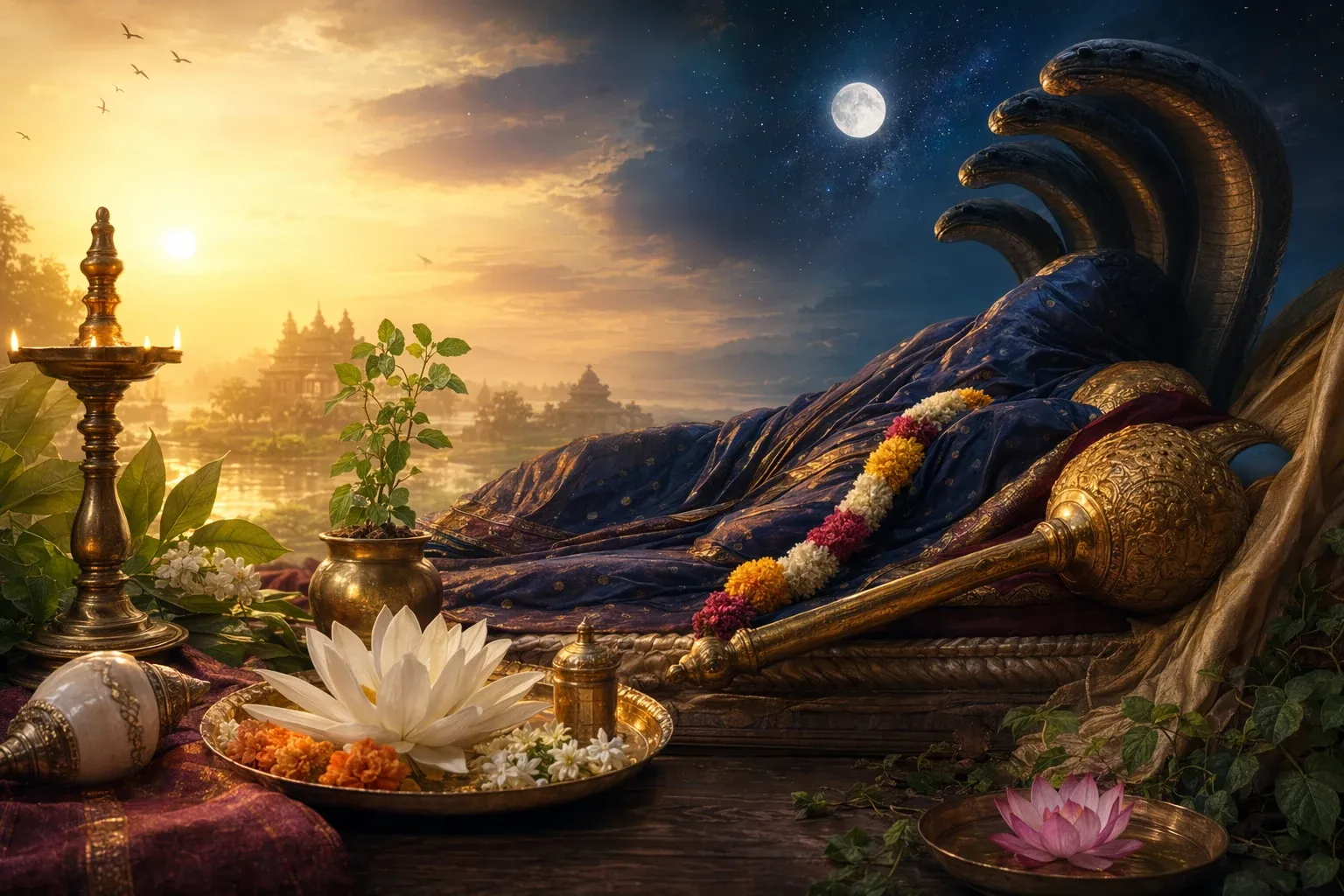
The image of Vishnu sleeping is connected with Vishnu resting on Shesha in the cosmic ocean. This is one of the most powerful images in Hindu art: Vishnu in yogic rest, Lakshmi near him, Shesha supporting him, and the deep waters suggesting cosmic potential. Sleep here does not mean weakness. It means divine rest, inwardness, and the hidden support beneath creation.
In ordinary life, sleep renews the body and mind. In sacred storytelling, divine sleep can mark a pause in outward activity. Chaturmas asks devotees to recognise that not every season is for expansion. Some seasons are for conserving energy, deepening practice, and allowing the heart to become cleaner.
For more on this imagery, see Bhaktilipi’s guide to Vaikuntha, Kshira Sagara, and Shesha.
Devshayani Ekadashi: the beginning of restraint
Devshayani Ekadashi is a day of remembrance, fasting or dietary discipline for many devotees, and prayer to Vishnu. The name itself points to the deity entering sacred sleep. In Maharashtra, the day is also deeply connected with the Pandharpur Wari and devotion to Vithoba, a beloved form associated with Vishnu and Krishna traditions.
The emotional tone of Devshayani Ekadashi is not sadness. It is reverent quiet. The devotee accepts that the coming months are a time to become more careful. Food, speech, entertainment, anger, and laziness can all be examined. Even a small vow, kept sincerely, can make the period meaningful.
Devutthana Ekadashi: waking and renewal
Devutthana Ekadashi celebrates Vishnu’s waking. The word suggests rising, awakening, or becoming alert again. Many families connect this day with Tulsi Vivah, the ceremonial marriage of Tulsi and Vishnu or Shaligram in several traditions. The day carries a mood of auspicious return.
After the inward months of Chaturmas, public celebration gradually becomes more prominent. Weddings and other ceremonies may resume according to regional practice. The spiritual lesson is gentle: renewal is more meaningful after restraint. Celebration becomes brighter when the heart has practiced discipline.
How Ekadashi fits into Vishnu devotion
Ekadashi is the eleventh lunar day and is especially important in Vaishnava devotion. Many devotees observe it by fasting fully, eating simply, avoiding grains, chanting Vishnu’s names, reading sacred stories, or visiting temples. The details differ by health, family tradition, and guidance from elders.
The purpose is not to show off austerity. Ekadashi trains attention. It asks the devotee to interrupt habit and remember what nourishes the inner life. If someone cannot fast for health reasons, they may still observe the day through prayer, charity, reading, or restraint in speech.
Beginners interested in home worship can also read Bhaktilipi’s guide to Vishnu mantra, Chalisa, and simple home worship.
Does Vishnu stop protecting the world?
No. The tradition should not be read as Vishnu abandoning devotees for four months. Sacred sleep is symbolic and devotional. Vishnu remains the cosmic support. The story changes the devotee’s relationship to time. It says: during these months, live more carefully, because the season itself is asking for humility.
Hindu traditions often use divine stories to teach human rhythm. Dawn, dusk, new moon, full moon, monsoon, harvest, and winter can all carry spiritual meaning. Vishnu’s sleep belongs to that larger wisdom of sacred timing.
Regional differences
Not every Hindu household observes Chaturmas in the same way. Some follow Vaishnava customs closely. Some know only the main Ekadashi dates. Some connect the period with local temple festivals. Some focus more on Shravan, Janmashtami, Ganesh Chaturthi, Navaratri, or Diwali, which fall during or near this larger seasonal arc.
This diversity is normal. Hindu practice is often regional, familial, and community-shaped. The key is to understand the meaning without forcing one uniform rule onto everyone.
Simple takeaway
Vishnu is said to sleep from Devshayani Ekadashi at the beginning of Chaturmas and wake on Devutthana Ekadashi near the end of Kartika. The dates shift each year, so a panchang is needed for the exact calendar. The deeper meaning is steady and beautiful: Chaturmas is a season for restraint, devotion, simplicity, and inner renewal. Vishnu’s waking then becomes a sign that disciplined quiet can lead back to auspicious action and celebration.