
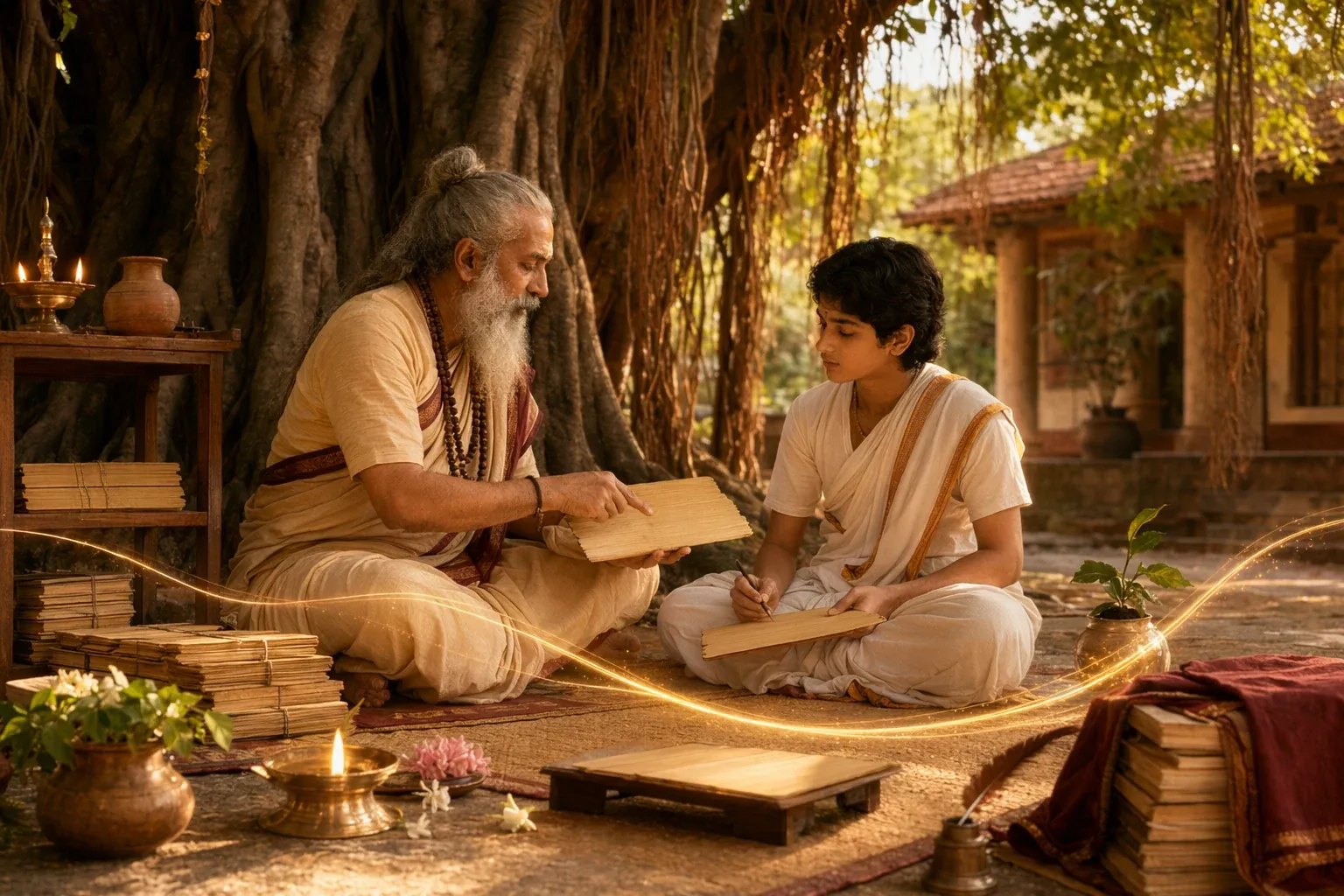
When people hear the words guru-shishya parampara, many immediately imagine an ashram, a saffron-clad teacher, and a student learning sacred texts. That image is not wrong, but it is only one part of a much larger Indian learning culture. The guru-shishya bond has lived in spiritual paths, philosophy, music, dance, yoga, martial practice, crafts, and many forms of close mentorship. So the simple answer is: no, guru-shishya is not only a religious practice. It is a way of learning where knowledge passes through trust, observation, correction, discipline, and lived example.
The religious side matters, of course. In many Hindu, Buddhist, Jain, Sikh, and other Indian-origin traditions, a guru is not merely a lecturer. The teacher may guide a student in scripture, meditation, ethics, ritual, or self-understanding. The Bhagavad Gita 4.34, for example, presents spiritual learning as a combination of respectful approach, sincere questioning, and service. That verse is often read as a reminder that wisdom is not picked up casually; it needs humility and a living teacher who has understood the path. But Indian culture did not restrict this teacher-student model to temples or monasteries.
A learning bond, not just a religious label
The Sanskrit word shishya means disciple or student, and parampara means a continuing line or succession. In plain language, the idea is that a learner receives knowledge from someone who has already practised, tested, and embodied it. The word guru can carry sacred meaning in many traditions, but in wider Indian usage it also means a respected teacher or master of a discipline. That is why we speak of music gurus, dance gurus, yoga gurus, craft masters, and even mentors in ordinary life.
This matters because some knowledge is hard to learn only from a book. A book can show a raga scale, a mudra name, a recipe, a yoga posture, or a philosophical sentence. A teacher can notice whether the note is alive, the hand is tense, the posture is unsafe, the translation is shallow, or the student is rushing without understanding. Guru-shishya learning is strongest where small corrections change the whole quality of practice.
Classical music keeps the idea very visible
Hindustani and Carnatic music are among the clearest non-only-religious examples. A student may learn raga, tala, voice culture, improvisation, repertoire, and the discipline of listening from a guru over many years. In Hindustani music, the language of gharana shows how styles were carried through family lines, places, courts, and chains of disciples. Gwalior, Agra, Jaipur-Atrauli, Kirana, Patiala and other gharanas are remembered not just as place names, but as musical approaches shaped through transmission.
None of this needs to be reduced to religion. A khayal singer learning how to approach Raga Yaman, a tabla student repeating bols slowly for months, or a sitar student learning meend and phrasing is participating in a disciplined learning culture. The atmosphere may include devotion and reverence, especially because Indian art often has sacred roots, but the training itself is artistic, technical, emotional, and intellectual.
Dance, theatre, and embodied practice
Indian classical dance also shows why guru-shishya learning cannot be understood only as a religious practice. Bharatanatyam, Kathak, Odissi, Kuchipudi, Kathakali, Manipuri, Mohiniyattam, and Sattriya all require the body to remember rhythm, posture, gesture, expression, and storytelling. A dance student learns adavus, footwork, facial expression, stage discipline, costume awareness, and how to treat a performance space with respect. Some dance themes come from Krishna, Shiva, Devi, the Ramayana, the Mahabharata, or bhakti poetry; some performances explore wider poetic and social themes. In both cases, the training depends on close correction.
Think of Kathak, where a guru may correct the clarity of a chakkar, the placement of the eyes, or the way a tihai lands on sam. In Bharatanatyam, a teacher may adjust araimandi, shoulder line, hand position, or the emotional truth of abhinaya. These are not small details. They decide whether the art becomes mechanical or alive. That is exactly where the guru-shishya method shines: it teaches through repeated practice, seeing, doing, and refining.
Yoga, crafts, and everyday skill
Yoga is another mixed space. In some lineages, yoga is deeply spiritual and connected with self-discipline, meditation, and liberation. In other settings, people learn yoga mainly for health, mobility, breath awareness, or mental steadiness. A careful teacher helps students avoid forcing the body, understand breath, and practise with patience. The relationship can carry traditional respect without demanding blind surrender.
Craft traditions also fit the same pattern. A bronze caster, temple architect, wood carver, handloom weaver, mural painter, percussion maker, Ayurvedic practitioner, or cook may learn through apprenticeship. Much of the knowledge sits in the hands: how wet clay behaves, how metal cools, how a loom tension changes, how a chisel should meet stone, how a spice is roasted without burning. These skills are often taught through families, workshops, guild-like circles, and long observation. They may be linked to ritual or temple culture, but they are also technologies of practice.
What changes in online learning?
Many people now ask whether digital communities, video classes, or paid courses can carry guru-shishya learning. The honest answer is: partly, but not completely. Online learning can make access easier. A student in a small town can attend a music session with a teacher in Chennai, Pune, Varanasi, Kolkata, or Delhi. A dance learner can record practice and receive corrections. A yoga student can join guided sessions. This is useful, especially when travel and cost are barriers.
But online format should not be confused with the full tradition. Guru-shishya learning is not just content delivery. It includes attention, responsibility, correction, trust, and ethical boundaries. A good digital class can support these qualities, but a flashy course page cannot guarantee them. For serious arts or spiritual learning, students should look for a teacher’s training history, clarity, patience, safety practices, and willingness to answer questions. Avoid any teacher or platform that demands secrecy, fear, instant worship, or unrealistic promises.
Respect is not blind obedience
One important modern clarification is that respect for a guru does not mean giving up judgement. Traditional language often praises surrender, service, and devotion. In a healthy setting, these point to humility, regular practice, gratitude, and openness to correction. They should not become excuses for abuse, financial pressure, emotional control, or silencing questions. The Gita’s model includes pariprashna, sincere questioning, alongside reverence. That balance is important for today’s learners.
It is also helpful to separate three layers. Tradition tells us how communities have honoured teachers. Interpretation explains what ideas like surrender, discipline, or lineage mean in different paths. Historical context reminds us that real teachers and students lived in changing societies, with different regions, languages, castes, genders, courts, temples, homes, and institutions shaping access to learning. No single romantic picture can represent every Indian community.
Common questions
Is Guru-Shishya only a religious practice?
No. It is important in spiritual traditions, but it also appears in classical music, dance, yoga, crafts, martial practice, and mentorship. The common thread is close transmission of knowledge from an experienced teacher to a committed learner.
Can music or dance students use the word guru?
Yes, many Indian arts use the word respectfully for a teacher who trains students deeply. The meaning depends on the tradition and relationship. It does not automatically mean the teacher is a religious authority.
Are online guru-shishya classes the same as traditional learning?
They can borrow some features, such as regular guidance and correction, but they are not automatically the same. The quality depends on the teacher, seriousness of practice, feedback, safety, and trust.
A balanced way to see the tradition
Guru-shishya parampara is best understood as a living Indian model of learning, not a narrow label. Its religious form is powerful and deserves respect. Its artistic and skill-based forms are equally real. What connects them is not costume or location, but the belief that knowledge becomes deeper when it passes through relationship, practice, humility, and responsibility. For a student today, the lesson is simple: learn from good teachers, ask sincere questions, practise steadily, and never confuse respect with losing your own conscience.