
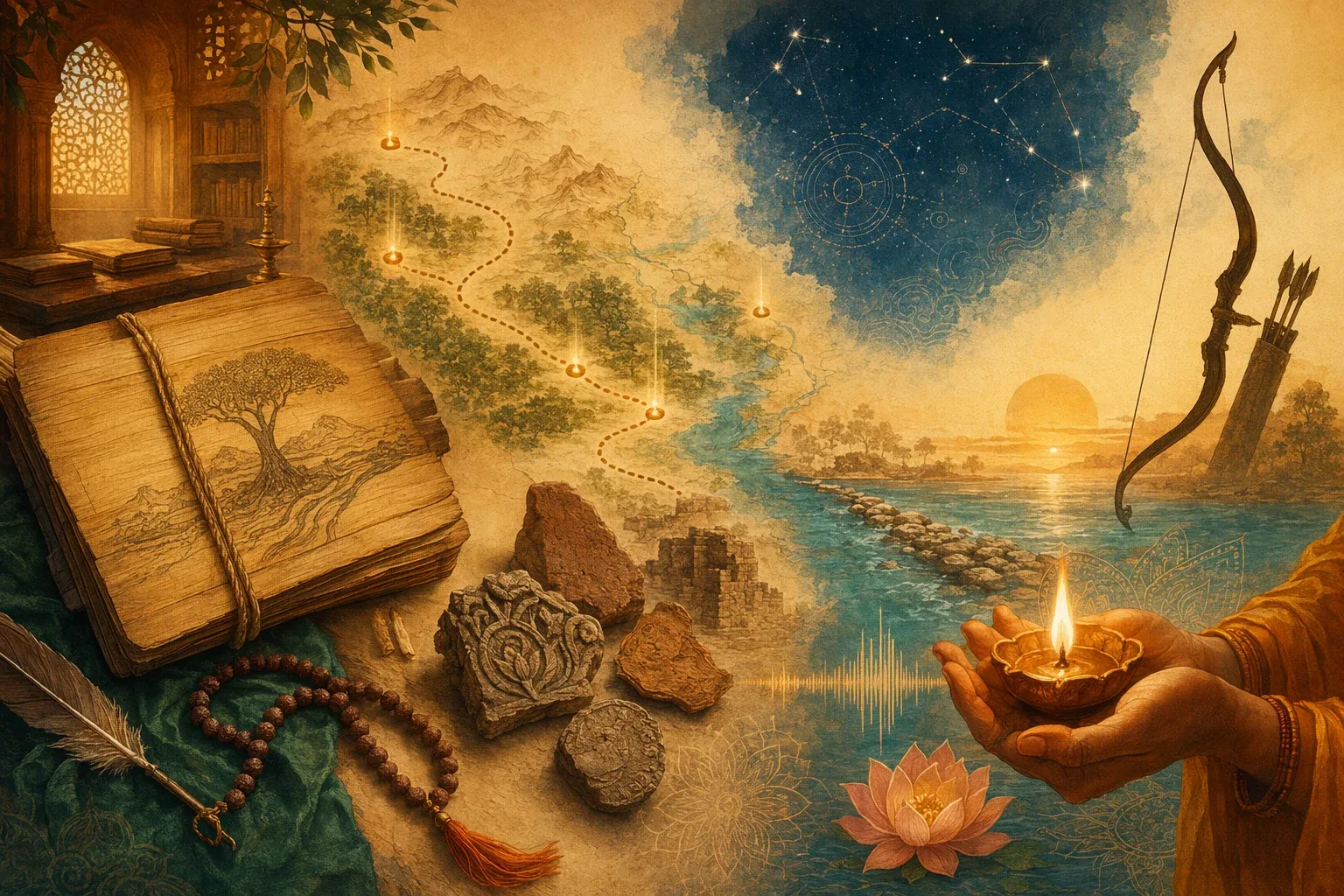
If you searched for 'is ramayana real', this beginner-friendly Bhaktilipi guide is for you.
Reader questions behind this guide: Is Ramayana real?; Did Ramayana really happen?; In which Yuga did Ramayana happen?; Is there proof of Ramayana?.
We will keep the explanation simple, respectful, and useful, while clearly separating tradition, interpretation, and modern historical discussion where needed.
Quick answer
For many Hindus, the Ramayana is sacred Itihasa and a living truth carried through worship, memory, festivals, and family tradition. It is not treated as “just a myth” in that devotional world.
From a modern academic history angle, exact dates, locations, and material proof are debated. A respectful answer should hold both points clearly: faith has its own way of knowing, while historical proof has stricter methods.
What Itihasa means
Itihasa is often translated as “thus it happened.” In Indian tradition, it carries memory, moral teaching, sacred story, genealogy, geography, and cultural identity together.
Itihasa should not be flattened into either modern newspaper history or imaginary fiction. It belongs to a different civilisational category that has shaped how people understand dharma and life.
What tradition says about Treta Yuga
Traditional Hindu understanding places the Ramayana in Treta Yuga. This connects Rama’s story with a sacred time framework much larger than ordinary modern chronology.
Young readers should know that Yuga timelines are part of Hindu cosmology. They are not usually handled the same way as a school textbook timeline of recent centuries.
What historians and archaeologists can and cannot prove
Historians and archaeologists can study places, texts, languages, material remains, manuscript traditions, and cultural memory. But they may not be able to prove every epic event exactly as devotional tradition receives it.
That does not automatically make the Ramayana meaningless. Many ancient traditions carry truth through story, ritual, place, and memory, not only through laboratory-style evidence.
Ram Setu and place memory
Places associated with the Ramayana, such as Ayodhya, Chitrakoot, Panchavati, Rameswaram, and Lanka-related traditions, are important in pilgrimage and cultural geography.
Modern discussions about Ram Setu and other places should be approached carefully. It is better to say “associated with” or “traditionally connected with” when evidence is complex.
Why the story matters either way
Even for readers still exploring faith questions, the Ramayana has shaped Indian ethics, language, festivals, performing arts, names, political imagination, family ideals, and devotional life.
Its cultural reality is undeniable. The story lives because people continue to read it, perform it, argue with it, pray through it, and learn from it.
If this topic interests you, continue with Are the Puranas Real History or Mythology? A Respectful Beginner Answer and A Divine Journey: Doul Govinda Temple History and Legends.
A respectful beginner mindset
Avoid two lazy extremes: mocking faith as foolish, or making exaggerated proof claims that cannot be responsibly supported.
A mature Bhaktilipi approach is simple: respect tradition, be honest about evidence, and keep learning with humility.