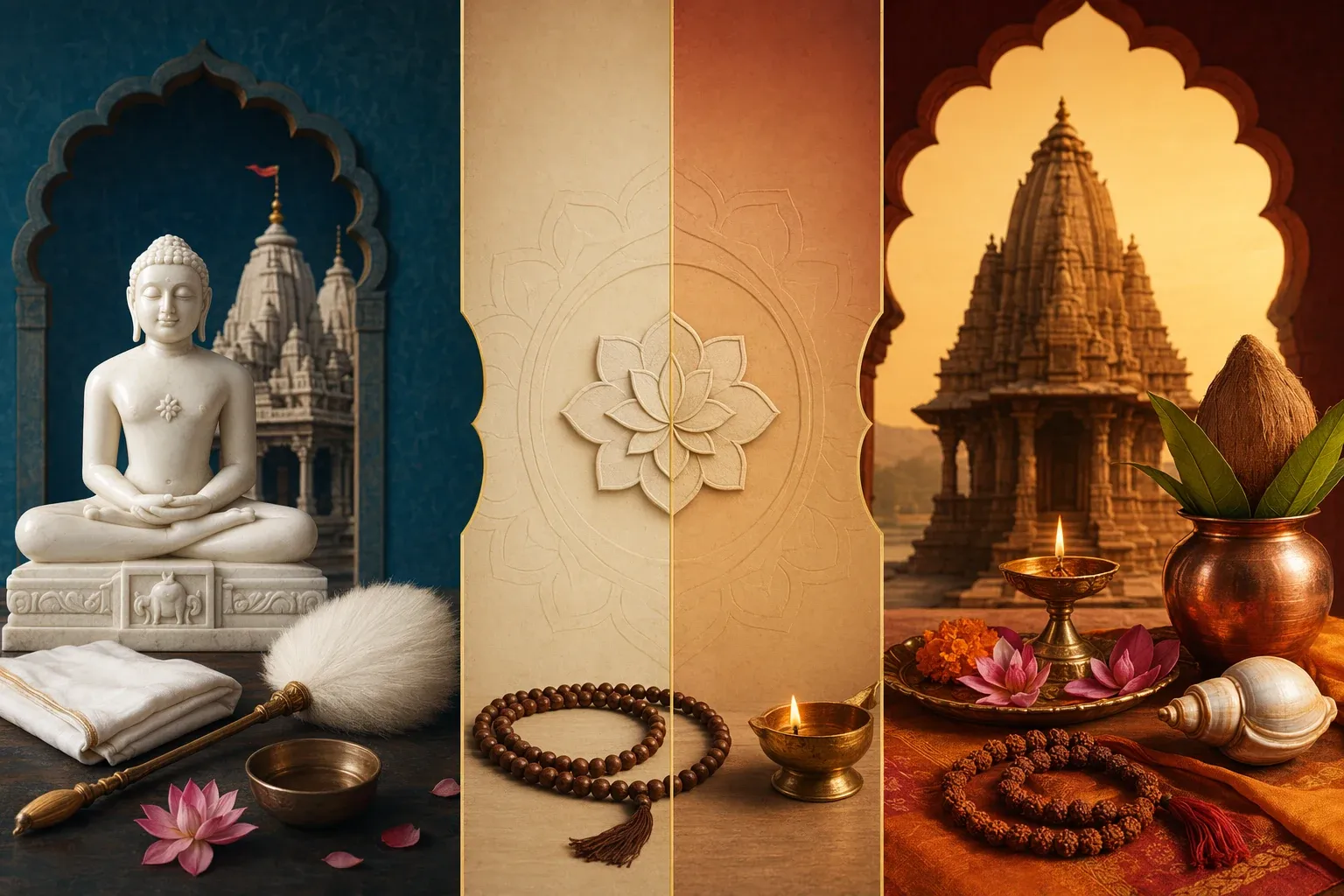
Jainism and Hinduism are related in the sense that they grew within the larger Indian religious and cultural world. They share words like karma, dharma, moksha, tapas, yoga, samsara, and ahimsa. They also share geography, festivals in some social settings, temple culture in broad form, and centuries of conversation with each other.
But they are not the same religion. Jainism has its own teachers, scriptures, vows, monastic lineages, temple traditions, philosophy of soul and karma, and path to liberation. Hinduism is itself very diverse, with many sampradayas, deities, scriptures, philosophies, and devotional paths.
Where they overlap
Both traditions take karma and rebirth seriously, though they explain them differently. Both value liberation from bondage. Both have renunciant traditions as well as household life. Both use practices of discipline, fasting, pilgrimage, temple worship, mantra or sacred recitation in some contexts, and respect for teachers.
The word dharma is important in both worlds, but its meaning changes by context. If you want a broader Indian explanation, our dharma meaning guide is a helpful companion. The important point is that shared vocabulary does not erase distinct meaning.
Difference in God and worship
Many Hindu traditions worship a supreme deity or many forms of the divine, such as Vishnu, Shiva, Devi, Ganesha, Surya, or others. Hindu theology can be devotional, non-dual, dualist, qualified non-dual, ritual, philosophical, or folk-traditional depending on the path.
Jainism does not centre on a creator God who creates and controls the universe. Jains revere Tirthankaras, Arihants, Siddhas, and perfected beings as ideals of liberation. Worship is often an act of reverence, purification, gratitude, and aspiration, not a request to a creator deity to rewrite destiny.
Difference in soul and karma
Jainism teaches that individual souls, or jivas, are real and eternal. Karma is understood as a subtle bondage that attaches to the soul through action and passion. Liberation comes when karmic bondage is completely removed through right faith, right knowledge, right conduct, and deep discipline.
Hindu traditions also speak of karma, rebirth, and liberation, but they differ widely. Some emphasize Atman and Brahman, some devotion to God, some yoga, some ritual duty, and some philosophical knowledge. Our guide to karma in Indian thought can help readers see the broader shared idea before noticing Jain precision.
Difference in scriptures and teachers
Jain scriptures, commentaries, stories, and monastic teachings are distinct from Hindu Vedas, Upanishads, Puranas, Itihasa, Agamas, and other texts. Mahavira and the Tirthankaras are central to Jain memory, while Hindu traditions centre many different rishis, gurus, deities, avatars, and texts.
This difference matters because respectful comparison should not collapse one tradition into another. Saying “everything is the same” may sound friendly, but it can erase real identities.
Food, non-violence, and daily life
Jain practice is especially known for strict ahimsa. Many Jains are vegetarian, and some avoid root vegetables or night eating depending on family and level of observance. Hindu communities also include strong vegetarian and non-violence traditions, but practice varies widely by region, caste, sect, family, and personal choice.
A respectful comparison table in words
If you need a simple comparison, start like this: both traditions speak about karma, rebirth, ethics, and liberation; Jainism is centred on the Tirthankaras and a non-creator universe; Hindu traditions include many paths centred on deities, Vedic and non-Vedic texts, devotion, ritual, knowledge, yoga, and philosophy. Both can be devotional, but the object and meaning of devotion differ.
This phrasing is better than saying “Jains are Hindus” or “they are totally unrelated”. The truth is more careful: they are distinct traditions that have lived near each other, borrowed cultural forms, debated ideas, and shaped Indian civilization together.
Mistakes to avoid when comparing
Do not assume one Hindu view represents all Hinduism. A Shaiva, Vaishnava, Shakta, Smarta, Vedantic, folk, or regional practice may explain God and liberation differently. Also do not assume every Jain follows the strictest possible rule in the same way as a monk or nun. Household practice varies.
The most respectful comparison names both closeness and difference. Shared words show conversation; distinct doctrines show identity. Young readers should learn both, because accuracy is a form of respect.
Do Jains celebrate Hindu festivals?
Some Jain families may participate socially in festivals that are widely celebrated around them, while also keeping Jain meanings and boundaries. For example, Diwali has a special Jain memory connected with Mahavira’s nirvana, even though many Hindu communities connect Diwali with Rama, Lakshmi, Krishna, or regional stories. The same public festival can carry different religious meanings.
This is why identity cannot be judged only from outer culture. Lamps, temples, Sanskrit words, fasting, or pilgrimage may look similar from a distance, but the theology and memory behind them can differ. Respect begins when we ask what a practice means to the community itself.
In daily life, the two communities may live side by side, share languages, trade networks, neighbourhoods, and public festivals. Still, a Jain temple, Jain monk, Jain vow, and Jain explanation of karma have their own meaning. Cultural closeness should make us more curious, not careless.
What beginners should remember
Readers who want wider Hindu context can explore Om/Aum symbolism and Upanishadic ideas of Atman, Brahman, karma, and moksha while remembering that Jain meanings remain distinct.
Jainism and Hinduism are close neighbours in Indian civilization, not identical twins. They share language, geography, ethical concerns, and long cultural interaction, but differ in theology, scriptures, teachers, ritual focus, and the Jain understanding of karma and liberation. A good comparison should be warm, accurate, and respectful to both.