
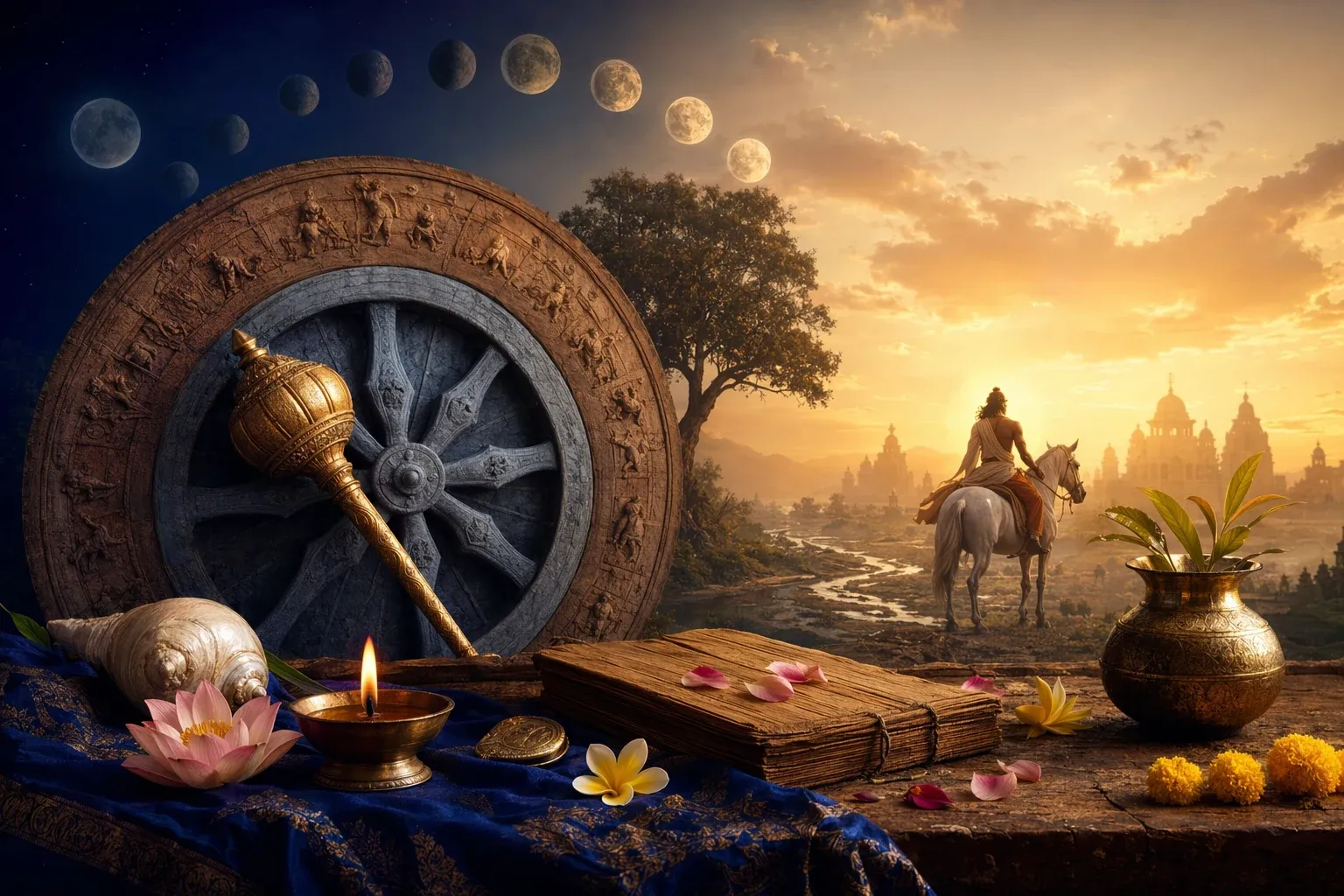
Kalki is remembered in many Hindu traditions as the future avatar of Vishnu, associated with the end of Kaliyuga and the restoration of dharma. The idea is powerful, but beginners should read it carefully. It is not meant to become a viral fear story, a date-prediction game, or a reason to panic about the present.
For young readers, the most helpful approach is to understand what the story teaches: when disorder becomes overwhelming, dharma is not abandoned. Vishnu’s avatar idea says that divine response appears when balance must be restored. Kalki represents that final restoring force in the cycle of yugas.
The short answer
Kalki is usually described as Vishnu’s future avatar who appears at the end of Kaliyuga. Traditions often connect Kalki with a horse, a sword, and the renewal of righteousness. Exact dates, viral countdowns, and claims about a currently identified person should be treated with caution. The central meaning is dharma restoration, not internet prophecy.
Kaliyuga in simple language
In Hindu time cycles, Kaliyuga is commonly understood as an age in which confusion, conflict, greed, and decline in values become more visible. Different texts and traditions explain time in different ways, so beginners should avoid pretending that one social-media chart settles everything. The idea works at both cosmic and moral levels: it asks people to notice what happens when truth, restraint, and responsibility weaken.
This does not mean every person in Kaliyuga is bad or that good action is useless. In fact, the opposite lesson is more useful. If dharma becomes difficult, then honest action, compassion, self-control, and devotion matter even more.
Why Vishnu is connected with restoration
Vishnu is widely connected with preservation, protection, and the restoration of cosmic order. In popular Hindu memory, avatars such as Rama and Krishna appear when dharma needs support in a specific situation. Kalki belongs to this larger pattern, but with a future-facing role. The story says that preservation sometimes requires decisive renewal.
This is why Kalki should not be read as only a dramatic warrior image. The horse and sword are symbols of movement, clarity, and the cutting away of adharma. The deeper message is about restoring order, not enjoying destruction.
Be careful with date and place claims
Many online posts claim to know exactly when Kalki will appear, where he has already been born, or who he is. A respectful beginner guide should be careful here. Puranic and devotional traditions carry symbolic, theological, and narrative meaning. They should not be flattened into a modern breaking-news format.
It is fine to learn the traditional details. It is not wise to turn them into fear, harassment, or false certainty. When a claim sounds sensational, ask: Is it from a reliable text, a respected teacher, a scholarly discussion, or just a viral post? That one question saves a lot of confusion.
What the story teaches today
Kalki’s story can be read as a reminder that dharma must be protected even when the world feels noisy. For a student, that may mean telling the truth, using technology responsibly, caring for family, refusing cruelty, studying honestly, and not joining every angry crowd. Big sacred stories often become meaningful through small daily choices.
The future-avatar idea also teaches humility. Humans do not control cosmic time. We can only act well in the time given to us. That is why dharma is the practical heart of the story.
Related reading
For the ethical background, read What Is Dharma? Meaning, Examples, and Why It Still Matters Today. This link is relevant because Kalki is best understood through dharma restoration rather than prediction culture.
What beginners should remember
Remember three points. First, Kalki is the future avatar of Vishnu in many Hindu traditions. Second, Kaliyuga discussions should be handled with respect and caution, not fear. Third, the most useful lesson is dharma restoration: when life becomes confused, truth and responsibility still matter.
If you keep those points clear, the Kalki idea becomes easier to understand. It remains sacred, symbolic, and meaningful without becoming sensational.
Common beginner questions
Beginners often ask whether Kalki should be understood literally, symbolically, or both. Different Hindu communities may answer with different emphasis. Some focus on the Puranic narrative as sacred history, some focus on its symbolism, and many hold both together devotionally. A beginner does not need to settle every theological debate immediately. It is enough to understand the main pattern: when adharma rises, divine restoration remains possible.
Another common question is whether Kaliyuga means people should give up hope. Traditional teaching does not support that attitude. If anything, difficult times make dharma more valuable. Charity, truthfulness, self-control, prayer, study, and service become practical ways to live responsibly even when the world feels unstable.
How to read the imagery
Kalki’s horse, weapon, and final-restoration imagery can look dramatic, but sacred imagery often speaks through symbols. The horse can suggest movement and speed. The sword can suggest discrimination, justice, and the cutting away of falsehood. The future setting can suggest that time itself moves through cycles and that decline is not the final truth.
Reading the imagery this way keeps the topic respectful without becoming frightening. It also helps young readers avoid two extremes: treating everything as a literal news prediction, or dismissing the whole idea as meaningless. The tradition is more thoughtful than either extreme.
A balanced takeaway
The balanced takeaway is simple: learn the tradition, respect the sacred story, avoid sensational claims, and focus on dharma in daily life. Kalki is not an excuse to stop doing good work now. The story asks people to remember that order, truth, and responsibility still matter even when they seem delayed.
That makes the topic relevant without needing fear. A student can understand Kalki as a future avatar of Vishnu and also ask a practical question: what can I do today that supports dharma rather than confusion?