
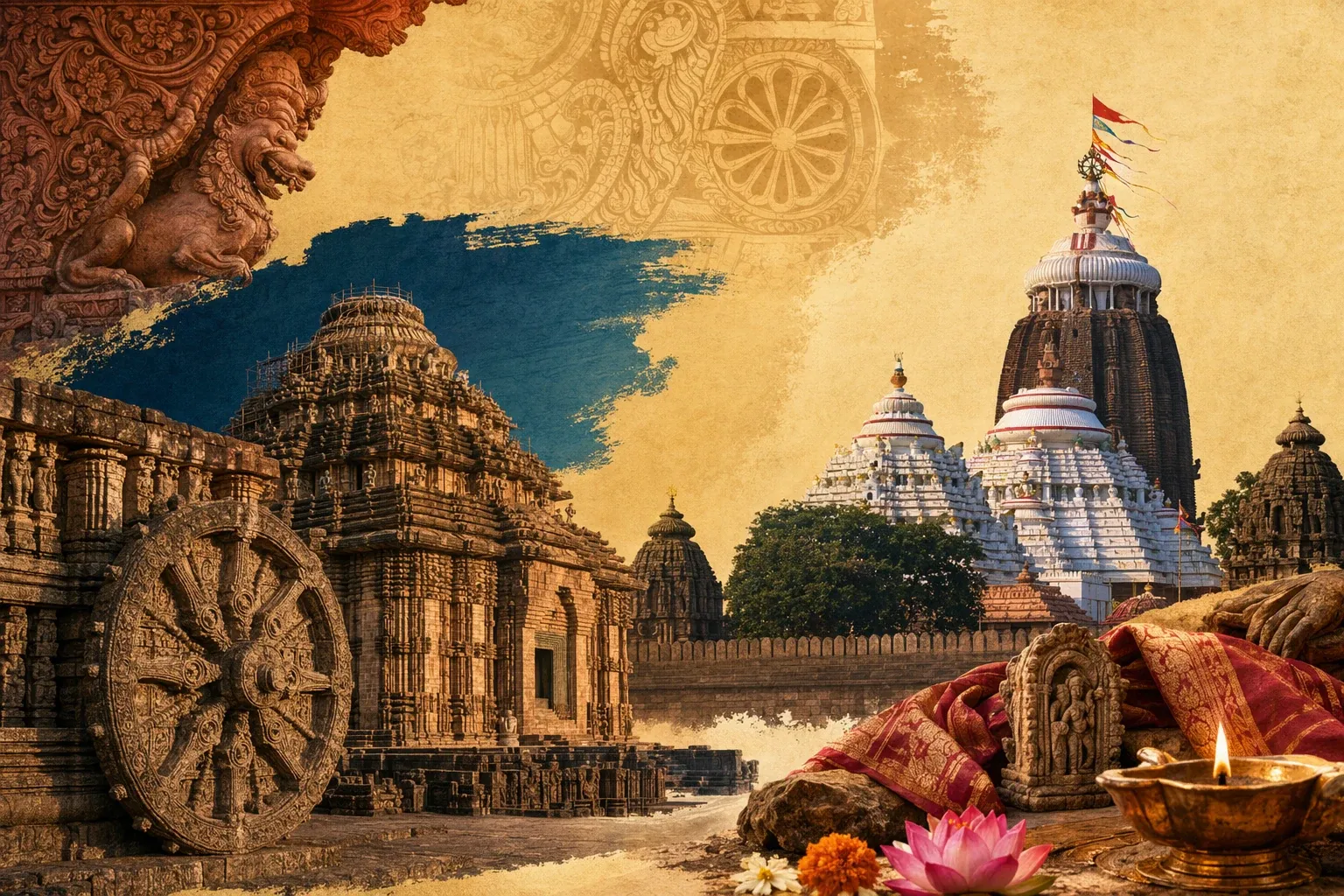
Odisha temple architecture has a personality you can recognise once you know what to look for. The towers rise with a strong vertical pull, the halls step upward in layered forms, and the carved stone often feels both disciplined and alive. Two famous examples make the style easier to understand: the Sun Temple at Konark and the Jagannath Temple at Puri. One is now mainly a monument of stone, memory, and conservation. The other is a living pilgrimage centre where worship, festival, food, music, and community continue every day.
Both belong to the wider Kalinga style, the temple tradition associated with ancient Kalinga or Utkala, roughly the cultural region of present-day Odisha. This style is not only about decoration. It is a complete way of organising sacred space: the sanctum, the tower above it, the assembly hall, the festival life around the temple, and the symbolic journey from the outside world toward the deity.
The Kalinga style in simple words
A classic Odisha temple is often described through the word deula, meaning temple or shrine. The most important part is the sanctum, the inner chamber where the deity is present. Above this sanctum rises the tall curving tower called a rekha deula. Its shape is different from the flat pyramid-like halls in front of it. The hall, often called jagamohana, usually uses the pidha deula form, with stepped horizontal tiers that rise like a layered roof.
Some Odisha temples also use a khakhara deula, a barrel-roofed form often associated with goddess shrines. These categories are not random labels. They help us read the temple like a language. The sanctum tower pulls the eye upward. The hall gathers people. The doorway, platform, walls, subsidiary shrines, sculptural panels, and processional routes all support the movement from public space toward sacred focus.
Konark: a temple imagined as the Sun’s chariot
Konark Sun Temple, built in the 13th century and generally associated with Eastern Ganga ruler Narasimhadeva I, is one of the most dramatic examples of Odisha’s architectural imagination. It is dedicated to Surya, the Sun. Its surviving form is famous because the temple is conceived like a huge stone chariot with carved wheels and horses. The idea connects architecture with cosmic movement: the Sun travelling across the sky, time moving through days and months, and devotion turning a building into a symbolic vehicle.
The temple is also a reminder that heritage can be incomplete and still powerful. Much of the original structure has not survived in its full form. The great sanctum tower is lost, while the assembly hall and many sculptural surfaces remain central to what visitors see today. That is why responsible descriptions should avoid pretending that Konark stands exactly as it did in the 13th century. Its present beauty includes ruins, restoration, archaeology, and the memory of an even larger sacred complex.
Jagannath at Puri: architecture inside a living tradition
The Jagannath Temple at Puri shows another side of Odisha architecture. Here the temple is not mainly encountered as a frozen monument. It is a living sacred world dedicated to Jagannath, understood within Vaishnava devotion and local Odia tradition. The present temple is associated with the Eastern Ganga period, especially Anantavarman Chodaganga and later rulers, though the sacred history of Puri is older in tradition and literature.
Architecturally, Puri follows the Kalinga pattern of a powerful sanctum tower with halls and enclosed sacred space. Culturally, it is famous for wooden images of Jagannath, Balabhadra, and Subhadra, the massive Ratha Yatra, kitchen traditions, servitor communities, and its place among major Hindu pilgrimage routes. This matters because a temple is not only stone. In Puri, architecture holds ritual time. The structure becomes the setting for daily offerings, annual festivals, royal memory, social roles, and the deep Odia feeling that Jagannath is both cosmic lord and intimate household presence.
What Konark and Puri teach together
Konark and Puri are often mentioned together, but they should not be treated as the same kind of experience. Konark helps beginners see the artistic and symbolic daring of Odisha temple architecture. Puri helps them see how temple form supports a living community of worship. Konark’s chariot idea is carved into stone. Puri’s chariot festival rolls through the streets every year. One teaches through sculpted motion; the other through ritual motion.
They also show how kingship, devotion, craft, and regional identity worked together. The Eastern Ganga rulers did not simply build isolated monuments. Their temples expressed political confidence, sacred legitimacy, artistic skill, and public devotion. In Odisha, temple architecture became one of the strongest languages through which region, ruler, deity, and people spoke to one another.
Sculpture, story, and everyday detail
Odisha temples are full of sculptural life. A wall may carry deities, dancers, guardians, musicians, animals, floral forms, mythic scenes, and everyday human moods. These carvings should not be seen as filler. They create a universe around the sanctum. The sacred centre is surrounded by life in many forms: divine, royal, natural, social, playful, and devotional.
At Konark, the wheels, horses, musicians, dancers, and varied human scenes make the temple feel like a world in movement. At Puri, much of the deepest experience is not visible to every visitor because entry and ritual access follow temple rules. Still, the public form of the temple, the towering skyline, and the Ratha Yatra make Jagannath’s presence part of the city’s living rhythm.
Tradition, interpretation, and historical care
Odisha’s temples are surrounded by rich traditions. Devotees may explain Konark through Surya’s power, time, and sacred geometry. Jagannath devotees may speak through bhakti, local legends, Purana references, and family memory. Historians look at dynastic records, inscriptions, architecture, conservation, and regional politics. All three views matter, but they should not be mixed carelessly.
A respectful learner can say: tradition gives meaning from inside the faith; interpretation helps us understand symbolism; historical study asks what can be dated, compared, and verified. This approach keeps the wonder alive without turning every story into a hard factual claim.
A beginner’s checklist for Odisha temples
When you see an Odisha temple, first look for the sanctum tower and the hall in front of it. Notice whether the main tower curves upward like a rekha deula, and whether the hall rises in stepped pidha tiers. Then look at the platform, doorway, carvings, subsidiary shrines, and the temple’s place in local life. Ask whether the site is primarily a protected monument, a living shrine, or both.
Finally, remember that Odisha temple architecture is not only a regional art style. It is a way of thinking about water, stone, direction, festival, community, kingship, and the divine. Konark and Jagannath are famous because they make that world visible: one through the Sun’s stone chariot, the other through Jagannath’s living city of devotion.