
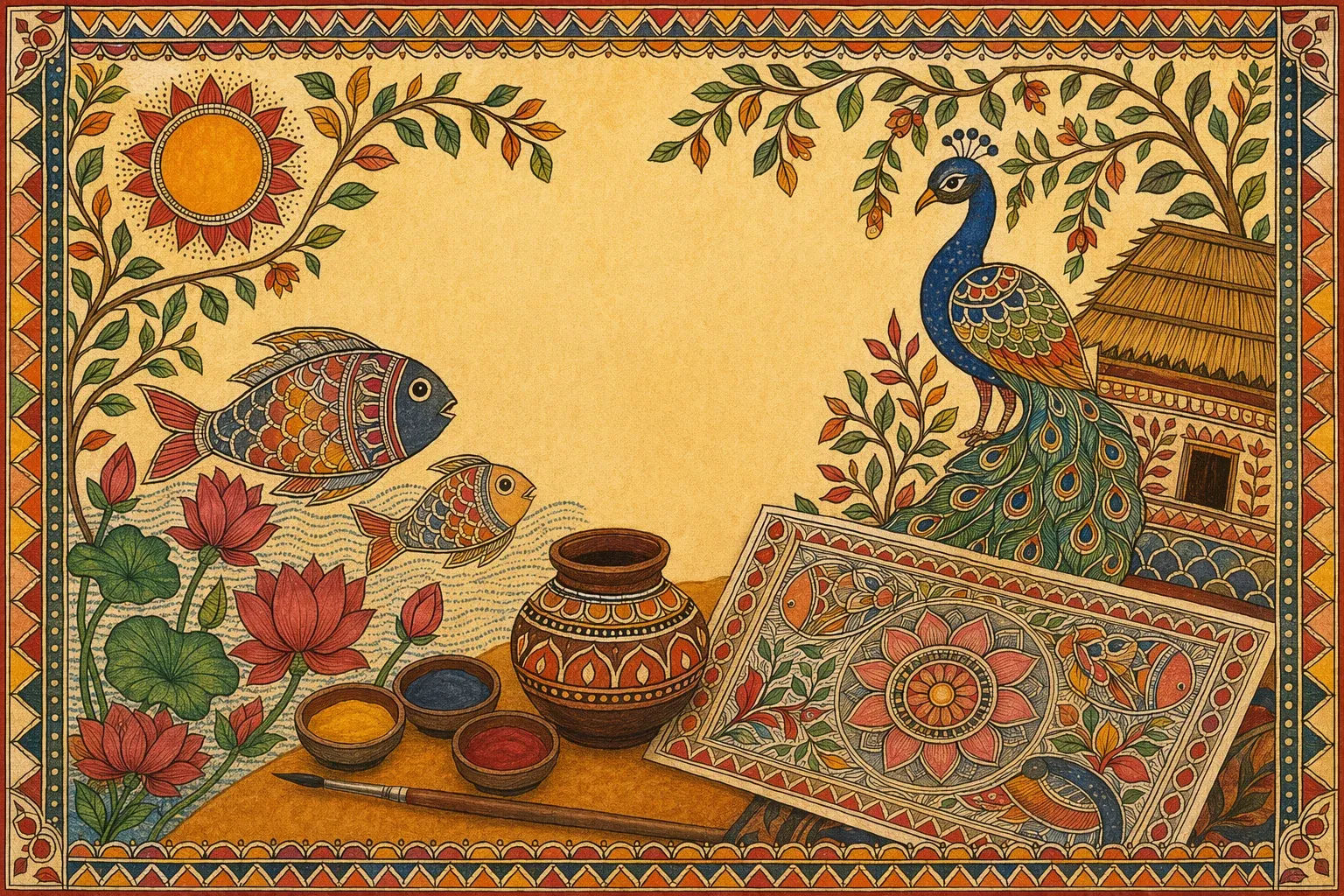
Madhubani painting is a vibrant Mithila tradition of line, pattern, devotion, nature, and storytelling. This guide introduces its roots and visual language for beginners. This article introduces the subject in clear language for readers who want cultural context, visual clues, and practical appreciation.
A Mithila tradition with many voices
Madhubani painting is closely associated with the Mithila region of Bihar and parts of Nepal. It is also called Mithila painting, a name that honours the wider cultural region more directly. The tradition includes household wall painting, ritual imagery, festival designs, and works on paper and cloth made for wider audiences. Its famous density of line and colour is not mere decoration; it reflects a worldview where nature, devotion, community, and story fill the surface with life.
From walls to paper
Older Madhubani paintings were often made on walls and floors for marriages, festivals, and domestic rituals. Over time, artists began painting on handmade paper and cloth, especially as the tradition reached collectors and cultural institutions. This shift helped many women artists gain recognition and income. A paper painting may look portable and modern, but it often carries the memory of walls, courtyards, songs, and household ceremonies.
The power of outline
A strong outline is one of the first things beginners notice. Figures, animals, flowers, and borders are usually drawn with confidence. The line may be black or another dark colour, and it holds the composition together. Inside the outline, artists add stripes, dots, crosshatching, petals, scales, and small repeated marks. This gives the painting its lively surface. The line is both boundary and rhythm.
Why the surface feels full
Madhubani paintings often avoid empty space. Backgrounds may be filled with leaves, flowers, vines, dots, geometric marks, fish, birds, or fine lines. This fullness can suggest abundance, auspiciousness, and the belief that the world is alive with presence. A beginner should not read dense filling as clutter. When handled well, it creates visual music, guiding the eye from large figures to tiny details and back again.
Common themes and stories
Madhubani themes include Krishna and Radha, Rama and Sita, Durga, Lakshmi, Shiva, Ganesha, marriage scenes, village life, the kohbar or nuptial chamber imagery, nature, and protective symbols. Some contemporary artists also address education, environment, social justice, health, and women’s experiences. This range shows that Madhubani is not frozen in the past. It keeps its visual grammar while responding to changing life.
Fish, birds, lotus, and tree of life
Nature symbols are central. Fish may suggest fertility and prosperity; birds can bring companionship and movement; lotuses point toward auspicious beauty; the tree of life shelters many beings. These meanings vary by context, so they should be read gently. Our guide to Indian folk art symbols offers a wider introduction to animals and nature signs across traditions.
Colours and older material memory
Traditional colours could come from natural sources such as soot, turmeric, leaves, flowers, rice paste, and mineral pigments, depending on local practice and availability. Many contemporary artists use acrylic or poster colours because they are accessible, bright, and durable. The change of material does not automatically make a work less meaningful. What matters is the artist’s knowledge, intention, technique, and connection to the tradition.
Styles within Madhubani
Beginners often hear names such as Bharni, Kachni, Tantrik, Godna, and Kohbar. These labels refer to different visual approaches, communities, themes, or techniques within the broader Mithila tradition. Bharni is often associated with filled colour; Kachni with fine line work; Godna with tattoo-like patterning; Kohbar with marriage symbolism. The categories can overlap, and artists may innovate, so use these names as doors rather than rigid boxes.
A beginner’s viewing path
When looking at a Madhubani painting, begin with the central subject. Then move to the border, the background filling, the animals, and the small repeated details. Notice whether the composition is symmetrical, crowded, devotional, playful, or narrative. Ask how the artist uses pattern to hold attention. This slow viewing reveals the intelligence of the work, especially in pieces that first appear simply colourful.
Making a respectful practice page
If you want to practise, begin with a border, a fish, a lotus, or a tree rather than copying a sacred marriage or deity composition without context. Use a pencil lightly, outline with pen, and fill areas with repeated patterns. Our beginner drawing guide, draw Indian folk art, suggests a gentle practice path that keeps learning and respect together.
Women artists and recognition
Madhubani’s wider recognition is deeply tied to women artists whose domestic knowledge became visible to the world. Their work challenged narrow ideas about who counts as an artist. Many named artists and families have developed distinctive approaches while carrying inherited forms forward. Remembering makers is important. A painting is not only a style sample; it is labour, memory, and often a source of livelihood.
Buying with care
If you are buying Madhubani art, look for artist attribution, regional context, handmade variation, and credible sourcing. Very cheap printed imitations may borrow the look while giving nothing to artists. That does not mean every affordable work is false; many artists create small accessible pieces. The point is to ask questions and value the maker. For more detail, see our guide to genuine folk art.
Why Madhubani stays alive
Madhubani painting survives because it can hold continuity and change together. It remembers ritual walls and village courtyards, yet it also travels through exhibitions, classrooms, homes, and new subjects. Its lines can show gods, forests, buses, brides, fish, protests, and family stories. That flexibility is a sign of life. A living tradition grows without losing its roots.
The beginner’s takeaway
For a beginner, Madhubani is best understood as a rich visual language from Mithila: outlined, patterned, symbolic, and deeply connected to nature and ceremony. Do not rush to master it. Spend time looking at works by named artists, learning the meanings of motifs, and practising simple forms. The reward is not only a pretty drawing, but a more attentive relationship with Indian folk art.
Continuing the journey
For related reading, see Indian folk art symbols. Let the next artwork you see become a patient conversation with region, maker, material, symbol, and use. Indian folk art rewards slow attention, and every careful question adds depth to the first moment of visual delight.