
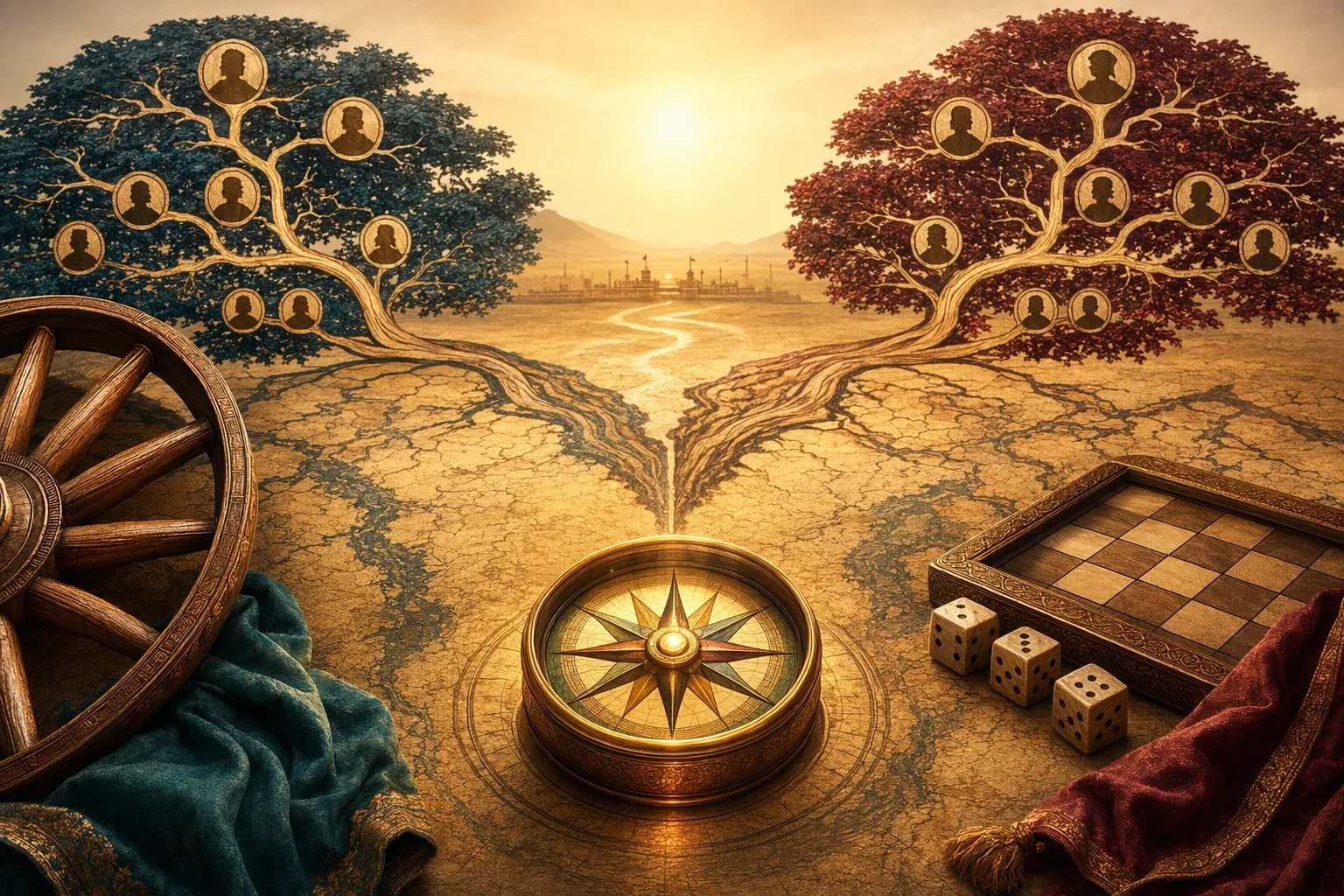
The Mahabharata is huge, intense, and unforgettable. It has family drama, politics, philosophy, war, devotion, vows, mistakes, revenge, forgiveness, and the Bhagavad Gita. For beginners, it can feel like too many names and too many events. But at its heart, the Mahabharata asks one question again and again: what is dharma when every choice has a cost?
The epic centres on the conflict between the Pandavas and the Kauravas, two branches of the Kuru family. Their rivalry grows through jealousy, humiliation, injustice, failed diplomacy, and finally the great war of Kurukshetra. Yet the Mahabharata is not just a war story. It is a mirror of human nature.
What does Mahabharata mean?
The name Mahabharata can be understood as the great story of the Bharata lineage. It is traditionally attributed to Maharishi Vyasa, who is also a character within the epic. The text is considered an Itihasa, a sacred epic connected with remembered history, moral teaching, and civilisational memory.
A famous idea says that whatever is found here may be found elsewhere, and what is not found here is hard to find anywhere. That is a poetic way of saying the Mahabharata contains an enormous range of life: duty, power, weakness, wisdom, grief, and liberation.
The main story in simple words
The Pandavas are Yudhishthira, Bhima, Arjuna, Nakula, and Sahadeva. The Kauravas are led by Duryodhana. Both sides belong to the same royal family, but Duryodhana’s jealousy of the Pandavas grows into deep hostility. A rigged dice game leads to the Pandavas losing their kingdom and Draupadi being humiliated in court.
After exile and failed attempts at peace, war becomes unavoidable. On the battlefield of Kurukshetra, Arjuna breaks down, unable to fight his relatives, teachers, and elders. Krishna then teaches him the Bhagavad Gita, explaining duty, action, devotion, knowledge, and the deeper self. The war ends with the Pandavas victorious, but victory feels heavy because the cost is devastating.
Tradition, interpretation, and historical context
In tradition, the Mahabharata is revered not merely as literature but as a dharma text. Krishna is worshipped as the divine guide, and the Bhagavad Gita is one of the most loved spiritual texts in the world. The epic is recited, performed, retold, and discussed across India in many languages.
In interpretation, the Mahabharata refuses simple hero-villain thinking. Yudhishthira is righteous but not flawless. Arjuna is heroic but confused. Bhishma is noble but bound by difficult vows. Karna is generous and tragic, yet tied to Duryodhana’s injustice. Draupadi is powerful, wounded, and central to the moral force of the story. The epic teaches by complexity.
Historically, scholars study the Mahabharata as a layered Sanskrit epic that grew over time. Traditions connect it with Kurukshetra and the Kuru lineage; academic dating and reconstruction are debated. A respectful beginner can hold both truths: the Mahabharata is sacred tradition for millions, and it also has a long textual history.
Why dharma is difficult in the Mahabharata
In many stories, right and wrong look simple. In the Mahabharata, dharma is often difficult because people have duties in many directions: to family, kingdom, teacher, truth, promise, friendship, and justice. When these duties clash, even great people struggle.
This is why the epic still feels modern. Students face pressure, families face conflict, leaders face moral tests, and friends sometimes support the wrong side out of loyalty. The Mahabharata does not say life is easy. It says we must still choose with awareness.
What beginners should notice
Notice how small wrongs grow when pride protects them. Notice how silence in the face of injustice becomes part of the problem. Notice how Krishna does not remove Arjuna’s responsibility; he helps Arjuna understand it. Notice how victory without inner clarity can still leave sorrow.
Also notice the epic’s compassion. Even flawed characters are given depth. The Mahabharata understands that human beings are mixtures of strength and weakness. That is why it teaches so powerfully.
The takeaway
The Mahabharata remains alive because it does not offer childish answers. It gives us a vast field of human choices and asks us to think deeply. If the Ramayana often shows the beauty of ideal conduct, the Mahabharata shows the struggle to find dharma in a broken situation. That struggle is why it still speaks.
A gentle way to remember the Mahabharata
If the Mahabharata feels too complicated, remember three pressures: power, loyalty, and conscience. Duryodhana wants power without fairness. Karna is trapped by loyalty to a friend who supports adharma. Arjuna’s conscience wakes up at the very moment he is expected to fight. These tensions make the epic feel painfully human.
That is why the Mahabharata should not be read only to decide who is your favourite character. It is better read as a training ground for judgment. It asks whether we can recognise injustice early, speak when silence becomes harmful, and act without losing our inner compass.
What to keep in mind
One beginner mistake is trying to master everything in one sitting. Indian knowledge traditions are layered, and the first reading is only the first friendship. Learn the basic meaning, notice the main values, and then return with better questions. That slow return is how understanding becomes mature.
It also helps to separate respect from blind acceptance. Respect means we do not mock a living tradition or flatten it into memes. Careful thinking means we ask about context, language, community, and interpretation. When both are present, learning becomes honest and warm.