
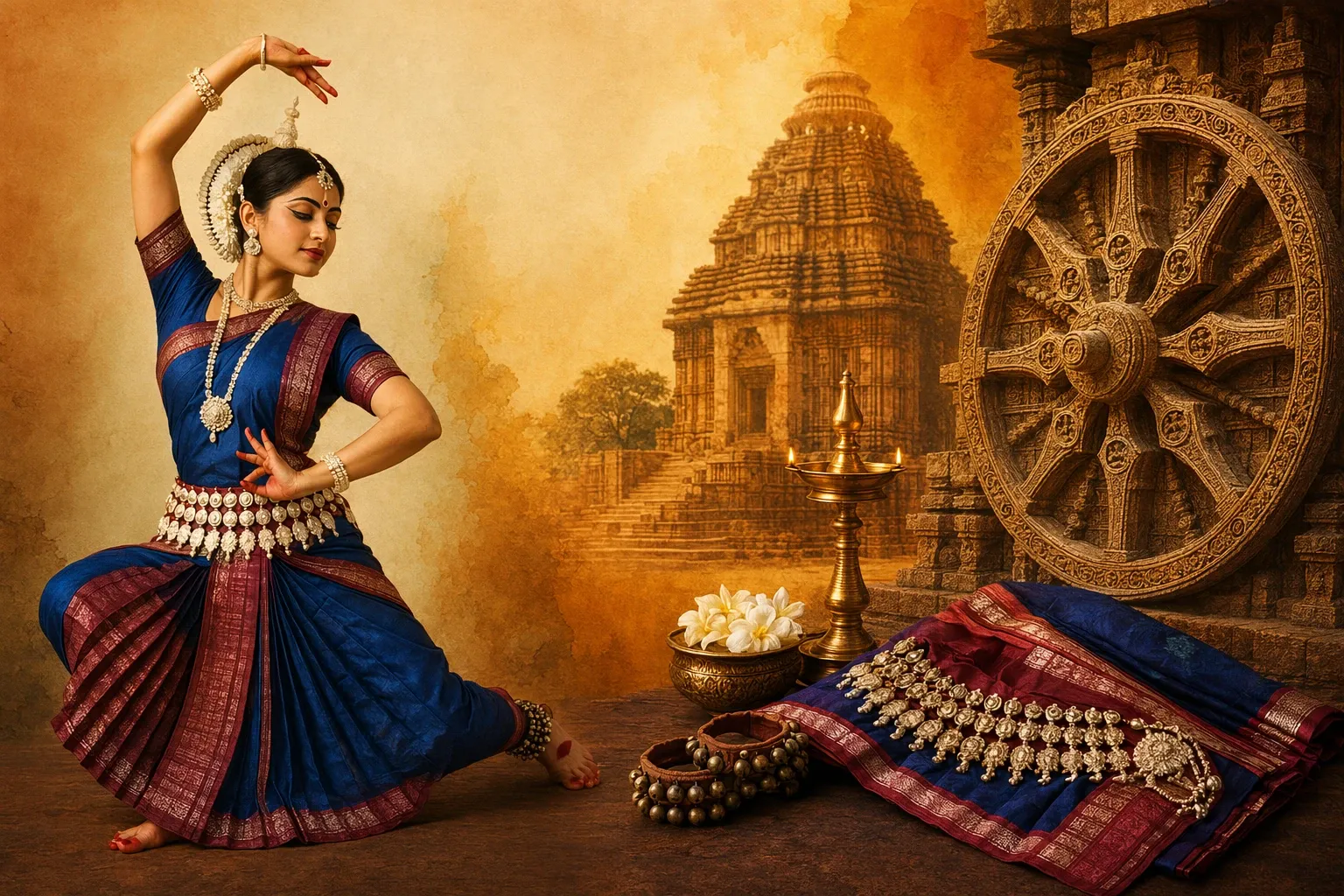
Odissi is a classical dance form from Odisha, known for graceful curves, expressive storytelling, temple-linked imagery, and sculpture-like movement. This beginner guide explains its meaning, costume, roots, and what to notice when watching respectfully.
Short answer
Odissi is an Indian classical dance form from Odisha. It is known for graceful curves, expressive storytelling, devotional themes, and sculpture-like poses inspired by Odisha’s artistic and temple heritage.
For a beginner, Odissi often feels flowing and lyrical. The body creates curves, the torso moves beautifully, and the dancer seems to bring old stone sculpture into living motion.
Temple roots and cultural memory
Odissi is connected with Odisha’s temple culture, devotional traditions, and regional music and poetry. Like other classical forms, its modern stage form developed through preservation, revival, teaching, and institutional work.
So when we say “temple roots,” we should also remember the artists, gurus, scholars, and communities who shaped what audiences see today.
Tribhangi and chowka
Two beginner terms are tribhangi and chowka. Tribhangi means a three-bend posture that creates Odissi’s famous curved silhouette. Chowka is a square, balanced stance associated with strength and stability.
These shapes give Odissi a distinct visual identity. It can look soft and graceful, but the control required is intense.
Costume and music
Odissi costume often includes bright silk, silver jewellery, waist belt, head ornament, and expressive makeup. The costume helps the audience read body lines, face, and movement from the stage.
The music has its own regional flavour, connected with Odisha’s classical and devotional traditions. Understanding the song meaning makes the dance much richer.
What beginners should watch for
Watch the eyes, torso, hand gestures, and transitions between stillness and movement. Notice how the dancer uses grace without becoming vague: every gesture has training behind it.
If you want to learn, start with posture, basic steps, rhythm, and meaning. Do not copy advanced items from videos without guidance.
Key takeaway
Odissi is Odisha’s graceful classical language of devotion, sculpture, rhythm, and expression. It rewards slow, attentive watching.
Additional beginner context
The next sections add plain-language context so the article is more useful as a complete beginner guide.
A beginner-friendly way to read this
This guide is mainly about Odissi for Beginners: Grace, Temple Roots, Costume, and Meaning. The useful way to read it is not as a final verdict, but as a beginner-friendly map: learn the key idea, notice the context, and then connect it with the wider Indian cultural world. Important terms in this article include Odissi, Grace, Temple, Roots, Costume. The central angle is: A beginner-friendly Odissi profile that explains Odisha roots, tribhanga/chowka, devotional storytelling, and why costume/jewellery details carry cultural meaning.
Indian classical dance is not only entertainment. It brings together rhythm, gesture, facial expression, costume, music, devotion, regional memory, and storytelling. A beginner should look beyond the stage photo and ask: what story is being shown, what mood is being created, and how does the body become a language?
What to remember
Each form has its own history and personality. Bharatanatyam, Kathak, Odissi, Kuchipudi, and the other recognised forms should not be flattened into one generic ‘Indian dance’ image. Their postures, costumes, musical settings, temple or court associations, and training methods all matter.
For modern readers, the safest approach is to keep curiosity and humility together. A tradition can be meaningful without being reduced to a slogan, and a complex topic can be made simple without pretending that every region, family, school, or teacher follows the exact same wording.
For students, the respectful approach is to learn vocabulary slowly: mudra, abhinaya, tala, costume, guru, repertoire, and practice. Once those words become familiar, performances stop looking like decoration and start becoming readable cultural expression.
Where to go next
For the wider dance background, read our Indian classical dance beginner guide. To understand how music and rhythm shape classical performance, see Indian classical music for beginners and our simple guide to taal, swara, and laya.
More context for careful readers
Common misunderstandings to avoid
A common mistake is to treat Odissi for Beginners: Grace, Temple Roots, Costume, and Meaning as only one sentence or one social-media definition. In reality, Indian classical dance topics usually carry many layers: language, practice, regional memory, family tradition, teacher explanation, and modern interpretation. A beginner guide should simplify the entry point, but it should not erase that depth.
Another mistake is to assume that one version explains every community. Indian traditions often travel through many regions and languages, so examples may differ. That does not make the topic confused; it means the tradition is alive and has been remembered in more than one way.
The safest reading habit is to keep the main idea clear and hold details gently. Start with what the word means, then notice where it appears, who practices or discusses it, and what value it is trying to teach. This makes Odissi for Beginners: Grace, Temple Roots, Costume, and Meaning easier to remember without forcing a narrow answer.
Why this matters today
This topic still matters because young readers are meeting Indian culture through school, family stories, social media, travel, music, health conversations, and festival posts. Without context, the same idea can look either too mysterious or too casual. A clear explanation helps readers respect the subject without feeling lost.
For Bhaktilipi readers, the practical value is not just information. The goal is better cultural literacy: knowing enough to ask good questions, avoid lazy stereotypes, and recognise why earlier generations preserved these ideas through stories, songs, rituals, debates, art, and daily habits.
Good learning also means knowing the limits of a short article. This guide gives a reliable starting point, but deeper study can come from teachers, trusted books, temple or community elders, museums, performances, and careful reading of primary traditions where possible.
Simple takeaway
If you remember only one thing, remember this: Odissi for Beginners: Grace, Temple Roots, Costume, and Meaning becomes meaningful when the definition, the cultural setting, and the human purpose are read together. That balanced view protects the topic from both blind rejection and blind romanticisation.
Use this article as a first map. Revisit the key words, compare them with real examples, and keep learning patiently. Dharma-oriented learning is not about collecting facts quickly; it is about understanding what those facts ask us to value and practice.