
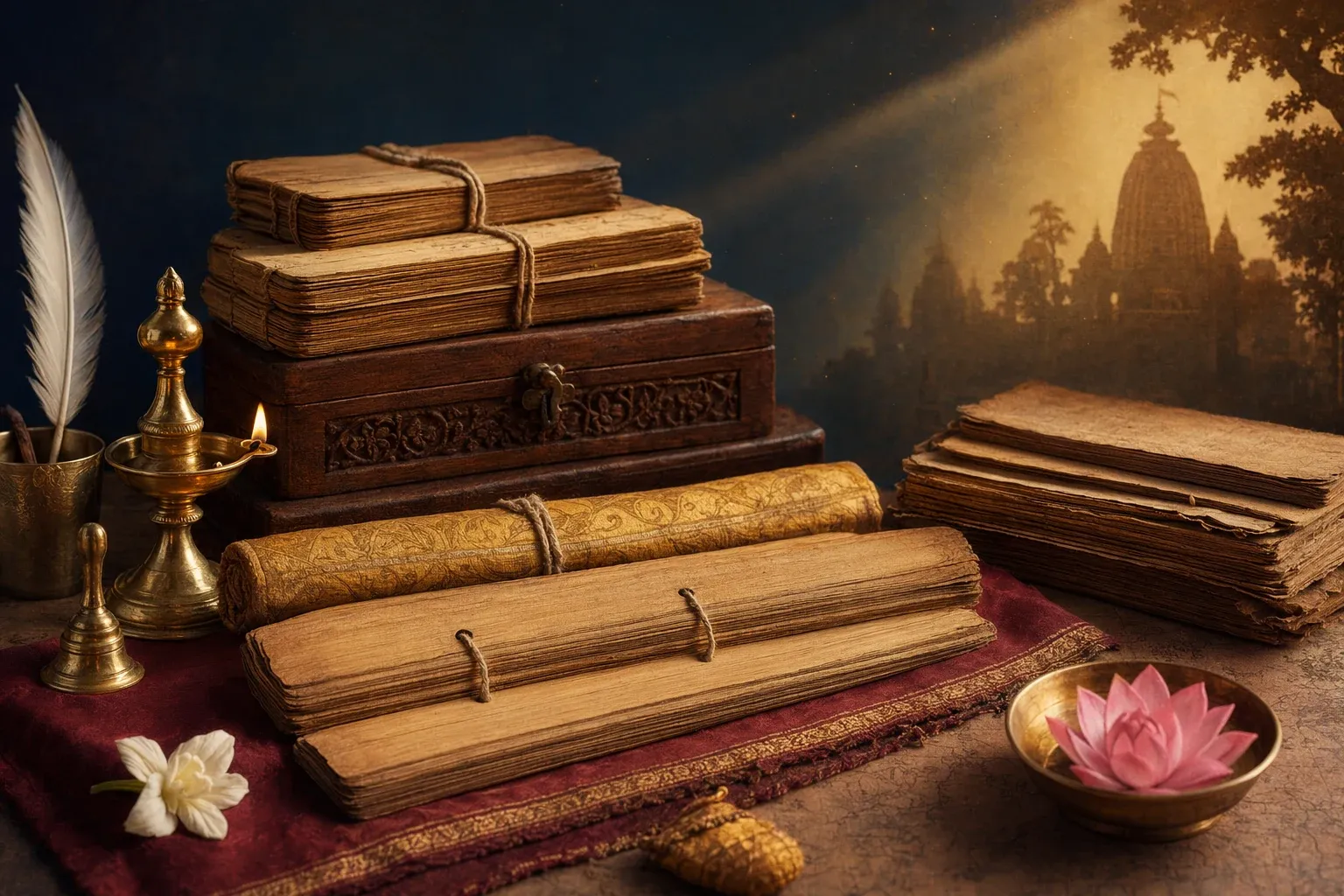
When people ask about old Hindu manuscripts, they are usually asking two questions at once. One question is about sacred and cultural texts: Vedas, Upanishads, Ramayana, Mahabharata, Puranas, Agamas, stotras, dharma texts, and philosophical works. The other question is about physical copies: palm leaves, birch bark, paper folios, illustrated pages, and bundles kept in libraries, temples, mathas, bhandars, museums, or homes.
Both questions matter, but they should not be mixed carelessly. A Hindu text tradition can be very old even when the surviving manuscript copy is much later. In India, knowledge often lived through oral recitation, teacher-student transmission, memorisation, commentary, copying, and local practice. For the wider background, it helps to first understand what Indian manuscripts are. The manuscript is one powerful witness in that chain, not always the beginning of the chain.
The text is not always the same age as the copy
A modern printed Bhagavad Gita may be new, but the Gita as a text belongs to the Mahabharata tradition. A palm-leaf Purana copied in the sixteenth century may preserve stories and teachings shaped over a much longer period. A Vedic manuscript may be physically recent compared with the oral tradition it records. This is why scholars, pandits, conservators, and readers ask different questions: When was the text composed? When was this copy written? Where was it copied? What script does it use? Does it preserve an older reading?
This difference is especially important for Hindu traditions because memory has always been sacred. Shruti means “that which is heard,” and the Vedas were preserved through highly disciplined oral methods long before manuscript copies became common evidence. Smriti means “that which is remembered,” and includes a huge range of remembered, composed, retold, and interpreted literature. A manuscript may record either kind of tradition, but it does not replace the living discipline behind it.
Vedic manuscripts and the older oral stream
The Vedas are among the most respected bodies of Hindu sacred knowledge: Rigveda, Samaveda, Yajurveda, and Atharvaveda, along with associated Brahmanas, Aranyakas, and Upanishads. For many Hindu communities, their authority is not based simply on a very old object in a glass case. It is based on revelation, recitation, lineage, and careful transmission.
Historically, this means we should be careful with claims like “the oldest manuscript of Hinduism.” The Vedic tradition is older than most surviving manuscript copies. Palm leaf, birch bark, and paper decay. Manuscripts are recopied. Collections are lost in fire, humidity, insects, war, neglect, or ordinary use. So a physical Veda manuscript may be centuries old and still represent a much older oral and textual tradition. That is not a weakness. It is a clue to how Indian knowledge survived through both memory and material culture.
Puranas, epics, Agamas, and devotional works
Old Hindu manuscripts are not only Vedic. The Ramayana and Mahabharata circulated in Sanskrit and many regional retellings. The Puranas preserved stories of Vishnu, Shiva, Devi, Skanda, pilgrimage places, genealogies, cosmology, vrata traditions, and local sacred geography. Agamas and Tantras guided temple worship, iconography, ritual, yoga, mantra, and philosophy in Shaiva, Vaishnava, and Shakta settings.
There are also stotras, sahasranamas, paddhatis, ritual manuals, commentaries, Vedanta works, Mimamsa discussions, Nyaya logic, grammatical texts, devotional poetry, temple records, and local calendars. A household manuscript might contain a vrata katha or a stotra used in daily devotion. A temple manuscript might preserve ritual procedure. A scholar’s copy might preserve a commentary with margin notes. A royal or monastery collection might contain several traditions side by side.
Examples that make the story clearer
The Pārameśvaratantra palm-leaf manuscript associated with Nepal is often mentioned as an old dated Sanskrit palm-leaf example connected with Shaiva Siddhanta. It reminds us that Hindu manuscript culture was not only about one central region. Nepal, Kashmir, Tamil Nadu, Odisha, Karnataka, Kerala, Bengal, Rajasthan, Gujarat, Maharashtra, Assam, and many other regions preserved texts in different scripts and materials.
Odia palm-leaf manuscripts can combine writing with etched illustration. South Indian palm-leaf bundles may preserve temple, philosophical, and ritual works. Kashmir and north-western regions are linked with birch bark and scripts such as Sharada in many manuscript discussions. Jain bhandars, though Jain rather than Hindu, also help us understand the wider Indian habit of protecting handwritten knowledge in libraries, cupboards, and religious institutions. The point is simple: Hindu manuscripts belong to a larger Indian manuscript world, not an isolated shelf.
Why “oldest” is a complicated word
People love ranking: oldest, first, biggest, rarest. But manuscripts punish overconfidence. A manuscript can be old as an object, old as a copy of a text, old as a witness to a version, or old in the tradition it carries. These are different meanings. A late physical copy may preserve an earlier reading. An early fragment may preserve only a small part. A beautifully illustrated manuscript may be younger than a plain damaged one. A sacred text may have been orally protected long before the surviving copy was written.
Dating also depends on evidence: script style, material, colophon, calendar era, ownership note, carbon dating where appropriate, comparison with other manuscripts, and scholarly study. If someone online gives a dramatic claim without evidence, treat it with patience but caution. Respect for Hindu heritage does not require exaggeration. In fact, exaggeration can weaken trust in real tradition.
Comparison should not become point scoring
Searches sometimes ask whether the Rigveda is older than the Bible or another religious text. A careful answer does not need rivalry. The Rigveda is widely regarded as one of the world’s ancient sacred compositions, preserved through an extraordinary oral tradition. Biblical texts have their own complex history of oral, written, edited, and manuscript transmission. Comparing traditions can be useful for learning, but turning it into a scoreboard usually creates more heat than understanding.
A better question is: what does each tradition teach us about memory, language, community, and sacred authority? Hindu manuscript culture shows a deep relationship between hearing, remembering, reciting, writing, copying, worshipping, debating, and preserving. That relationship is richer than a single internet ranking.
How beginners can explore old Hindu manuscripts
Start with legitimate digital collections, museum catalogues, university libraries, and cultural portals. Look for basic catalogue details: title, language, script, material, date, region, number of folios, subject, and collection. Ask whether the manuscript is Vedic, Puranic, epic, ritual, philosophical, devotional, grammatical, or local. Notice whether it has illustrations, colophons, wooden covers, holes for string, margin notes, or signs of repair.
Most of all, keep three layers separate. Tradition tells us how communities understand and revere a text. Interpretation tells us how teachers, commentators, and readers explain it. Historical source context tells us what a particular manuscript object can prove. When these layers are respected, old Hindu manuscripts become more than ancient-looking pages. They become living bridges between memory, devotion, learning, and careful evidence.