Samskara and samsara look and sound similar, but they do not mean the same thing. Samskara usually points to formations, impressions, conditioning, refinements, or rites depending on the tradition. Samsara means the cycle of worldly existence, birth, death, and repeated experience marked by ignorance, craving, karma, and suffering. The two words are related by language and philosophy, but they answer different questions.
The short difference
For more background on the samskara side of the comparison, read What Is Samskara? Meaning in Hinduism, Yoga, and Daily Life. You may also like Is Yoga Religious or Spiritual? A Respectful Beginner Explanation for beginner context on yoga language and spirituality.
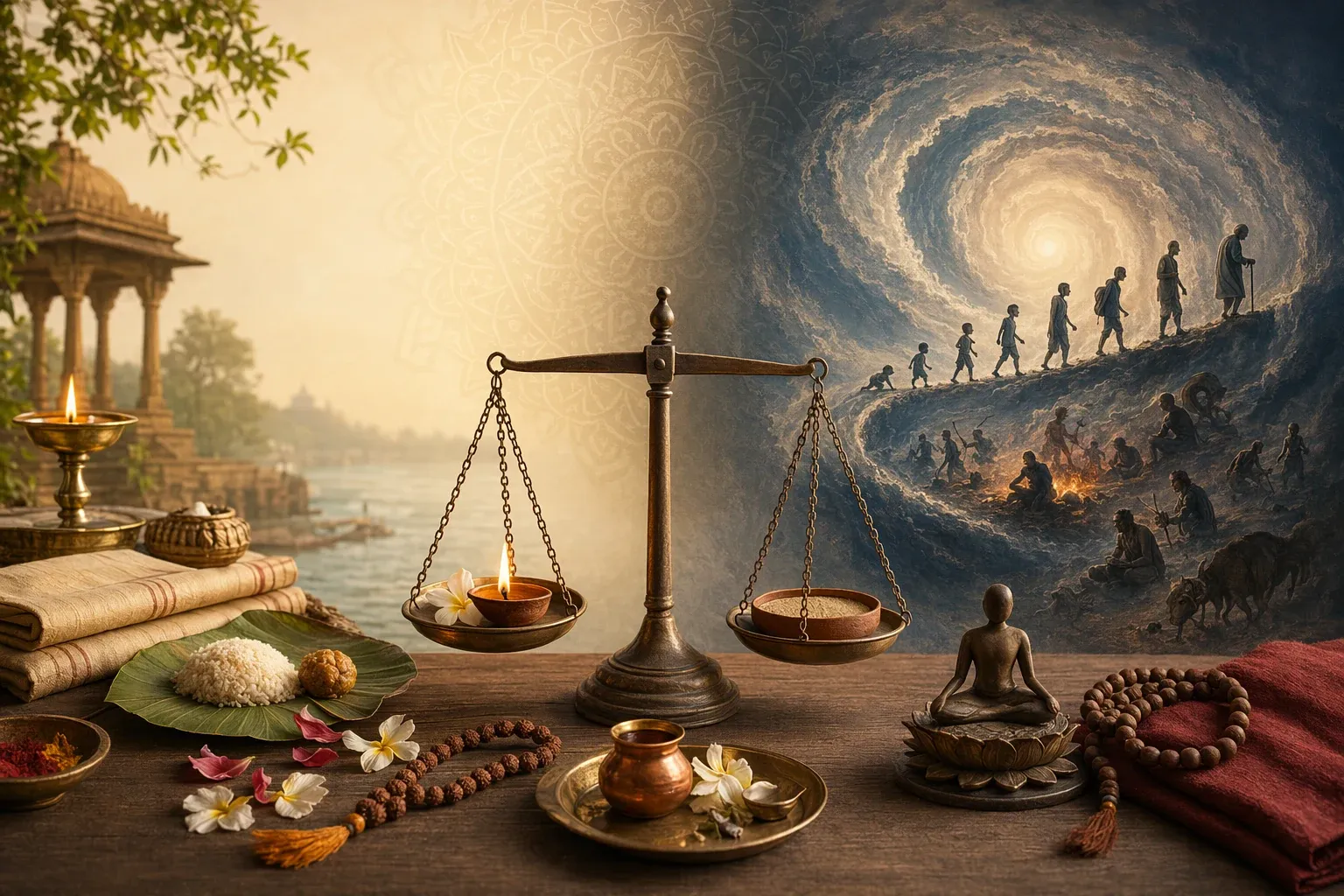
If you want one simple memory aid, use this: samskara is what shapes experience; samsara is the cycle in which shaped experience keeps turning. A samskara may be a mental impression, a volitional formation, or a refining rite. Samsara is the wider condition of repeated existence from which liberation is sought in many Indian traditions.
This distinction matters because beginners often read a yoga article, a Hindu ritual guide, and a Buddhist text and assume all three are using the same word in the same way. They are not. Context decides the meaning.
Samskara in Hindu and yoga language
In Hindu and yoga discussions, samskara is commonly used for subtle impressions left by thought, action, memory, and repeated behavior. These impressions shape tendencies. For example, if a person repeatedly responds with anger, that pattern can become easier to repeat; if a person repeatedly practices patience, that too leaves an impression. In this sense, samskaras are the grooves of habit in the mind.
Yoga philosophy often uses this idea to explain why practice takes time. Meditation, ethical discipline, mantra, study, and self-observation are not merely one-time events. They gradually weaken some patterns and strengthen others. Samskara here is not a mysterious label for fate; it is a way of talking about conditioning, memory, and the momentum of repeated action.
The same Sanskrit word also appears in Hindu ritual life. In that setting, samskaras are rites of passage or refining ceremonies that mark important transitions such as birth, naming, initiation into study, marriage, and death. The ritual meaning and the psychological meaning are not identical, but both share a theme: something is being shaped, refined, or marked with significance.
Samskara in Buddhism: sankhara and formations
In Buddhist contexts, the Pali form sankhara corresponds to Sanskrit samskara. It is often translated as formations, volitional formations, mental formations, fabrications, or conditioned things. One important use is in the teaching of the five aggregates, where formations are listed alongside form, feeling, perception, and consciousness.
The Encyclopedia of Buddhism summarizes the five aggregates as psycho-physical heaps and identifies saṃskāra-skandha as volitional formations such as desires, wishes, and tendencies. This helps explain why Buddhist translators often avoid a single English word. “Formation” captures the constructed quality of experience; “volition” captures the role of intention; “fabrication” emphasizes that experience is put together by causes and conditions.
In dependent origination, formations are also part of the chain by which ignorance conditions experience and suffering. So in Buddhism, samskara or sankhara is not primarily a wedding rite or family ceremony. It is a technical term in the analysis of mind, karma, and conditioned existence.
What samsara means
Samsara is the cycle of worldly existence. In Hindu, Buddhist, Jain, and other Indian philosophical settings, it usually refers to repeated birth and death, or more broadly to the restless round of conditioned experience. The exact explanation differs across traditions, but the basic contrast is clear: samsara is the cycle, not the individual impression.
In many Hindu traditions, liberation is moksha, freedom from bondage to samsara and ignorance of the true self or ultimate reality. In Buddhism, liberation is nirvana, the ending of ignorance, craving, and the conditions that keep suffering turning. These traditions do not explain self, liberation, or ultimate truth in exactly the same way, so it is better not to flatten them into one generic definition.
How the two ideas connect
Samskaras can help explain why samsara continues. If impressions, intentions, and habits keep shaping action, and action bears consequences, then patterns can repeat. A person’s reactions become familiar; familiar reactions produce further choices; choices deepen tendencies. In religious philosophy, this connects with karma and rebirth. In everyday language, it also describes how habits can make life feel circular.
Still, samskara and samsara are not interchangeable. Saying “I am trapped in a samskara” may make sense metaphorically if you mean a habit pattern. Saying “samsara is a mental impression” is too small, because samsara refers to the larger cycle of conditioned existence.
Why translations differ
Translations differ because these words carry long histories across Sanskrit, Pali, Hindu schools, Buddhist schools, yoga commentaries, ritual manuals, and modern teaching contexts. Samskara may be translated as impression in yoga psychology, sacrament in ritual writing, formation in Buddhist philosophy, or refinement in broader Sanskrit usage. No single English word works everywhere.
The best reading habit is to ask three questions. Which tradition is speaking? Is the passage about ritual life, meditation psychology, metaphysics, or Buddhist analysis of mind? Is the word describing a personal habit, a formal rite, a conditioned phenomenon, or the whole cycle of existence?
Common mistakes
- Do not confuse samskara with samsara just because the spellings are close.
- Do not assume the Hindu ritual meaning of samskara is the same as the Buddhist aggregate meaning.
- Do not reduce samsara to “the world” only; it usually means conditioned cyclic existence.
- Do not treat samskaras as permanent destiny. Many traditions teach that practice can transform patterns.
A simple example
Imagine someone who habitually reacts to criticism with defensiveness. The repeated inner pattern is close to the everyday idea of samskara: an impression or conditioning that shapes response. If that pattern leads to repeated conflict, regret, and more defensive habits, we can see a small-life example of cyclic suffering. That everyday cycle is not the full religious doctrine of samsara, but it helps a beginner feel the difference.
On the ritual side, a family ceremony called a samskara marks and refines a life transition. That is a different usage again. The word is the same because the underlying idea of shaping or refining remains, but the setting changes the meaning.
FAQs
What is the difference between samskara and samsara?
Samskara means an impression, formation, conditioning, refinement, or rite depending on context. Samsara means the cycle of conditioned worldly existence, often described through birth, death, karma, craving, and suffering.
What is samskara in Buddhism?
In Buddhism, samskara appears as sankhara in Pali and often means formations or volitional formations. It is one of the five aggregates and also appears in teachings on dependent origination.
What is samskara in Indian philosophy?
Broadly, it can mean a shaping impression, a refinement, or a formal rite. In yoga and Hindu psychology it often refers to mental impressions; in ritual contexts it can refer to life-cycle ceremonies.
How can I remember samskara vs samsara?
Remember: samskara shapes; samsara cycles. Samskaras are impressions or formations within experience, while samsara is the larger round of conditioned existence.