
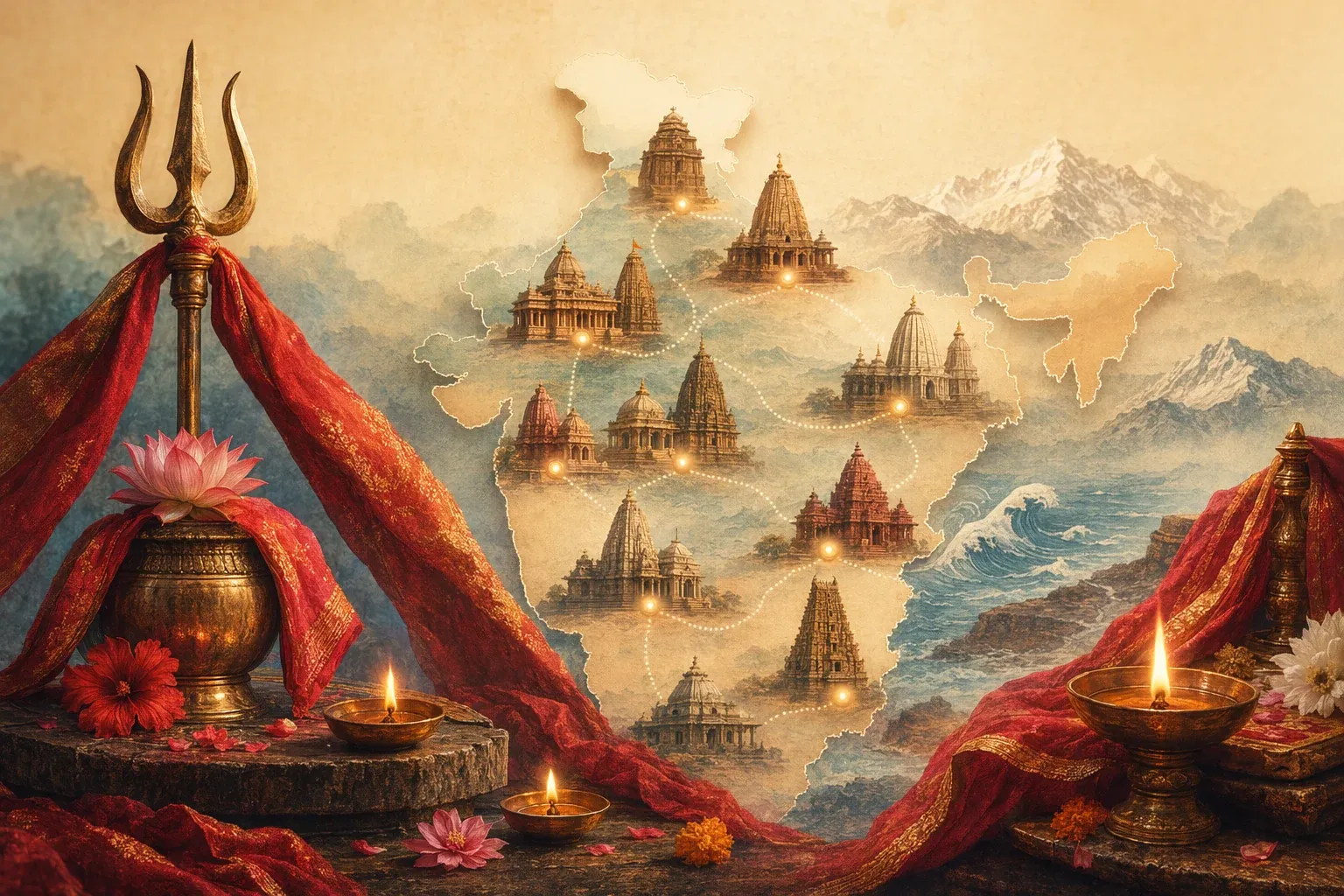
Shakti Peeths in India form a sacred geography of Devi worship. They are remembered across different states, languages, landscapes, and regional traditions. For beginners, the topic can feel confusing because public lists may mention 51, 52, 64, 108, or other counts, and names can vary by source.
This guide is a state-wise learning map, not a claim that one short article can settle every traditional variation. The goal is to help you understand how to read Shakti Peeth lists with respect, accuracy, and calm curiosity.
What “Shakti Peeth in India” means
A Shakti Peeth is traditionally understood as a sacred seat of the Goddess. Many accounts connect these places with the story of Sati and Shiva, where different parts or ornaments of Sati are remembered as falling across the land. Each place becomes a centre of Devi presence, story, and worship.
If you are completely new to the idea, begin with our Shakti Peeth meaning and origin guide. This article focuses on how beginners can think about the India-wide map without getting lost in list variations.
Why state-wise lists are helpful
A state-wise view helps readers connect devotion with geography. Instead of memorising a long list at once, you can notice clusters: Bengal and Assam in the east, Himachal and Jammu in the north, Gujarat and Maharashtra in the west, Tamil Nadu and Andhra regions in the south, and so on.
This does not mean sacred geography follows modern state borders perfectly. Many Shakti Peeth traditions are older than current state boundaries. A state-wise guide is only a learning tool, useful for memory and travel planning.
Why counts vary
Different sources give different counts because Shakti Peeth memory grew through Puranic stories, Tantric traditions, regional temple lists, oral memory, pilgrimage networks, and local devotion. Some lists focus on major Peeths. Some include Upapeeths or related Devi seats. Some preserve names that are identified differently by region.
That variation should not be treated as a failure. It shows how living traditions carry layered memory. A respectful beginner can say, “This is the list followed by this source or community,” instead of claiming every other list is fake.
How to read a state-wise map
When you see a Shakti Peeth map, check three things: the temple name, the state or region, and the tradition behind the identification. Also check whether the map is naming a major Peeth, a regional Devi temple, or a broader pilgrimage site. These categories are sometimes mixed online.
Maps can be useful, but they can also over-simplify. A dot on a map cannot explain local rituals, festival calendars, temple history, language, or family devotion. Use maps as doorways, not final authorities.
Examples of regional memory
Eastern India has many famous Devi sites remembered in Shakti traditions, including places in Bengal, Assam, Odisha, and nearby regions. Northern India includes Himalayan and plains-based Devi seats with powerful pilgrimage memory. Western India has important Devi shrines in Gujarat, Maharashtra, and Rajasthan. Southern India has its own sacred geography connected with forms of the Goddess and temple tradition.
Maharashtra’s regional “Sade Teen” memory is one example of how a state develops its own devotional grouping. It shows that an India-wide sacred map can also contain local clusters that families and regions remember with special affection.
Using the list for pilgrimage
If you are planning darshan, do not rely only on a viral map. Check official temple information where available, local travel conditions, crowd levels, weather, festival dates, accessibility, accommodation, and safety. Some shrines are easy city visits; others need serious travel planning.
Our Shakti Peeth darshan planning guide explains how to approach pilgrimage respectfully without turning devotion into a rushed checklist.
Common misunderstandings
One misunderstanding is that all lists must match exactly. Another is that a temple becomes unimportant if it is not included in one famous list. A third is that every state-wise map is automatically accurate. Beginners should avoid these extremes.
A better approach is to learn the widely cited names first, then notice regional traditions and local explanations. The larger Shakti Peeth list guide can help you compare names without treating sacred memory like an argument to win.
What beginners should remember
Shakti Peeths in India are not only points on a map. They are living centres of Devi worship, story, landscape, language, and pilgrimage. A state-wise guide is useful for learning, but humility matters: lists vary, local traditions matter, and devotion is deeper than memorisation.
What to include in your own notes
If you are making study notes, create columns for name, state, nearby city, Devi form, Bhairava name if your source includes it, and the source you used. This keeps your notes honest. It also reminds you that a name on one list may appear slightly differently on another list.
Do not worry if you cannot memorise everything at once. Start with major well-known sites, then add regional details slowly. Sacred geography is learned through repetition, stories, maps, and sometimes travel.
How not to argue about lists
Online arguments often become harsh because people treat list differences as insults. A calmer approach is better: ask which text, temple tradition, regional source, or family memory the person is following. Many differences come from layered history, not bad faith.
This matters because Shakti Peeths are sacred to living devotees. A beginner’s goal should be learning and reverence, not winning comment-section debates. Strong faith and careful language can exist together.
Map, story, and darshan
A map shows location. A story gives meaning. Darshan gives devotional experience. A complete understanding of Shakti Peeths needs all three, but beginners can start with whichever doorway is easiest. Some readers love maps, some remember stories, and some connect through temple visits.
However you begin, keep the Goddess at the centre of the topic. The geography matters because it carries Devi memory, not because it creates a travel checklist. That spirit makes the state-wise guide more than a set of dots.
Related reading
For broader context on Bhaktilipi, continue with How to Plan Shakti Peeth Darshan: Beginner-Friendly Route, Etiquette, and Learning Guide and Shakti Peeth in Himachal and North India: Jwala Devi, Naina Devi, Chamunda, and More.