
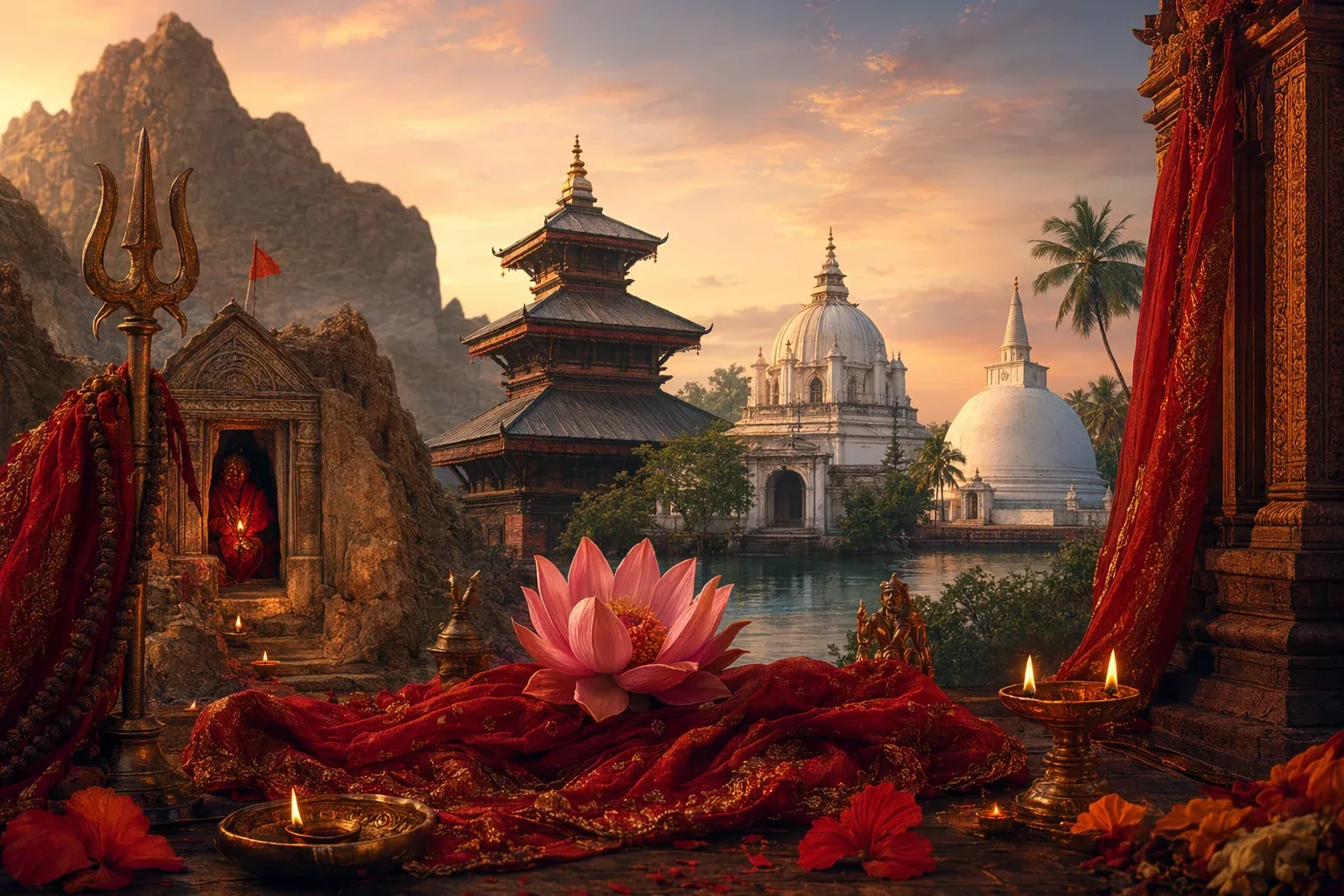
Many beginners are surprised to learn that some Shakti Peeth traditions include sacred places outside present-day India. Hinglaj in Balochistan, sites remembered in Nepal and Bangladesh, and southern references connected with Sri Lanka appear in different devotional lists and travel conversations. This can feel confusing if we imagine sacred geography only through modern national borders. The Shakti Peeth tradition is older than those borders, and its memory moves through story, region, language, pilgrimage, and community devotion.
The heart of the tradition is the story of Sati, Shiva, and the sacred presence of Devi across many places. Lists differ in number and detail, but the emotional idea remains clear: the Mother Goddess is remembered as present across a wide sacred landscape. When a site lies outside India today, the tradition does not become less Indian or less meaningful. It reminds us that older cultural geography often crossed the borders we use now.
Why borders can confuse beginners
Modern maps are political. Sacred maps are cultural and devotional. A temple, cave, hill, riverbank, or shrine may be remembered for centuries through pilgrimage routes, oral tradition, local worship, and textual references. When political boundaries change, the older memory does not simply disappear. This is why a Shakti Peeth guide may speak about places in Pakistan, Nepal, Bangladesh, or Sri Lanka while still discussing a Hindu sacred tradition known across the Indian subcontinent.
A respectful reader should avoid two mistakes. The first is to treat these places as casual tourist trivia. The second is to force every site into a modern argument. A better approach is to ask what devotees remember, what local tradition preserves, and how the place appears in broader Shakti Peeth lists. For the foundation, start with the meaning of Shakti Peeth.
Hinglaj Mata and the western sacred memory
Hinglaj Mata, often associated with Balochistan, is one of the most widely mentioned Shakti sites outside present-day India. The shrine is important not only because of its place in lists but also because of the devotion attached to a difficult landscape. Pilgrimage to remote sacred places has always carried a feeling of tapas, courage, and surrender. Hinglaj keeps that feeling alive in the imagination of many devotees.
For beginners, the key point is not to reduce Hinglaj to a political headline. It is a sacred memory held by communities across generations. Some know it through family stories, some through temple references, and some through wider Shakti Peeth lists. The site teaches that Devi devotion has travelled through desert, mountain, river, and borderland memory.
Nepal and Himalayan Devi devotion
Nepal has a deep goddess tradition, and several Shakti-related memories are associated with its sacred landscape. The Himalayan setting matters because mountains often carry powerful associations in Shaiva and Shakta imagination. For devotees, the presence of Devi in such regions can feel protective, fierce, and maternal at once.
Nepal also shows how Hindu and regional practices can overlap in distinctive ways. A beginner should be careful not to flatten everything into one standard description. Local names, festivals, priestly customs, and historical layers may differ. That difference is part of the cultural richness. It is better to read Nepal-related Shakti Peeth references alongside local temple context rather than relying only on a simplified list.
Bangladesh and eastern sacred geography
Bangladesh appears in Shakti Peeth discussions because older sacred geography across Bengal did not fit neatly into today’s borders. Bengal has long been a major region for Shakta devotion, with strong traditions of Kali, Durga, Tara, and other forms of the goddess. Some places now in Bangladesh are remembered in relation to Devi, local river landscapes, and older pilgrimage networks.
This is where historical sensitivity matters. A site may be sacred to one community, historically important to another, and locally understood through names that differ from a modern search result. The respectful way to learn is to compare sources patiently and to honour the living community around the place.
Sri Lanka and southern references
Some Shakti Peeth conversations include Sri Lanka or southern island references, depending on the list and tradition being followed. Beginners should treat such references with care because names, identifications, and locations can vary. Rather than arguing from a single table, ask what the tradition is trying to express. Often it is showing that Devi’s sacred presence is remembered across a wide civilisational landscape, not only in one region.
Sri Lanka also reminds us that Indian sacred stories often move through sea routes, trade, language, temple contact, and epic imagination. A place can be meaningful through story and devotion even when details are debated.
How to study these sites responsibly
When studying Shakti Peeth sites outside India, use more than one source. Compare a list guide, local temple information, historical notes, and devotional explanations. Do not assume that every spelling variation is an error. Names travel through Sanskrit, Hindi, Bengali, Gujarati, Tamil, Nepali, Sinhala, and other languages, so spellings often shift.
For a broader list format, see the 51 Shakti Peeth guide. Use it as a starting map, not as the end of learning. If you plan an actual visit across borders, rely on current travel rules, safety information, and local guidance. Devotion should be joined with practical care.
Simple takeaway
Shakti Peeth sites outside present-day India show that sacred geography is older and wider than modern political maps. Hinglaj, Nepal, Bangladesh, and Sri Lanka-related traditions invite us to read the Devi story with patience, humility, and historical awareness. The main lesson is simple: respect the list, respect the local tradition, and remember that pilgrimage memory often travels farther than borders.