
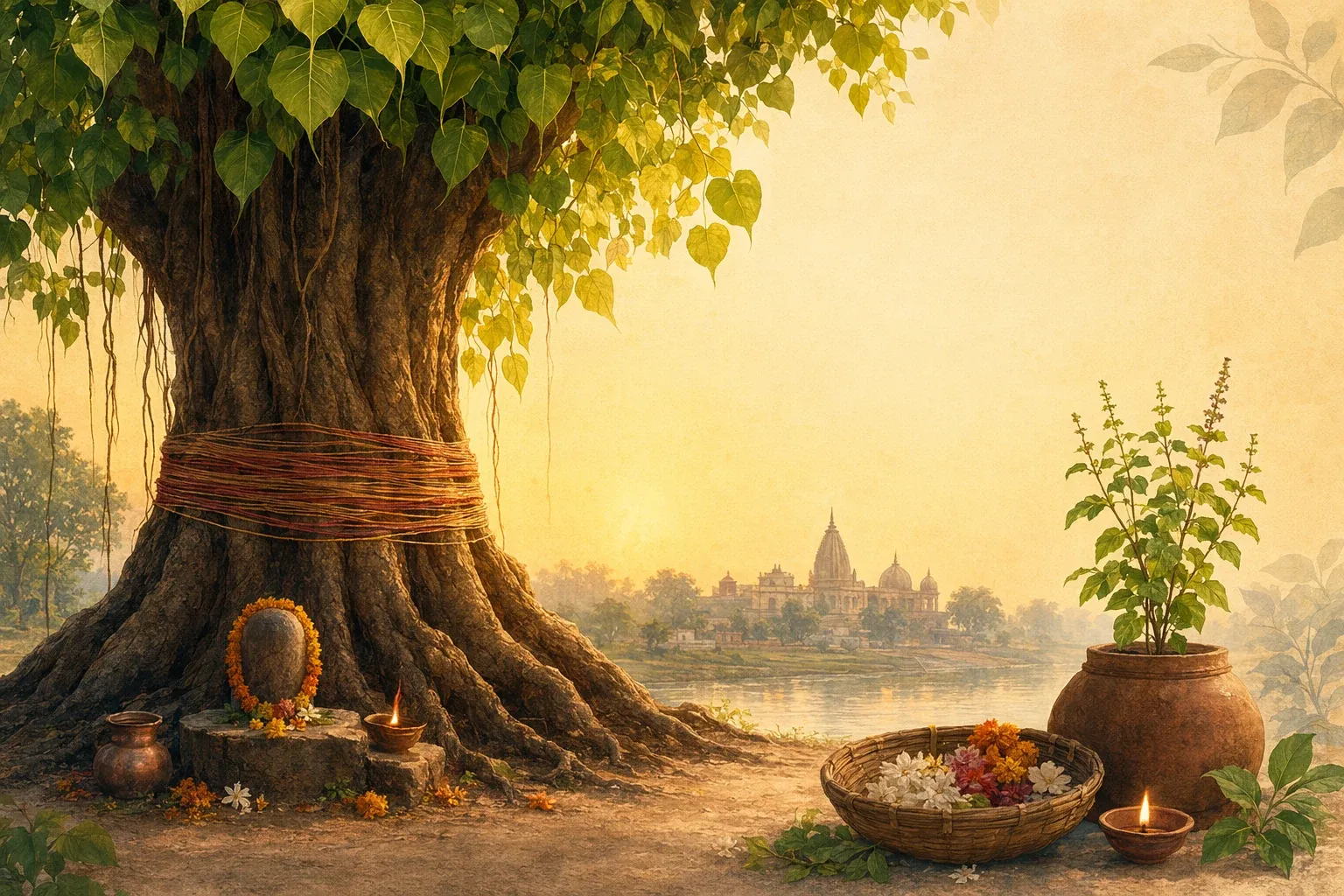
Sacred trees in India are trees and plants that communities treat with special respect because they are connected with worship, stories, healing traditions, village memory, ancestors, deities, saints, or the simple experience of life-giving shade. A sacred tree may stand inside a temple courtyard, beside a village shrine, near a pond, on a roadside platform, in a family courtyard, or inside a protected sacred grove. The main idea is not that the tree is a magic object. The deeper idea is that a living tree can become a meeting point between nature, culture, gratitude, and dharma.
For beginners, the best way to understand sacred trees is to begin with ordinary life. A large tree gives shade in summer, fruit in season, flowers for worship, leaves for ritual use, shelter for birds, medicine in traditional knowledge systems, and a place for people to gather. Over many generations, such trees naturally gathered stories. People remembered them through names, vows, festivals, temple practices, and local rules about not cutting them casually.
The simple meaning of a sacred tree
A sacred tree is a tree treated as worthy of reverence. In India, this reverence may come from Hindu, Buddhist, Jain, Sikh, folk, tribal, village, regional, and family traditions. Sometimes the tree is linked with a deity, such as a bilva or bael tree linked with Shiva worship. Sometimes it is linked with a sacred event, such as the Bodhi Tree at Bodh Gaya in Buddhist tradition. Sometimes it belongs to a sacred grove where the whole patch of forest is protected because a local deity, guardian spirit, or ancestor is believed to reside there.
This does not mean every Indian follows the same list or the same explanation. India is too large for that. A tree that is central in one region may be less visible in another. The peepal, banyan, tulsi, neem, bael, amla, ashoka, mango, coconut, banana, shami, and kadamba all appear in different cultural contexts, but the importance of each one changes by place, community, ritual, and period.
Familiar examples across India
The peepal or sacred fig, botanically Ficus religiosa, is one of the most recognisable sacred trees of the Indian subcontinent. Its heart-shaped leaves and long cultural presence make it important across several Indian-origin religious traditions. In Buddhist tradition, the Bodhi Tree at Bodh Gaya is a sacred fig associated with the Buddha’s enlightenment. In many Hindu settings, peepal trees are also circumambulated, watered, or respected near shrines.
The banyan, Ficus benghalensis, is the national tree of India and is loved for its vast shade and aerial roots. It often feels like a living pavilion. Under a banyan, people can sit, talk, rest, teach, trade, or hold community discussions. The tree’s spreading form made it a natural symbol of shelter, continuity, and shared life.
Tulsi, or holy basil, is not usually a huge tree, but it is one of the most sacred household plants in many Hindu homes, especially in Vaishnava traditions. A tulsi plant in a courtyard or tulsi vrindavan is often cared for daily. Its presence shows how sacredness is not limited to forests and temples; it can also enter domestic life through small, regular acts of care.
Bael or bilva, Aegle marmelos, is especially connected with Shiva worship. Its trifoliate leaves are offered in many Shiva temples. Neem is respected for its protective, medicinal, and cooling associations. Shami or khejri has strong links with arid India, Dussehra customs, and the memory of communities such as the Bishnois, who became famous for protecting trees in Rajasthan.
Sacred groves and community protection
India’s sacred-tree tradition is not only about single famous trees. Sacred groves are equally important. These are patches of forest or woodland protected by community belief and custom. In many groves, hunting, cutting wood, or damaging the space is restricted or taboo. Such rules can preserve biodiversity, water sources, medicinal plants, and local ecological balance.
Examples are found across India under different names and local traditions: devrai in parts of Maharashtra, devarakadu in Kodagu, sarna in parts of eastern and central India, kavus in Kerala, and sacred groves in Meghalaya such as Mawphlang. The religious explanation may differ, but the practical effect is similar: a community learns to treat a living landscape as more than raw material.
Tradition, interpretation, and evidence
When we talk about sacred trees, it is useful to separate three layers. Tradition tells us how people worship, remember, and care for the tree. Interpretation asks what the tree means: shelter, fertility, wisdom, purity, protection, devotion, or the cycle of life. Historical and ecological context asks what evidence we have for practices, how they changed, and what benefits they created for people and nature.
This separation keeps the subject respectful and honest. We do not need to claim that every tree cures every illness or that every story is a laboratory fact. At the same time, we should not dismiss sacred-tree practices as mere superstition. A tradition can hold symbolic, social, ecological, and emotional truth even when its language is poetic.
Why sacredness helped trees survive
A tree that is sacred is harder to cut without thought. That simple cultural protection matters. In a hot country, the value of an old tree is enormous. It cools the area, shelters birds and insects, holds soil, supports memory, and gives a neighbourhood its identity. Sacred rules often made people pause before treating such a tree as just timber.
This is where dharma becomes practical. Reverence becomes a behaviour. Watering a plant, not harming a grove, protecting a peepal near a pond, or saving a khejri in a desert village are not only rituals. They are also habits of restraint. In modern language, we may call this conservation. In older language, it may be described as respect for life.
Beginner questions about sacred trees
What are sacred trees?
Sacred trees are trees or plants treated with reverence because of their religious, cultural, ecological, family, or community meaning. In India, examples include peepal, banyan, tulsi, bael, neem, amla, ashoka, shami, and trees inside sacred groves.
What are the most sacred trees?
There is no one universal list for all India. Peepal, banyan, tulsi, bael, neem, amla, ashoka, mango, coconut, banana, kadamba, and shami are among commonly respected examples, depending on region and tradition.
Are sacred trees worshipped as gods?
Sometimes a tree is treated as the seat, symbol, or beloved form of a deity. In other cases, the tree is respected because of a story, saint, ancestor, local guardian, or ecological role. Practice varies widely.
How to remember sacred trees respectfully
A sacred tree is not just a plant with a label. It is a living relationship. People give it water, lamps, threads, flowers, protection, stories, and memory. The tree gives shade, air, fruit, leaves, beauty, gathering space, and a feeling of continuity. That exchange is the heart of India’s sacred-tree tradition: reverence that turns nature into kinship.