
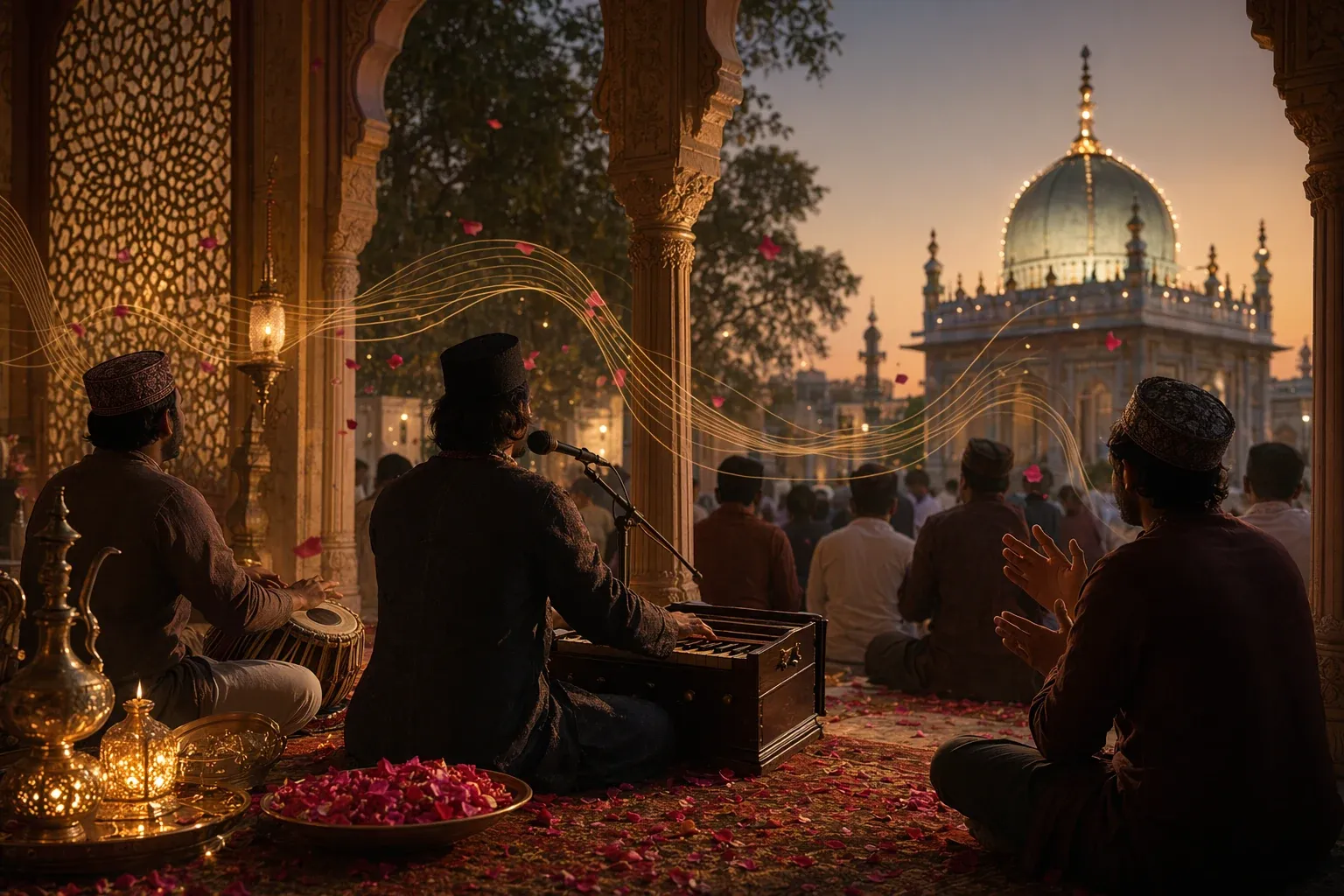
Sufi music in India is often heard first as a feeling: a rising chorus, clapping hands, a harmonium line, repeated words of love, and a voice that seems to move from pain to surrender. Many listeners discover it through songs, films, streaming platforms, or clips from famous dargahs. But qawwali is not just a “vibe.” It belongs to a devotional world where poetry, remembrance, community, and spiritual longing come together.
India’s Sufi music traditions are especially connected with the Chishti order, dargah culture, and gatherings of devotional listening. The most famous form is qawwali, but the larger world also includes poetry, regional languages, shrine practices, and different ways of remembering the divine. To understand it well, we need to respect both the music and the sacred setting that shaped it.
Qawwali as devotional listening
Qawwali is a South Asian form of Sufi devotional singing. The word is linked with qawl, meaning an utterance or saying, and a qawwal is a singer who performs this tradition. In practice, qawwali is usually sung by a lead vocalist and supporting singers, with repeated lines, clapping, rhythmic build-up, and a strong call-and-response energy.
The gathering is often called mehfil-e-sama, a session of spiritual listening. Sama means listening, but in Sufi use it is not casual background listening. It is meant to awaken remembrance, love of God, humility, and longing. In a shrine setting, the music is part of a larger devotional atmosphere: ziyarat, prayer, offerings, fragrance, crowds, quiet tears, and shared attention.
The Chishti connection in India
The Chishti order became one of the most influential Sufi orders in South Asia. Khwaja Muinuddin Chishti is closely associated with Ajmer in Rajasthan, and his dargah remains one of the most visited Sufi shrines in the subcontinent. Later Chishti saints such as Qutbuddin Bakhtiyar Kaki, Baba Farid, and Nizamuddin Auliya shaped devotional life across regions.
Chishti spirituality is often remembered for love, service, openness, and distance from worldly power. That does not mean every historical detail is simple, or that every person experienced Sufi spaces in the same way. But culturally, Chishti dargahs became places where poetry, food, prayer, blessing, and music could bring very different people into one shared atmosphere.
Amir Khusrow and cultural memory
Amir Khusrow, the celebrated poet and musician of the Delhi Sultanate period, is strongly connected in popular memory with qawwali and with the circle of Nizamuddin Auliya. He wrote in Persian and Hindavi traditions and is remembered as a bridge between literary cultures. Many stories credit him with shaping or enriching musical forms associated with Sufi gatherings.
Here, care is important. Tradition gives Khusrow a huge place in the heart of Indian music memory. Historical scholarship may be more cautious about exactly which form, tune, or style can be traced to him with certainty. Both points can stand together: he is central to the cultural imagination of Indo-Persian and Hindavi devotional art, and we should avoid turning every later song into a proven direct invention.
Poetry, language, and repetition
Sufi music in India carries many languages. Persian brought courtly and mystical vocabulary. Hindavi and later Urdu helped devotional poetry feel close to North Indian listeners. Punjabi, Sindhi, Bengali, Kashmiri, and other regional traditions also carry Sufi expression. A single performance may move between praise of God, love for the Prophet, longing for the beloved, and respect for saints.
Repetition is not a weakness in qawwali. It is part of the method. A line may return again and again until the listener stops treating it as information and begins feeling it as remembrance. A phrase like man kunto maula, a praise line for the Prophet, or a couplet about ishq can gather emotional force through rhythm, chorus, and rising intensity.
The dargah is not a concert hall only
Many people now hear qawwali on YouTube, streaming apps, film soundtracks, weddings, college festivals, and live concerts. That spread has helped new generations discover the music. Still, the dargah context should not be forgotten. At Ajmer Sharif, Nizamuddin Dargah in Delhi, and many smaller shrines, qawwali is tied to memory, devotion, and the presence of a saint’s resting place.
This does not mean a listener must belong to one community to appreciate it. Indian culture has long contained shared spaces where people listen across boundaries. But respect matters. A song sung at a shrine is not only entertainment. It may carry prayer, grief, gratitude, and the hope of spiritual nearness for the people gathered there.
Famous voices and living lineages
Modern listeners often know qawwali through Nusrat Fateh Ali Khan, the Sabri Brothers, Abida Parveen’s Sufi repertoire, Rahat Fateh Ali Khan, Aziz Mian, and Indian dargah performers heard in Delhi, Ajmer, Mumbai, Hyderabad, and elsewhere. Some performers come from hereditary qawwal families where repertoire and style pass across generations.
There are also many local singers whose names may not be famous online but who keep the tradition alive at annual urs gatherings, Thursday evenings, and community events. This matters because living culture is not preserved only by global stars. It survives through ustads, disciples, shrine caretakers, poets, listeners, and families who remember the words.
How streaming changed the listening habit
Streaming has made Sufi music easier to find. That is a good thing when it leads people toward legal listening and deeper curiosity. But it can also flatten the tradition into one generic “spiritual” sound. A playlist may place qawwali, film songs, ghazals, Punjabi kalam, and electronic remixes together without explaining their differences.
A better habit is to listen with context. Check the singer, language, poet, shrine connection, and meaning of repeated lines. Notice whether a track is a traditional qawwali, a film adaptation, a studio fusion, or a devotional performance from a shrine. All can be enjoyable, but they are not the same thing.
Questions people ask
How is Sufi music connected to Indian traditions?
It grew through South Asian Sufi orders, especially Chishti networks, and absorbed Persian, Hindavi, Urdu, Punjabi, and regional expressions. Dargahs, saints, poets, and hereditary musicians all shaped its Indian life.
Can I buy authentic Sufi music albums related to Indian traditions online?
Yes, but choose legal platforms, official artist pages, reliable labels, or direct support for performers when possible. Avoid pirated uploads and random downloads that do not credit singers, poets, or sources.
What is the best way to start listening?
Begin with well-known qawwali artists, then explore recordings from Ajmer, Nizamuddin, and regional Sufi traditions. Read translations of the lyrics so the music becomes more than sound; it becomes meaning.
A respectful way to hear it
Sufi music in India asks for more than ears. It asks for attention. Listen to the poetry, the longing, the names, the repeated lines, the community response, and the sacred places that shaped the sound. Enjoy the beauty, but do not reduce it to decoration. Qawwali is powerful because it joins art with devotion, and that union deserves both joy and respect.
For a wider cultural comparison, read Bhaktilipi’s guide to Bhakti Movement and Sufism.