
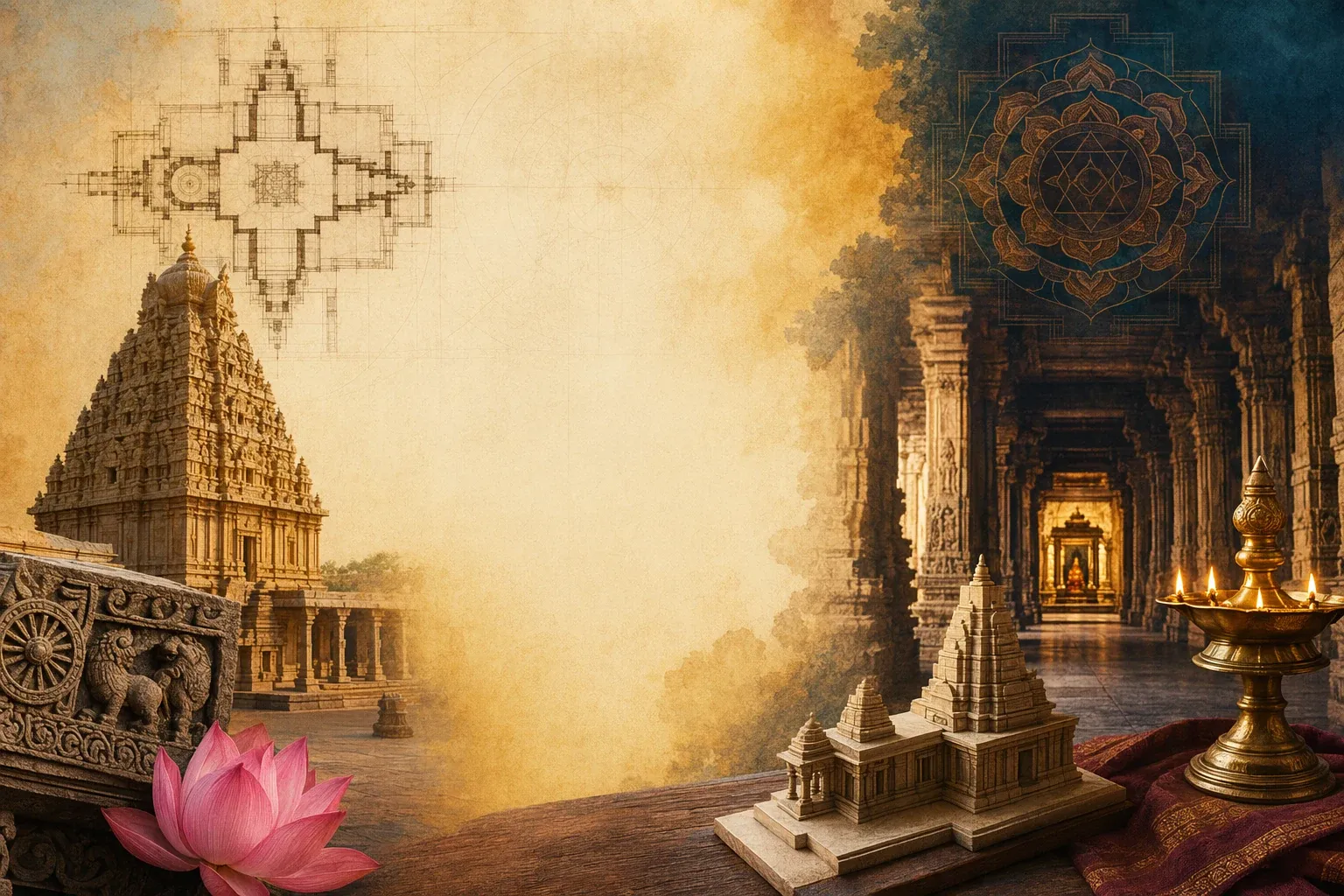
A Hindu temple often feels sacred before we understand its technical language. A visitor may notice the dark inner shrine, the rising tower, carved deities on the walls, bells, lamps, flowers, water, fragrance and the slow movement of people walking around the deity. None of these elements is random. Temple architecture in India developed through many regions and centuries, but it repeatedly uses space, direction, image and movement to make devotion something the body can experience.
This does not mean every line of every temple has one secret code. Temples were built by patrons, sthapatis, sculptors, priests and local communities in real historical settings. Materials, climate, dynasty, budget and regional style all mattered. Still, many Hindu temples share a symbolic grammar: the devotee moves from the ordinary world toward a concentrated sacred centre, while the building itself suggests a small model of cosmic order.
A sacred journey in stone
The most basic movement in many temples is from outside to inside. The outer zone is open, social and visually busy. The inner zone becomes quieter and more focused. This journey can be seen in a small village shrine and also in famous temple complexes. The devotee may pass through a gateway, stand in a mandapa or hall, and finally approach the garbhagriha, the sanctum where the main murti is placed.
The experience matters. You do not simply look at a temple like a monument from a distance. You enter, pause, turn, bow, listen, smell, see flame, receive prasada and leave with memory. Architecture supports this rhythm. The plan tells the body: slow down, orient yourself, and approach with attention.
Garbhagriha: the sacred centre
Garbha-griha literally means “womb chamber”. It is usually small, simple and darker than the surrounding spaces. Architecturally, it is the centre of the temple. Devotionally, it is the place where the presence of the deity is concentrated through ritual. A Vishnu temple, Shiva temple, Devi temple or Surya temple may differ in image and practice, but the sanctum remains the devotional heart.
The darkness of the sanctum is not a design failure. It helps make darshan intense. When a lamp is waved before the deity, the image appears through light, metal, flower, cloth and shadow. This gives the visitor a very different experience from a museum display. The murti is not treated as a decorative object. In tradition, it is honoured as a living presence after consecration, while historians also study its material, style, date and iconography.
Mandala, direction and Vastu
Many temple plans use square geometry because the square suggests stability, order and balanced direction. Architectural texts such as Vastu and Shilpa traditions discuss site, proportion, orientation and measurement. In practice, builders also adapted rules to land, patron needs and local craft knowledge. This is why one should not reduce all temples to a single diagram, but the diagram helps us understand the ideal behind many designs.
The mandala idea is especially useful. A mandala is an ordered field, not just a pretty pattern. In temple planning, it can represent the placing of sacred energy into a measured space. The centre is privileged; directions are meaningful; subsidiary deities may be arranged around the main shrine. The temple becomes a place where cosmic order is made visible and walkable.
Shikhara, vimana and the mountain image
Above the sanctum, many North Indian temples rise into a shikhara, while many South Indian temples use the term vimana for the tower over the sanctum. These forms differ by region, but both can suggest vertical ascent. The tower draws the eye upward from the earth toward the sky. It also marks the sanctum from a distance, telling the town or village where the sacred centre lies.
Indian temple symbolism often connects this upward form with the idea of a cosmic mountain, especially Mount Meru in Hindu, Buddhist and Jain imagination. That connection should be understood as symbolic, not as a claim that every tower exactly copies one mountain. The idea is that the temple rises like a centre-point between earth and heaven. Stone becomes a vertical imagination of sacred presence.
Sculpture as story, protection and celebration
Temple sculpture is not merely decoration. Images on walls, doorframes and pillars can teach stories, mark thresholds, protect the sacred space and celebrate life. A devotee may see Ganga and Yamuna near a doorway, guardians at entrances, forms of Shiva or Vishnu, episodes from the Ramayana or Mahabharata, celestial musicians, dancers, animals, vines and everyday figures.
This variety can surprise new visitors. Why would a sacred building include dancers, couples, animals and worldly scenes? One answer is that Hindu temple art often presents life as part of a larger sacred order. The divine is not placed against nature, music, fertility, beauty and community life. It gathers them into a larger vision. At the same time, each temple must be read in its own historical and regional context. Khajuraho, Chola temples, Odisha temples and Kerala shrines do not speak in exactly the same visual language.
Movement: pradakshina and embodied devotion
Many temples allow pradakshina, the clockwise circumambulation of the shrine. Walking around the deity is a form of prayer with the body. It keeps the sacred centre to one’s right and turns devotion into movement. Some temples have an inner circumambulatory path; others use the outer courtyard or prakara.
This movement is closely connected to architecture. A passage must be proportioned, lit and shaped for walking. Sculptures are placed where eyes will meet them. Thresholds tell the devotee when a new zone has begun. Even when a visitor does not know Sanskrit terms, the building guides behaviour through space.
How temple symbolism connects with Vastu Shastra
Vastu Shastra is a broad family of architectural ideas about site, direction, measurement, proportion and the relationship between built space and human life. In temple architecture, Vastu ideas can shape orientation, ground plan, hierarchy of spaces and the placing of different functions. Shilpa traditions add rules for image-making, measurement and iconography.
But it is important to be careful. Vastu is not a magic shortcut that explains every temple or guarantees supernatural results. It is better understood as a traditional design language. Real temples were created through a meeting of text, ritual, craft, patronage, geography and regional taste. That balance is what makes Indian temple architecture so rich.
Reading a temple with respect
A good way to read a Hindu temple is to ask three questions. What does tradition say this space means? What can history tell us about who built it and when? What does the actual experience of movement, sight and ritual do to the visitor? These questions keep us from two mistakes: treating the temple as only a religious mystery, or treating it as only an art object.
When we hold both together, temple design becomes more alive. The sanctum is both a carefully built room and a sacred centre. The tower is both a regional architectural form and a vertical symbol. Sculpture is both art history and storytelling. The temple is not only seen; it is entered, walked, heard and remembered.
Questions people ask
What is the symbolism behind different elements in Hindu temple design?
The sanctum symbolises the sacred centre, the tower suggests ascent and divine presence, the mandapa creates a gathering space, sculpture teaches stories and values, and circumambulation turns devotion into movement. Meanings vary by region and temple tradition.
How are temple architecture and sculpture connected?
Sculpture completes the architecture. Door guardians, river goddesses, deity forms, narrative panels and decorative motifs mark sacred zones, guide the devotee’s attention and give visual form to stories and philosophical ideas.
How is temple architecture connected to Vastu Shastra?
Vastu traditions influence ideas of orientation, proportion, site and sacred order. They are best understood as part of a wider design and ritual tradition, alongside local craft, historical patronage and regional style.