
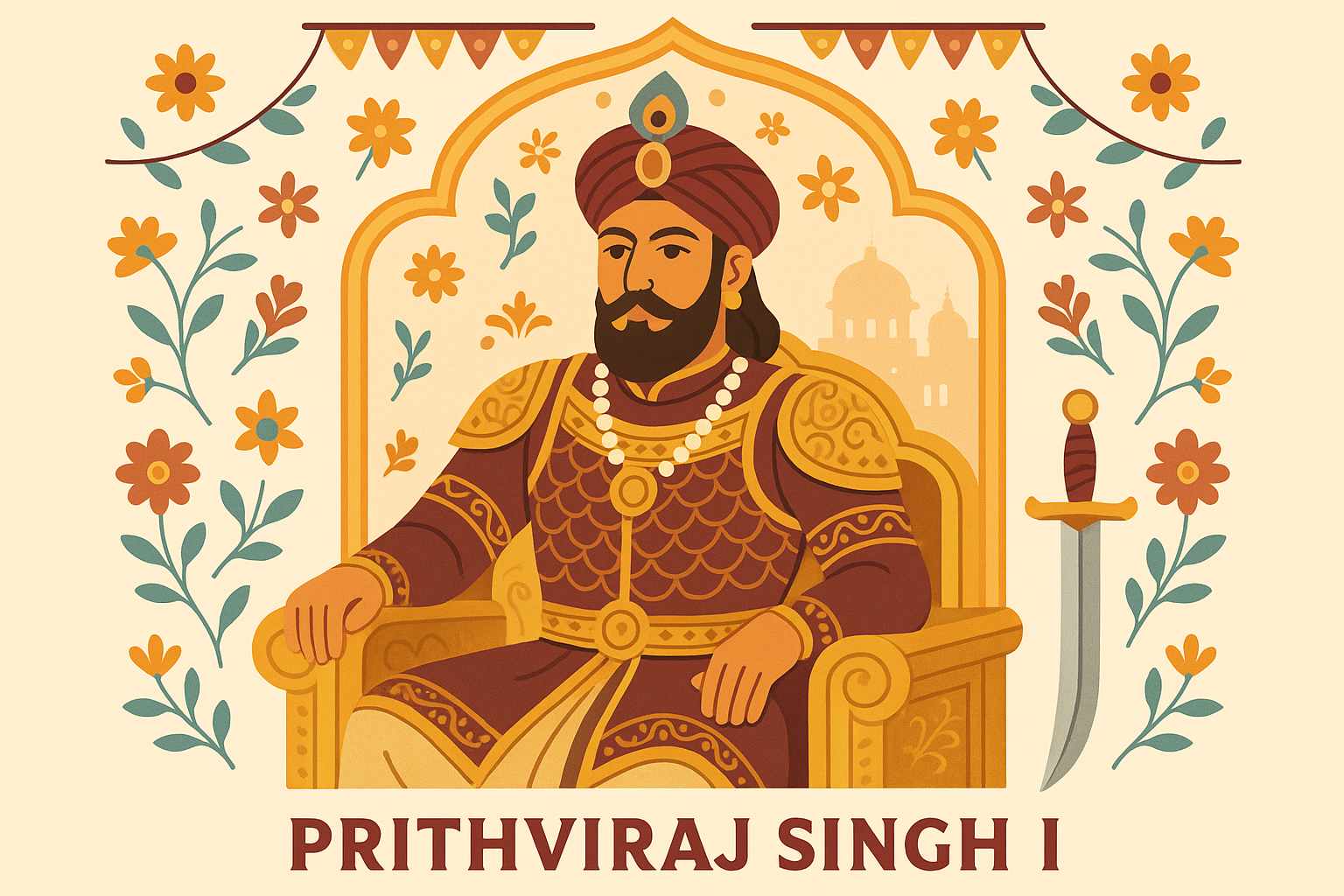
Prithviraj Singh I—also written Prithvi Raj or Prithviraj Kachhwaha—was the Kachwaha ruler of Amber from 1503 to 1527. He governed the Dhundhar kingdom in present-day Rajasthan during the rise of Rana Sanga of Mewar and the arrival of Babur's Mughal power in north India.
He is a different person from the twelfth-century Chahamana ruler Prithviraj Chauhan. He also did not build Deeg Palace, which belongs to the eighteenth-century Jat rulers of Bharatpur. Keeping these identities separate is essential because copied web articles routinely mix their battles, buildings and legends.
First identify the right Prithviraj
- Prithviraj Singh I of Amber: Kachwaha ruler, reigned 1503–1527; the subject of this guide.
- Prithviraj Chauhan or Prithviraja III: Chahamana ruler of Ajmer in the twelfth century, associated with the Battles of Tarain.
- Sawai Prithvi Singh II of Jaipur: an eighteenth-century ruler from a much later period.
- The rulers connected with Deeg Palace: especially Maharaja Suraj Mal and Maharaja Jawahar Singh of Bharatpur, not Prithviraj Singh I.
“Singh I” is a modern numbering convention used to distinguish rulers with similar names. Historical sources may call him Prithvi Raj Kachhwa without that suffix.
Amber before Jaipur
Prithviraj ruled from Amber, also written Amer, in the hill country near modern Jaipur. Jaipur city did not yet exist; Sawai Jai Singh II founded it in 1727, two centuries later. Referring to Prithviraj as a “ruler of Jaipur” can be understandable in dynastic shorthand, but “ruler of Amber” is geographically and chronologically clearer.
The Kachwahas had ruled in the Dhundhar region before 1503, but their position was not static. Clan politics, neighbouring Rajput powers, routes toward Ajmer and Delhi, and later Mughal expansion all shaped Amber's choices. The grand palace complex visible at Amber today was developed chiefly under later rulers, including Man Singh I and Mirza Raja Jai Singh I; it should not all be assigned to Prithviraj.
Reign and chronology
Jadunath Sarkar's A History of Jaipur, as revised by Raghubir Sinh, dates Prithviraj's reign from 17 January 1503 to 4 November 1527. The precision reflects a particular historical reconstruction and calendar conversion; a general account can safely state 1503–1527.
He succeeded Chandrasen. After Prithviraj's death, his son Puranmal succeeded him, followed by a period of contested and changing succession before Bharmal gained the throne in 1548. Bharmal's later alliance with Akbar belongs to the next political generation and should not be projected backward onto Prithviraj's reign.
Amber, Mewar and Rana Sanga
In the early sixteenth century, Rana Sanga of Mewar became the strongest Rajput ruler in the region. Historical reconstructions treat Amber as subordinate or allied to Mewar during Prithviraj's reign. The language matters: later heroic narratives often present a fully unified, equal confederacy, while political relationships could include pressure, tribute, alliance and shared military interest.
Prithviraj is associated with Rana Sanga's coalition against Babur. This connection places him within a regional network rather than as an isolated king acting alone.
The Battle of Khanwa
The Battle of Khanwa was fought in March 1527 between Babur's forces and the coalition led by Rana Sanga. Prithviraj of Amber is listed in later and modern histories among the Kachwaha participants on Sanga's side.
Popular accounts sometimes say that Prithviraj died on the battlefield. The standard reign chronology extends to 4 November 1527, months after the battle, so that claim should not be repeated without stronger evidence. Sources also differ in how they narrate individual acts during the fighting. The secure historical point is his political and military association with Sanga's coalition, not every dramatic anecdote attached to it.
Religion and Galta traditions
Later Kachwaha and regional traditions connect Prithviraj with the Vaishnava teacher Krishnadas Payahari and the Galta sacred landscape near Jaipur. These traditions are important for understanding the dynasty's religious memory, but details about particular images, miracles and exact personal exchanges should be attributed to the relevant lineage or text rather than presented as contemporary documentation.
The Kachwaha court's later relationship with Krishna devotion became highly visible, especially under subsequent rulers. It is safer to describe Prithviraj's place within that developing tradition than to credit him with every later Jaipur temple or practice.
The baro-kotri legacy
Genealogical and historical accounts associate Prithviraj with the distribution of estates among sons and relatives, remembered through the baro kotri or “twelve chambers” of Kachwaha aristocracy. These branches became important within the later Amber–Jaipur state.
The number and exact list can vary across genealogical traditions. “He divided Rajasthan into twelve kingdoms” would be a serious exaggeration. The claim concerns branches and estates within the Kachwaha political order, not twelve independent states covering the region.
Succession and longer dynastic impact
Prithviraj's historical importance rests partly in the lineage that followed him. His descendants and collateral branches shaped Amber's succession and aristocracy. Bharmal later entered an alliance with Akbar; Bhagwant Das and Man Singh I became prominent within the Mughal imperial system.
That later prominence should not be treated as Prithviraj's completed master plan. Dynastic outcomes emerged through conflict, marriage, succession, imperial service and decisions made decades after his death.
What the evidence does not support
- Prithviraj Singh I was not Prithviraj Chauhan and did not fight Muhammad Ghori at Tarain.
- The Prithviraj Raso is about Prithviraj Chauhan traditions, not a biography of the sixteenth-century Amber ruler.
- Prithviraj Singh I did not build Deeg Palace; its major development belongs to Suraj Mal and Jawahar Singh of Bharatpur.
- He did not found Jaipur city; Sawai Jai Singh II founded Jaipur in 1727.
- The present Amber Palace complex was not built entirely during his reign.
- A claim that he died at Khanwa conflicts with the commonly cited November 1527 end date for his reign.
- Modern patriotic language should not replace evidence about Amber's changing relationships with Mewar and other powers.
How to research Prithviraj Singh I
Begin with a scholarly history of Jaipur/Amber and compare its chronology with regional genealogies and contemporary or near-contemporary records. Note that early Kachwaha history relies partly on later chronicles and bardic traditions; even a famous narrative should be dated and evaluated.
Search under spelling variants: Prithviraj, Prithvi Raj, Prithwi Raj, Kachhwaha, Kachwaha, Amber and Amer. Exclude “Chauhan” unless comparing identities. Museum labels, inscriptions and archival editions are more useful than generic “great king” listicles.
Visiting Amber with the right context
Amber Palace near Jaipur is a major heritage site, but most of its celebrated palace architecture postdates Prithviraj. A visit can still help readers understand the terrain, capital and later Kachwaha state. Read individual building labels rather than treating the entire complex as one ruler's work.
Follow current Rajasthan Tourism and site-management rules. Do not touch paintings or mirror work, carve surfaces, enter closed passages or use animals in ways that raise welfare concerns. Heat, steep paths and crowds require water, suitable footwear and realistic pacing.
Frequently asked questions
Who was Prithviraj Singh I?
He was the Kachwaha ruler of Amber in present-day Rajasthan from 1503 to 1527.
Was he Prithviraj Chauhan?
No. Prithviraj Chauhan lived in the twelfth century and belonged to the Chahamana dynasty. Prithviraj Singh I of Amber lived more than three centuries later.
Did he fight at Khanwa?
Historical accounts associate him with Rana Sanga's coalition at Khanwa in 1527. Detailed heroic anecdotes require source-specific verification.
Did he die in the Battle of Khanwa?
The standard Amber reign chronology ends on 4 November 1527, after the March battle. A battlefield-death claim should therefore not be stated as fact without better evidence.
Did he build Deeg Fort or Palace?
No. Deeg's major palace complex is associated with the eighteenth-century Jat rulers of Bharatpur, particularly Suraj Mal and Jawahar Singh.
Was he the founder of Jaipur?
No. He ruled from Amber. Sawai Jai Singh II founded Jaipur in 1727.
Sources and further reading
- Jadunath Sarkar, revised by Raghubir Sinh, A History of Jaipur, c. 1503–1938, Orient Longman/Orient BlackSwan.
- University of Kerala Library catalogue: A History of Jaipur
- Institutionalizing Rajadharma: Kachwaha history and the baro-kotri context
- IGNCA digital text: Annals of Amber or Dhundhar (use critically as an older source)
- Rajasthan Tourism: Jaipur and Amber Palace
- Rajasthan Tourism: Amber Palace