
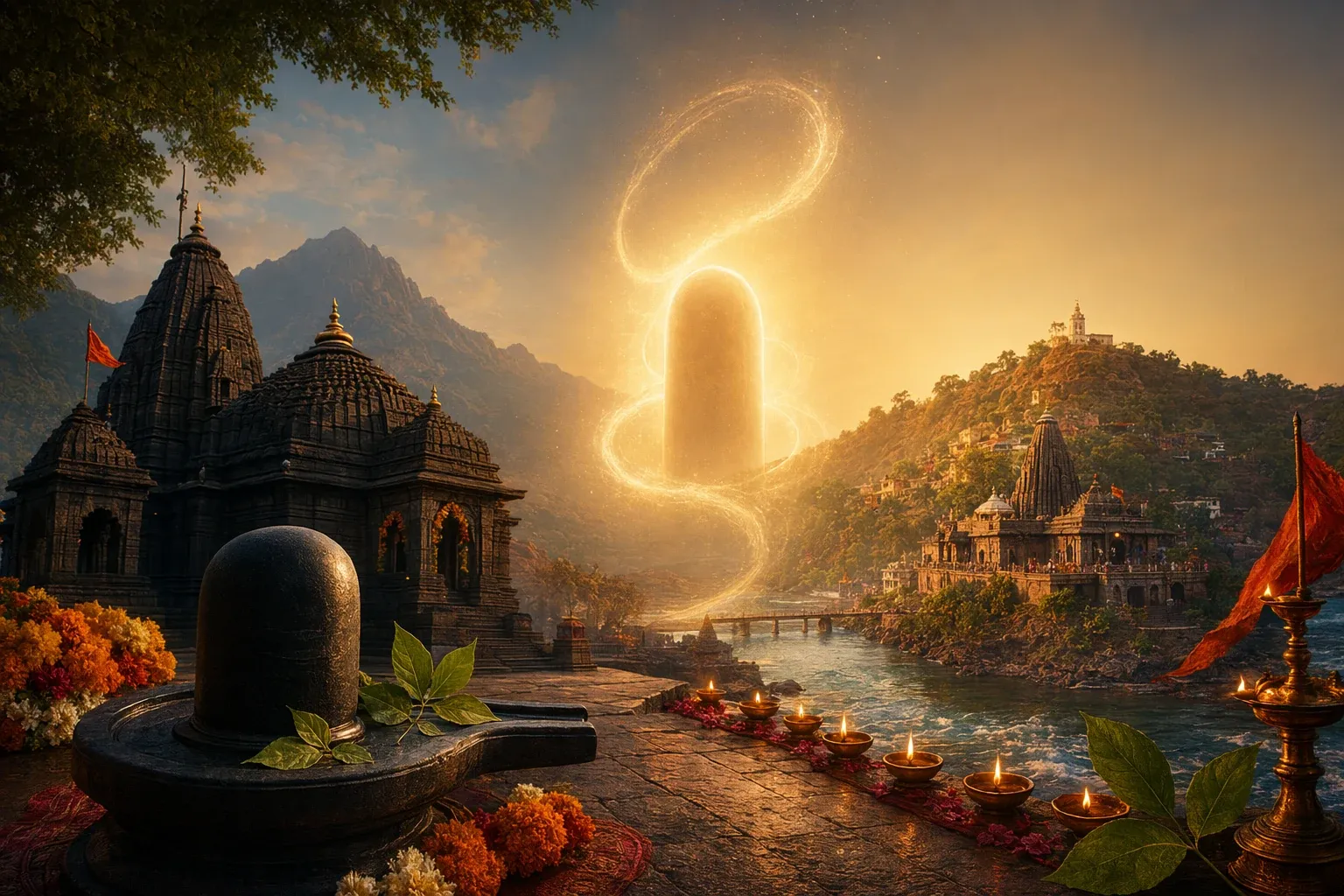
Trimbakeshwar, Mahakaleshwar, and Omkareshwar are all Jyotirlinga temples of Shiva, yet devotees remember each one in a different way. Trimbakeshwar is strongly linked with Nashik, the Brahmagiri hills, the Godavari River, and a distinctive three-faced form. Mahakaleshwar is the great Shiva shrine of Ujjain, associated with time, death, the south-facing lingam, and the famous Bhasma Aarti. Omkareshwar stands on the Narmada, where sacred geography itself becomes part of the experience through the Om-shaped island tradition.
A comparison like this should not become a ranking. In Hindu devotion, a shrine may be loved for its story, its ritual, its landscape, its old memories, or the grace a devotee feels there. These three Jyotirlingas are special because each teaches a different way to approach Shiva: as source, as time, and as sacred sound.
Jyotirlingas are shared, but each place has its own personality
The word Jyotirlinga is commonly understood as a radiant or light-form manifestation of Shiva. Across India, twelve shrines are especially revered in this tradition. The list joins distant regions into one pilgrimage imagination, but the temples are not copies of one another. Their local rivers, festivals, legends, architecture, and ritual customs make each site feel distinct.
That is why pilgrims ask questions such as why Trimbakeshwar Jyotirlinga is different, which Jyotirlinga is in Ujjain, or what makes Omkareshwar memorable. The answer is not only theological. It is geographical, cultural, and practical too. A devotee at Trimbak meets Shiva beside the source-memory of a great river. A devotee in Ujjain meets Mahakal in a city famous for sacred time and astrology. A devotee at Omkareshwar crosses water, walks around an island, and feels the presence of the syllable Om in the landscape.
Trimbakeshwar: Nashik, Godavari, and the three-faced tradition
Trimbakeshwar Temple is located at Trimbak near Nashik in Maharashtra, close to the Brahmagiri hills. Maharashtra Tourism describes it as one of the twelve Jyotirlingas and places it in a setting surrounded by Brahmagiri, Nilagiri, and Kalagiri. The region is closely connected with the Godavari, one of India’s most sacred rivers. Many pilgrims visit the Kushavarta Kund and remember the story of the river’s descent through the penance of Gautama Rishi.
The feature that most often makes Trimbakeshwar stand out is the tradition of a three-faced Jyotirlinga, symbolising Brahma, Vishnu, and Mahesh. This gives the temple a rare devotional identity. Instead of only thinking of Shiva as one isolated form, the shrine invites devotees to think about creation, preservation, and dissolution together. That is why the question “Why is Trimbakeshwar Jyotirlinga different?” usually receives two linked answers: its form is distinctive, and its sacred geography is tied to the Godavari.
Trimbakeshwar is also known as a place where many families perform specific rites and ancestral observances. Such practices should be approached respectfully, with guidance from authorised temple systems or trusted local sources. For a beginner, the main point is simple: Trimbakeshwar combines Shiva devotion, river sanctity, and a unique symbolic form.
Mahakaleshwar: Ujjain, Mahakal, and sacred time
Mahakaleshwar Jyotirlinga is in Ujjain, Madhya Pradesh, on the banks of the Shipra or Kshipra River. Ujjain is one of India’s ancient sacred cities and is famous for the Simhastha Kumbh Mela, astronomical associations, and long-standing Shiva devotion. Madhya Pradesh Tourism explains the meaning of Mahakal through maha, great, and kaal, time or death. In devotional language, Mahakaleshwar is Shiva as lord beyond time and death.
One distinctive feature of the shrine is the south-facing, or dakshinamukhi, lingam tradition. South is often associated with Yama and the direction of death in Hindu symbolism, so a south-facing Mahakal carries strong meaning. Devotees come not only for blessings but also for a sense of protection, surrender, and acceptance of life’s impermanence.
Mahakaleshwar is also widely known for Bhasma Aarti, the pre-dawn ritual in which sacred ash is offered to the deity. Incredible India describes this ritual as a unique daily practice connected with the Mahakaleshwar Jyotirlinga. For visitors, it is one of the most recognisable experiences of Ujjain. It also requires planning because participation rules, timings, and booking systems may change. The devotional lesson, however, is timeless: ash reminds the devotee that the body is temporary, while Shiva is beyond decay.
Omkareshwar: Narmada, Mandhata island, and the sound Om
Omkareshwar Jyotirlinga is in Madhya Pradesh on Mandhata, also called Omkar Parvat, an island in the Narmada River. Madhya Pradesh Tourism describes Omkareshwar as a sacred town named from an island shaped like the syllable “Om” and as home to one of the twelve Jyotirlingas. This is why Omkareshwar feels different even before a devotee enters the temple: the river, island, bridges, ghats, and parikrama path are part of the pilgrimage experience.
The name Omkareshwar means the Lord of Omkara, the sacred sound Om. In many Hindu traditions, Om is treated as a primordial sound, a seed of prayer and meditation. At Omkareshwar, that idea is not only recited; it is mapped onto place. Devotees may cross the Narmada, offer worship at the main shrine, visit nearby temples, and walk around the island as a form of circumambulation.
People sometimes ask when Omkareshwar Jyotirlinga was built. A careful answer is that the sacred tradition is ancient, while temple structures and patronage developed across time. Different parts of the complex may reflect different periods of building, repair, and regional support. For a beginner article, it is better not to force a single exact date unless a specific inscription or temple authority is being discussed.
How the three temples differ at a glance
Trimbakeshwar is remembered through source and form: the Godavari association, the Brahmagiri setting, and the three-faced Jyotirlinga tradition. Mahakaleshwar is remembered through time and ritual: Ujjain, Mahakal, the south-facing lingam, and Bhasma Aarti. Omkareshwar is remembered through sound and landscape: the Narmada, Mandhata island, the Om-shaped sacred geography, and parikrama.
These differences also shape the mood of pilgrimage. Trimbakeshwar can feel connected to family rites, river purity, and mythic origin. Mahakaleshwar can feel intense, early-morning, ash-marked, and philosophical. Omkareshwar can feel expansive and riverine, with movement across water and around the island. All three are Shiva shrines, but each opens a different doorway.
Comparing without ranking devotion
It is tempting to ask which Jyotirlinga is “more powerful” or “best.” A more respectful question is: what does this place help devotees remember? Trimbakeshwar remembers the sacred river and the unity of divine functions. Mahakaleshwar remembers time, mortality, and Shiva’s power beyond fear. Omkareshwar remembers Om, the Narmada, and the idea that geography itself can become prayer.
If you plan to visit, check current darshan timings, booking rules, dress guidance, and festival crowds from official temple or tourism sources. If you are learning from home, mark the three places on a map. Notice how Maharashtra and Madhya Pradesh contribute different landscapes to the Jyotirlinga tradition. That simple map exercise makes the comparison clearer than memorising isolated facts.
FAQs
Why is Trimbakeshwar Jyotirlinga different?
Trimbakeshwar is especially associated with a three-faced Jyotirlinga tradition representing Brahma, Vishnu, and Mahesh, and with the Godavari River near the Brahmagiri hills. This combination of form and river sanctity gives it a distinctive identity.
Which Jyotirlinga is in Ujjain?
Mahakaleshwar Jyotirlinga is in Ujjain, Madhya Pradesh. It is associated with Mahakal, Shiva as lord of time and death, and is famous for the Bhasma Aarti.
What makes Mahakaleshwar important?
Mahakaleshwar is important because of its place in Ujjain’s sacred history, its south-facing lingam tradition, its Mahakal symbolism, and its distinctive ash ritual. Devotees connect the shrine with protection, surrender, and Shiva beyond time.
When was Omkareshwar Jyotirlinga built?
The sacred tradition of Omkareshwar is ancient, but a single simple construction date is not the best way to explain it. The temple complex reflects layers of devotion, building, repair, and regional history. Its strongest identity is the Narmada island shaped like Om and the worship of Shiva as Omkareshwar.