
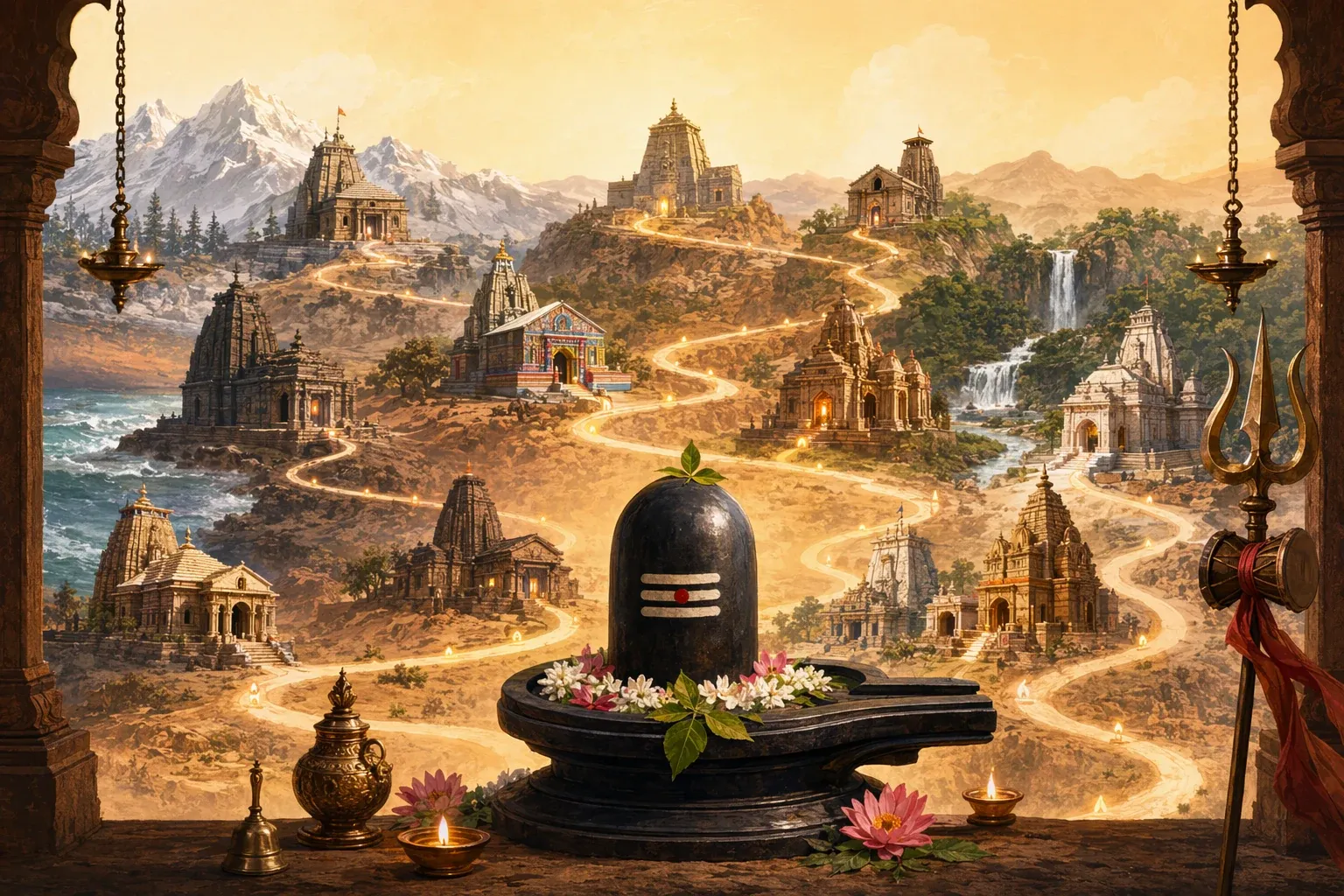
The 12 Jyotirlingas are among the most sacred Shiva shrines remembered across India. For beginners, the list can feel like a geography test: names, states, alternate spellings, pilgrimage routes, and local traditions all appear at once. This guide keeps it simple: first the list, then the meaning, then the common confusions.
A Jyotirlinga is not just a “famous Shiva temple”. In devotional understanding, it is connected with Shiva as jyoti, divine light, and with sacred stories that make each place part of a larger map of devotion. To understand the idea before memorising locations, read our Jyotirlinga beginner guide.
The 12 Jyotirlingas in one list
Here is the commonly remembered list: Somnath in Gujarat; Mallikarjuna at Srisailam in Andhra Pradesh; Mahakaleshwar in Ujjain, Madhya Pradesh; Omkareshwar on the Narmada in Madhya Pradesh; Kedarnath in Uttarakhand; Bhimashankar in Maharashtra; Kashi Vishwanath in Varanasi, Uttar Pradesh; Trimbakeshwar near Nashik, Maharashtra; Vaidyanath or Baidyanath, commonly associated with Deoghar in Jharkhand; Nageshwar near Dwarka in Gujarat; Rameshwaram or Ramanathaswamy in Tamil Nadu; and Grishneshwar near Ellora in Maharashtra.
Local spellings and exact identifications can vary, especially for names like Vaidyanath and Nageshwar. That does not make the tradition meaningless. India’s sacred geography grew through Puranic lists, oral memory, pilgrimage, regional devotion, temple histories, and family practice.
A state-wise way to remember them
Maharashtra appears often in the list, with Bhimashankar, Trimbakeshwar, and Grishneshwar. Gujarat has Somnath and Nageshwar. Madhya Pradesh has Mahakaleshwar and Omkareshwar. The remaining shrines stretch the map across Uttarakhand, Uttar Pradesh, Andhra Pradesh, Jharkhand in the common telling, and Tamil Nadu.
This spread is one reason the list matters. It connects the Himalayas, river islands, sea coasts, ancient cities, forested regions, and southern pilgrimage centres into one Shiva memory. For young readers, the list is not only about locations; it shows how devotion travels through geography.
Why the Jyotirlinga list matters
The list helps devotees remember Shiva across many regions instead of reducing worship to one city or one language. A Gujarati family may speak of Somnath, a Tamil family may remember Rameshwaram, a north Indian pilgrim may think of Kashi Vishwanath or Kedarnath, and a Maharashtrian devotee may feel close to Trimbakeshwar or Bhimashankar. The same tradition becomes local and pan-Indian at the same time.
The linga itself is often misunderstood by beginners, so our guide to Shiva linga meaning and symbolism is useful if you want the deeper background. In Jyotirlinga devotion, the symbol points toward Shiva’s presence, light, and mystery rather than a simple object label.
Common confusion: 12 or 13?
The traditional beginner list is 12 Jyotirlingas. Confusion appears because some sacred places have strong local claims, alternate names, or regional traditions. Some travellers also mix Jyotirlingas with other major Shiva temples. A respectful answer is: learn the standard list of 12, and also understand that India has many other important Shiva shrines outside that list.
Common confusion: exact location disputes
Names such as Vaidyanath and Nageshwar can have more than one associated site in public discussion. Instead of turning this into online fighting, beginners should understand how sacred geography works. Devotional memory is layered. Texts, local tradition, temple history, and pilgrimage practice may not always fit into a neat modern spreadsheet.
How to use this guide
If you are learning for school, remember the name plus state first. If you are planning travel, check the official temple location, current route, weather, crowd, accommodation, and local rules before making plans. Kedarnath, for example, involves a Himalayan route and seasonal access, while Rameshwaram and Somnath have very different travel conditions.
Also avoid rushing pilgrimage as a checklist. Visiting all 12 can be meaningful for some devotees, but devotion is not a race. Even reading about the shrines with respect can teach you how Indian culture links landscape, story, family memory, and faith.
What beginners should remember
The 12 Jyotirlingas are a sacred map of Shiva devotion across India. Learn the list, but do not treat it as only memorisation. Each shrine carries story, region, language, architecture, and living worship. The real value of the list is that it shows how one spiritual idea can shine through many places.
A simple north-to-south picture
If the list feels hard to remember, imagine moving across India. Kedarnath sits in the Himalayan imagination. Kashi Vishwanath stands in the ancient city of Varanasi. Mahakaleshwar and Omkareshwar bring Madhya Pradesh into the map. Somnath and Nageshwar point west toward Gujarat. Rameshwaram carries the memory to the far south.
This mental map is not a strict travel route. It is a learning tool. Once you remember the spread, the list becomes less like random names and more like a necklace of Shiva shrines across different landscapes.
Devotion, history, and practical travel
Each Jyotirlinga has its own temple history, local customs, festival crowds, darshan timings, and travel conditions. A beginner article cannot replace current travel planning. Before visiting, check official temple information, local weather, crowd season, accessibility, and accommodation. Sacred enthusiasm should be matched with practical care, especially for elderly family members and difficult routes.
For cultural learning, you can also study one shrine at a time: its story, architecture, river or landscape, language region, and local food culture. That slower approach makes the list meaningful even if you are not planning a full pilgrimage.
A respectful memory trick
Group the list by landscape. Somnath and Rameshwaram carry sea-side memory. Kedarnath carries Himalayan memory. Omkareshwar and Trimbakeshwar connect strongly with rivers. Kashi Vishwanath and Mahakaleshwar bring ancient sacred cities into the picture. This kind of grouping helps the list feel alive.
Once you learn the locations, return to the meaning. A Jyotirlinga list is not only a map. It is a way of remembering Shiva as present across many regions, languages, and family traditions. That is why devotees can feel connected to a shrine even before they physically visit it.