
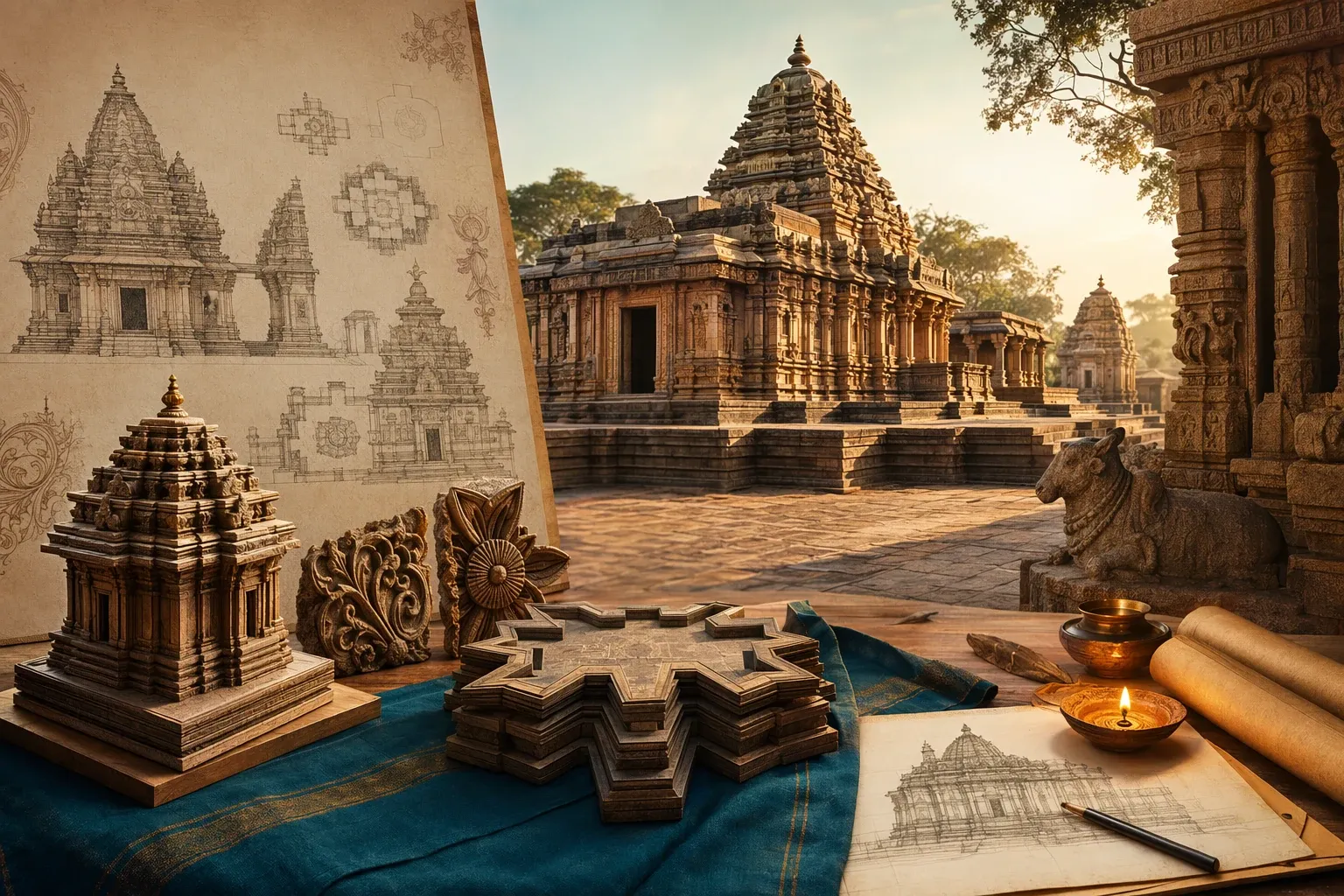
Vesara temple architecture is usually introduced in one line: a blend of Nagara and Dravida styles. That line is useful, but it is also a little too neat. The temples of the Deccan were not made by architects sitting with two boxes labelled “north” and “south.” They were made by skilled builders working across regions, dynasties, materials and sacred traditions, especially in Karnataka and nearby areas.
The Deccan sits between northern and southern India, so it naturally became a meeting ground. Ideas travelled through royal courts, pilgrimage routes, artisan families and political contact. The result was not a simple mixture, but a rich architectural language seen in Chalukya, Rashtrakuta and Hoysala monuments.
A style born in the middle zone
In many accounts, Vesara refers to temple forms that developed in the Deccan, especially between the Vindhyas and the Krishna-Tungabhadra region. Some older architectural texts use the term, while modern scholars debate exactly how broadly it should be applied. This is important: “Vesara” is a helpful teaching word, but real temples are often more experimental than textbook categories.
The Deccan was never culturally empty space between north and south. It had its own dynasties, languages, religious centres and artistic workshops. The Badami Chalukyas, Western Chalukyas and Hoysalas all created temples that look related to larger Indian traditions but also unmistakably local.
That is why some historians prefer more precise terms such as Early Chalukya, Later Chalukya, Karnata Dravida or Hoysala architecture. For a beginner, though, Vesara remains a useful doorway into the Deccan’s temple world.
What does “blend” actually mean?
When people say Vesara blends Nagara and Dravida, they usually mean that the temple may combine a southern-style plan or base with tower forms, wall treatment or decorative ideas associated with northern styles. But this does not happen in the same way everywhere. One temple may have a curving tower form; another may have a stepped or layered superstructure; another may focus on star-like plans and sculptural surfaces.
Think of Vesara less as a recipe and more as a workshop culture. Builders borrowed, adjusted and invented. They were comfortable with experimentation. A temple could be compact but highly decorated. It could use a plan that creates many projections and recesses, making light and shadow play across the wall. It could place sculpture not only as decoration but as part of the architectural rhythm.
This is why Deccan temples often reward slow looking. The overall outline may seem small compared with a giant South Indian gopuram, but the surface detail can be astonishingly dense.
Chalukya experiments at Aihole, Badami and Pattadakal
Aihole, Badami and Pattadakal in Karnataka are essential for understanding the early Deccan imagination. These sites show builders testing forms in stone: rock-cut caves, structural temples, different roof types, shrine plans and sculptural programmes. Aihole is sometimes called a laboratory of temple architecture because of its variety.
Pattadakal is especially famous because it brings northern and southern forms into close conversation. The site has 7th- and 8th-century temples connected with the Chalukyas. UNESCO has described Pattadakal as a harmonious blend of architectural forms from northern and southern India. The Virupaksha temple there is often discussed for its southern affinities, while other monuments show different experiments.
For a young reader, Pattadakal is the best place to understand that “Indian temple style” was not one straight line. It was a network of choices. Patrons wanted prestige, artists wanted expression, and sacred stories needed space in stone.
Rashtrakuta ambition at Ellora
The Rashtrakuta period gives us one of the most dramatic monuments in India: the Kailasanatha temple at Ellora. It is rock-cut, carved downward from a single mass of basalt, yet it imitates a structural temple complex. This makes it unusual in any simple style chart.
Ellora’s Kailasa shows Deccan ambition at full power. It connects mythology, royal authority and technical skill. The temple evokes Mount Kailasa, the sacred abode of Shiva, while also displaying sculptural panels and architectural forms that speak to wider Indian traditions. It reminds us that categories like Nagara, Dravida and Vesara are study tools, not cages.
Hoysala temples and the beauty of detail
When many people think of Vesara today, they picture Hoysala temples in Karnataka: Belur, Halebid and Somnathpura. These temples are famous for star-shaped or highly articulated plans, soapstone carving, polished pillars, bracket figures, narrative bands and jewel-like detail.
The Chennakeshava temple at Belur, the Hoysaleswara temple at Halebid and the Keshava temple at Somnathpura show how far Deccan architecture could move toward sculptural richness. Their walls are not plain surfaces. They turn in and out, creating many angles for carving. Horizontal bands may show elephants, horses, scrolls, epic scenes and deities. The eye keeps travelling.
Hoysala temples also show that scale is not the only measure of grandeur. A temple may be smaller than a huge Chola or Nayaka complex, yet feel immense because every inch carries craft.
Materials shaped the look
Architecture is not only an idea; it is also stone, tool and hand. Many Hoysala temples use chloritic schist, often called soapstone, which is softer when quarried and allows fine carving. This material helped artists create delicate ornaments, jewellery details, ceiling patterns and expressive figures.
Earlier Chalukya sites often used sandstone, giving a different texture and strength. Rock-cut monuments such as Badami and Ellora required yet another skill set. So when we compare temple styles, we should ask: what material was available, and what did it allow artists to do?
Common features to notice
In Deccan or Vesara-related temples, look for compact shrine plans, projections on the wall, rich carving, carefully shaped pillars, mixed tower forms and strong narrative sculpture. You may also see multiple shrines in one temple layout, such as trikuta plans with three sanctums. In Hoysala temples, the jagati or raised platform often allows devotees to walk around the shrine while viewing the outer carvings closely.
Also notice the ceiling. Many visitors look only at walls, but Deccan temples often have beautiful ceiling panels, lotus forms and carved domes inside mandapas. The sacred experience is meant to surround the devotee: below, around and above.
Why Vesara matters
Vesara matters because it breaks the lazy idea that Indian art has only two directions: north and south. The Deccan created its own solutions. It absorbed influences, but it did not merely copy. It produced temples that are experimental, local and deeply sophisticated.
It also teaches us how culture works. Traditions meet, but they do not simply merge into a bland mix. They argue, adapt and become something fresh. A Chalukya temple at Pattadakal and a Hoysala temple at Halebid both belong to the Deccan story, yet they do not look identical. That difference is the point.
Questions people often ask
Is Vesara just a hybrid of Nagara and Dravida?
It is often taught that way, but the better answer is that Vesara describes Deccan temple traditions that selectively combine, adapt and transform features associated with northern and southern architecture.
Which Deccan temples show the style clearly?
Pattadakal’s Chalukya temples, Badami and Aihole monuments, Ellora’s Kailasanatha temple, and Hoysala temples at Belur, Halebid and Somnathpura are useful examples for understanding the Deccan range.
Why do scholars debate the term?
Because historical texts and modern usage do not always match neatly. Some scholars prefer dynasty- or region-specific labels. Still, Vesara remains helpful for beginners if we use it carefully and avoid forcing every Deccan temple into one fixed box.
Vesara is best remembered as the architecture of intelligent exchange. It stands in the middle, not as a compromise, but as a confident creative zone where Indian temple builders turned contact into beauty.