
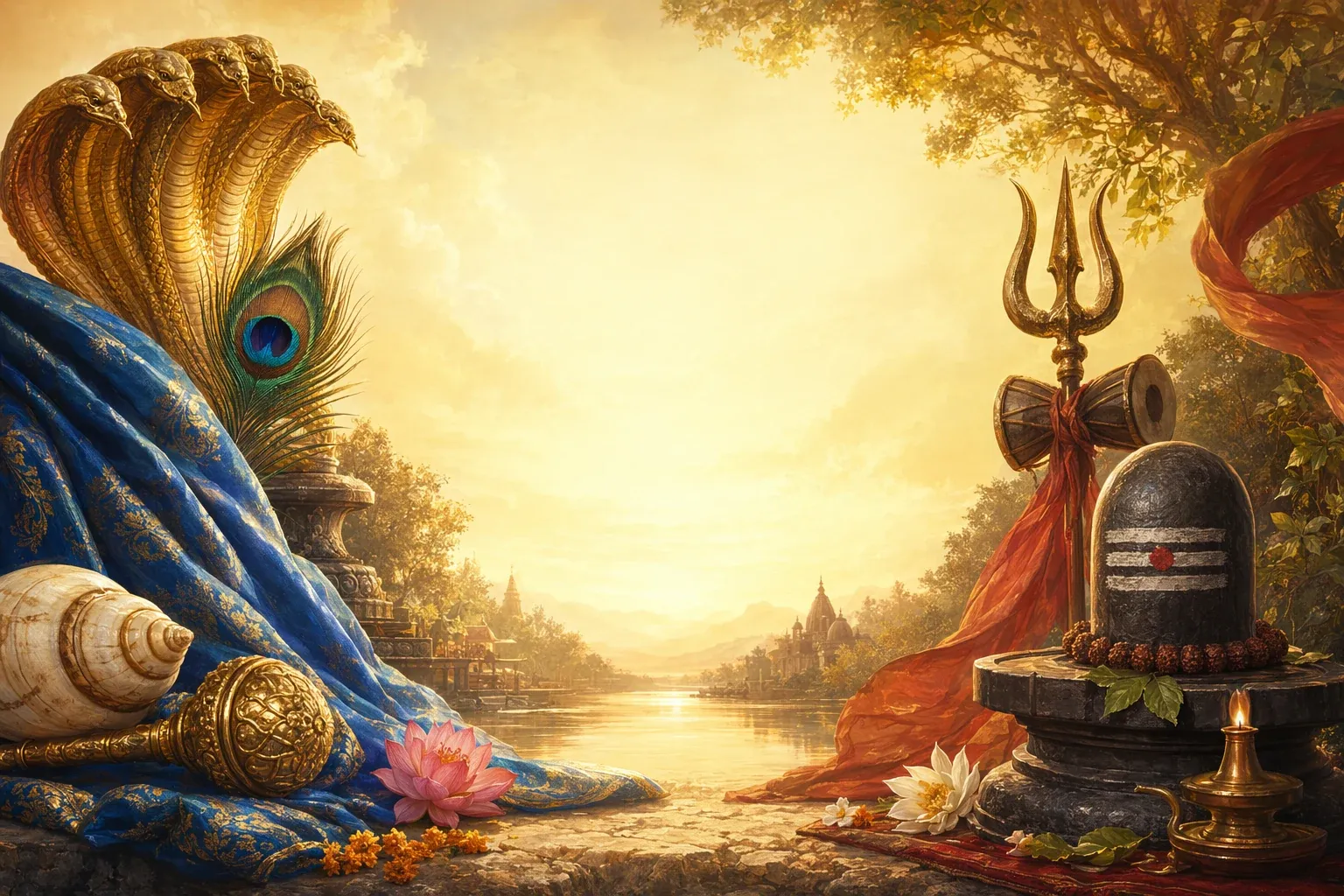
Questions about Vishnu and Shiva often get framed too sharply: are they the same, friends, or rivals? Hindu tradition gives a richer answer. Some devotees worship Vishnu as supreme. Some worship Shiva as supreme. Some understand both as forms of one ultimate reality. Many simply honour both with love.
Why the rivalry idea is too small
Stories sometimes show tension between divine beings, but sacred stories use drama to teach. They are not invitations for devotees to insult one another. The rivalry idea becomes harmful when it turns devotion into competition.
In lived Hindu practice, many families worship both Vishnu and Shiva. A person may visit a Shiva temple on Monday, chant Vishnu’s names on Ekadashi, celebrate Krishna Janmashtami, and still offer water to a Shiva linga with reverence. Devotion is often more generous than debate.
Vaishnava and Shaiva viewpoints
Vaishnava traditions place Vishnu, Narayana, Krishna, Rama, or related forms at the centre. Shaiva traditions place Shiva at the centre. Each tradition has scriptures, saints, temple practices, philosophy, poetry, and deep devotion.
This does not mean one must mock the other. Mature traditions explain their chosen deity as supreme while still recognising the sacredness of other forms. The language of supremacy is often the language of love: the devotee sees the beloved Lord as complete.
The one reality viewpoint
Many Hindu thinkers speak of one ultimate reality appearing through many names and forms. From this viewpoint, Vishnu and Shiva are distinct in worship but not separate in the deepest truth. The difference is real for devotion, while unity is real at the highest level.
A helpful comparison is light through different lamps. The lamps differ, the colours and settings differ, and the worship experience differs. Yet the sacred light is not divided in the way ordinary objects are divided.
Stories of mutual honour
There are many stories in which Vishnu and Shiva honour one another. Shiva worships Rama in some traditions. Vishnu praises Shiva in others. Harihara, a combined form of Vishnu and Shiva, visually teaches unity by joining both forms in one body.
These stories ask devotees to move beyond sectarian pride. If the deities honour each other, devotees should be careful about speaking with contempt.
Difference can be meaningful
Respecting unity does not require erasing difference. Vishnu is often associated with preservation, order, avatars, and sustaining dharma. Shiva is often associated with transformation, ascetic power, dissolution, meditation, and grace beyond convention. These are not enemies. Life needs both preservation and transformation.
A seed must be preserved to grow, but old forms must also change. A society needs order, but the ego needs to be dissolved. Vishnu and Shiva can therefore be understood as complementary sacred powers.
How beginners can approach both
If you are new, start with respect. Learn each deity through the tradition that loves him. Read a Vishnu story as a Vishnu devotee might read it. Read a Shiva story as a Shiva devotee might read it. Do not rush to flatten everything into one sentence.
For a broader frame, you may also enjoy Kalki Avatar explained and Bhaktilipi’s guide to common Hindu yantras.
A balanced answer
So, are Vishnu and Shiva the same? In some philosophical views, they are forms of one ultimate reality. Are they different? In worship, stories, temples, and devotional moods, yes. Are they rivals? That is the weakest reading. It misses the generosity of the tradition.
A respectful beginner answer is this: Vishnu and Shiva can be honoured as distinct divine forms, as mutually reverent powers, and as expressions of one sacred reality, depending on the tradition you are standing in.
How to avoid sectarian reading
A beginner should be careful with online arguments that turn Vishnu and Shiva into team labels. Sacred traditions are deeper than fan rivalry. Vaishnava and Shaiva saints often speak with intense love for their chosen deity, but that intensity is not the same as permission to insult another path.
A respectful reader asks: what is this tradition trying to reveal through its beloved form? Vaishnava poetry may reveal the sweetness of surrender to Narayana or Krishna. Shaiva poetry may reveal the grace of Shiva who dissolves bondage. Both can deepen reverence.
Harihara and shared devotion
The image of Harihara, half Vishnu and half Shiva, is a powerful reminder that Hindu imagination can unite what debate separates. One side carries Vishnu’s marks, the other Shiva’s. The form does not erase either deity. It honours both while pointing to a unity beyond ordinary division.
Shared devotion also appears in everyday life. Many people keep images of several deities at home. They may have a family deity, a personal favourite, and festival practices for others. This lived reality is often more balanced than theoretical arguments.
A practical answer for beginners
If someone asks whether they must choose between Vishnu and Shiva, the simplest answer is no, not unless a particular tradition or personal vow leads them that way. You can learn respectfully, worship sincerely, and allow each form to teach you.
Vishnu may teach steadiness, preservation, and loving order. Shiva may teach renunciation, transformation, and freedom from ego. A wise beginner receives both lessons with humility. The real danger is not choosing the wrong side; it is losing reverence.