
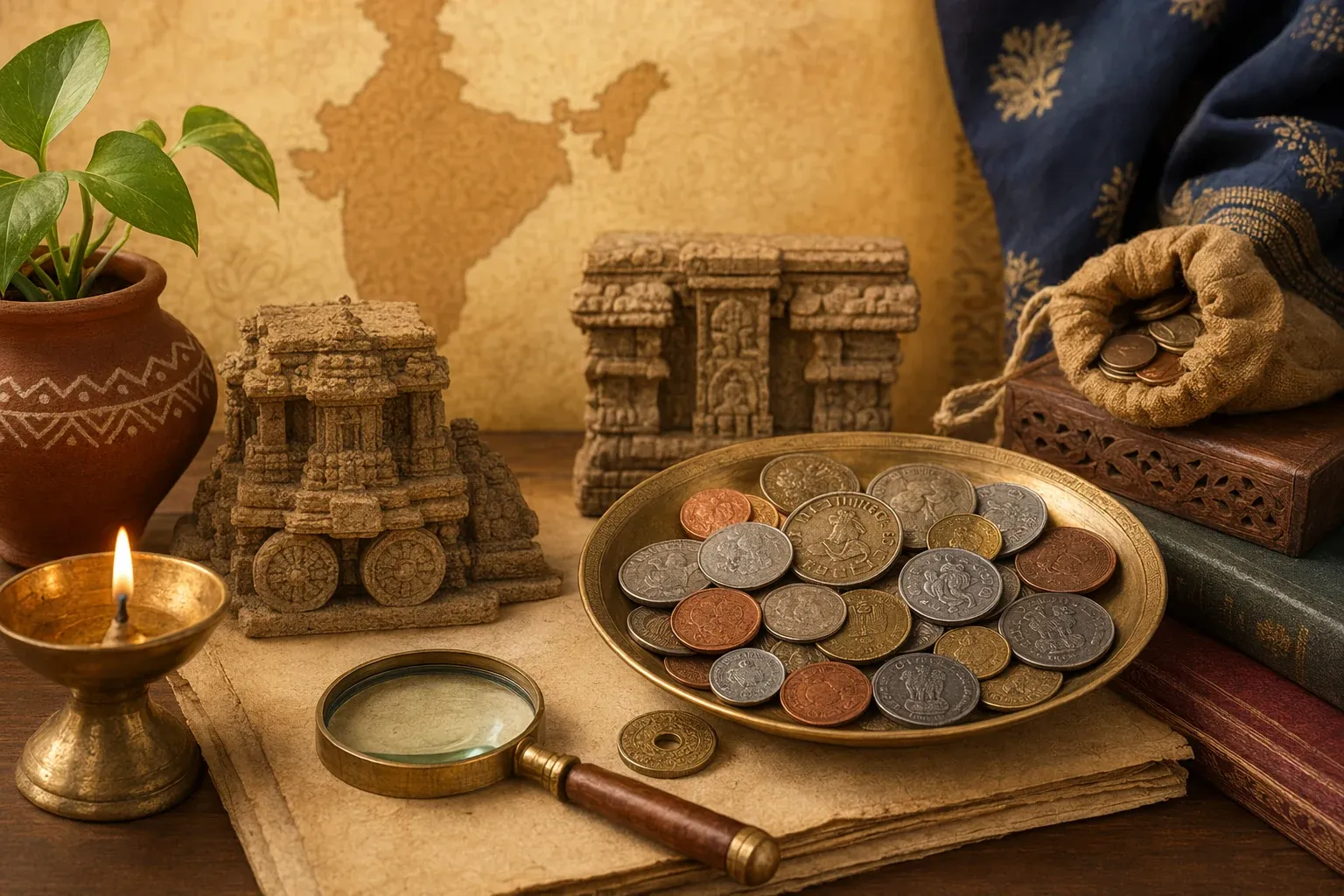
Indian coins are pieces of money, but they are also small records of power, trade, language, belief, technology, and everyday life. A coin can tell us who issued it, what metal was available, which symbols mattered, what script was used, and how people imagined authority. In India, coins have travelled through ancient kingdoms, empires, sultanates, colonial rule, princely states, and the modern republic. For a beginner, the subject may look complex, but it becomes friendly when we begin with simple questions: who made the coin, what is it made of, what is written on it, and how was it used?
Coins differ from medals and tokens because they are issued as money by an authority accepted in a particular economy. That authority may be a king, empire, colonial government, princely state, or modern nation. Coins have value because people agree to use them, and because the issuing power stands behind them. Sometimes the metal itself was valuable, as with gold or silver coins. In modern coins, the face value usually depends more on law and trust than on the metal content.
Ancient beginnings: punch-marked coins
Some of the earliest Indian coins are known as punch-marked coins. They were often made of silver and carried symbols punched onto the surface rather than a fully struck design with a portrait. These marks could include geometric signs, animals, trees, hills, sun-like symbols, or other motifs. They are associated with early historic trade and political formations.
For beginners, punch-marked coins show that money did not always look like today’s round, portrait-bearing coin. Their irregular shapes and multiple symbols reflect an early monetary world where weight, metal, and marks mattered. They also remind us that coins were part of expanding trade networks, urban growth, and state formation.
Coins of kingdoms and empires
As Indian political history changed, coins became more varied. Indo-Greek coins introduced portraiture and bilingual inscriptions in some regions. Kushan coins displayed rulers and a range of deities, reflecting cultural exchange across Central and South Asia. Gupta coins, especially gold types, are admired for their artistry, royal imagery, and inscriptions. They can show kings performing rituals, holding weapons, or appearing with divine symbols.
In south India, dynasties such as the Cholas, Pandyas, Cheras, and later Vijayanagara rulers issued coins with regional symbols, scripts, and religious imagery. Coins may show tigers, fish, bows, deities, temple emblems, or stylised marks. The variety is enormous because India was never one simple monetary zone for most of its history.
Sultanate, Mughal, and regional coinage
Medieval Indian coins include issues of the Delhi Sultanate, regional sultanates, the Mughals, Marathas, Rajputs, Sikhs, and many local powers. Islamic coinage often emphasised inscriptions, ruler names, titles, mint names, and dates, sometimes with elegant calligraphy. Mughal coins are especially important for their silver rupees, gold mohurs, and copper dams, as well as for their refined inscriptions.
The word rupee is historically linked to a silver coin standard associated with Sher Shah Suri and later Mughal monetary practice, though the story has many layers. Over time, the rupee became one of the most important units of money in the subcontinent. Regional powers often struck coins in their own names or in the name of a recognised emperor, depending on political circumstances.
Colonial and princely state coins
Under European trading companies and later British rule, Indian coinage changed again. The East India Company issued coins in different presidencies before more standardised coinage developed. British Indian coins often show the monarch on one side and denomination, date, and design on the other. These coins help beginners understand the shift toward machine-made uniform currency.
Princely states also issued coins, sometimes with local scripts, symbols, and ruler names. Collectors often find this area fascinating because it preserves regional authority within a larger colonial framework. Coins from states such as Hyderabad, Travancore, Baroda, Jaipur, Kutch, and others show how political identity could survive in metal.
Coins of independent India
After independence, India created coinage for the republic. Early coins used the Lion Capital of Ashoka as a state emblem and denominations in annas, pice, and rupees before decimalisation. In 1957, India moved to a decimal system, where one rupee became 100 paise. Early decimal coins were sometimes marked naye paise, meaning new paise, to help people adjust.
Modern Indian coins have changed in size, shape, metal, and design. Denominations such as 1, 2, 5, 10, and 20 rupees have circulated at different times, along with paise coins that are now rarely seen in everyday use. Designs may include the Ashoka emblem, denomination numerals, agricultural motifs, national integration themes, commemorative subjects, and mint marks.
What to notice on a coin
A beginner should look at both sides of a coin carefully. Notice the denomination, date, script, symbols, portrait or emblem, edge, weight, and metal colour. On modern Indian coins, the mint mark is especially useful. It can indicate where the coin was minted. Marks differ by mint, such as Mumbai, Kolkata, Hyderabad, and Noida. Kolkata coins traditionally may have no mint mark, while other mints use symbols such as a diamond, star, or dot in many issues.
Condition matters too. A coin with heavy wear may have lower collector value, although it can still be historically interesting. Cleaning coins harshly is usually a mistake because it can damage surfaces and reduce value. If you find an old coin, handle it by the edge and store it safely.
Circulating coins and commemorative coins
Circulating coins are made for everyday transactions. Commemorative coins mark events, personalities, institutions, anniversaries, or national themes. India has issued many commemorative coins, some for circulation and some in collector sets. A coin may carry the image or name of a leader, saint, scientist, cultural figure, movement, or institution.
Commemorative does not automatically mean rare or highly valuable. Many commemorative coins were produced in large numbers. Value depends on mintage, condition, demand, metal, errors, and authenticity. Beginners should be cautious of exaggerated claims, especially online.
Coin collecting without confusion
Numismatics is the study or collection of coins, paper money, tokens, and related objects. A beginner can start simply: collect coins by denomination, year, mint mark, theme, metal, or historical period. Modern Indian coins are a friendly starting point because they are accessible. From there, one can learn about colonial coins, princely states, Mughal rupees, ancient punch-marked coins, or regional types.
Keep basic records: where you got the coin, date, denomination, mint mark, condition, and any known story. Use coin holders or albums that do not damage metal. Avoid buying expensive coins without learning authentication basics or consulting trustworthy dealers. Counterfeits exist, especially for rare or high-value pieces.
Coins as cultural objects
Indian coins are useful because they bring history into the hand. A temple symbol, Persian inscription, royal portrait, Ashoka emblem, wheat motif, or national commemorative design can lead to wider questions. What language did the authority use? Which symbols built trust? What metal was affordable? How did trade move? Who was meant to recognise the design?
For readers interested in sculpture and symbols, Bhaktilipi’s guide to key features of Indian sculpture offers another way to read visual signs from Indian art. Coins are much smaller than sculptures, but both use images to communicate authority and meaning.
A simple way to begin
Start with coins you already have at home. Sort them by denomination and year. Look for mint marks. Compare older and newer versions of the same value. Notice how the 1 rupee coin changed in material, size, and design over time. Then read about one older period, such as Mughal rupees or punch-marked coins, rather than trying to learn everything at once.
Indian coins are small, durable witnesses. They passed through markets, pockets, temple donations, railway counters, shops, and family boxes. Studying them teaches patience and attention. A coin may seem ordinary until you ask the right questions; then it becomes a doorway into India’s political, economic, and artistic past.