
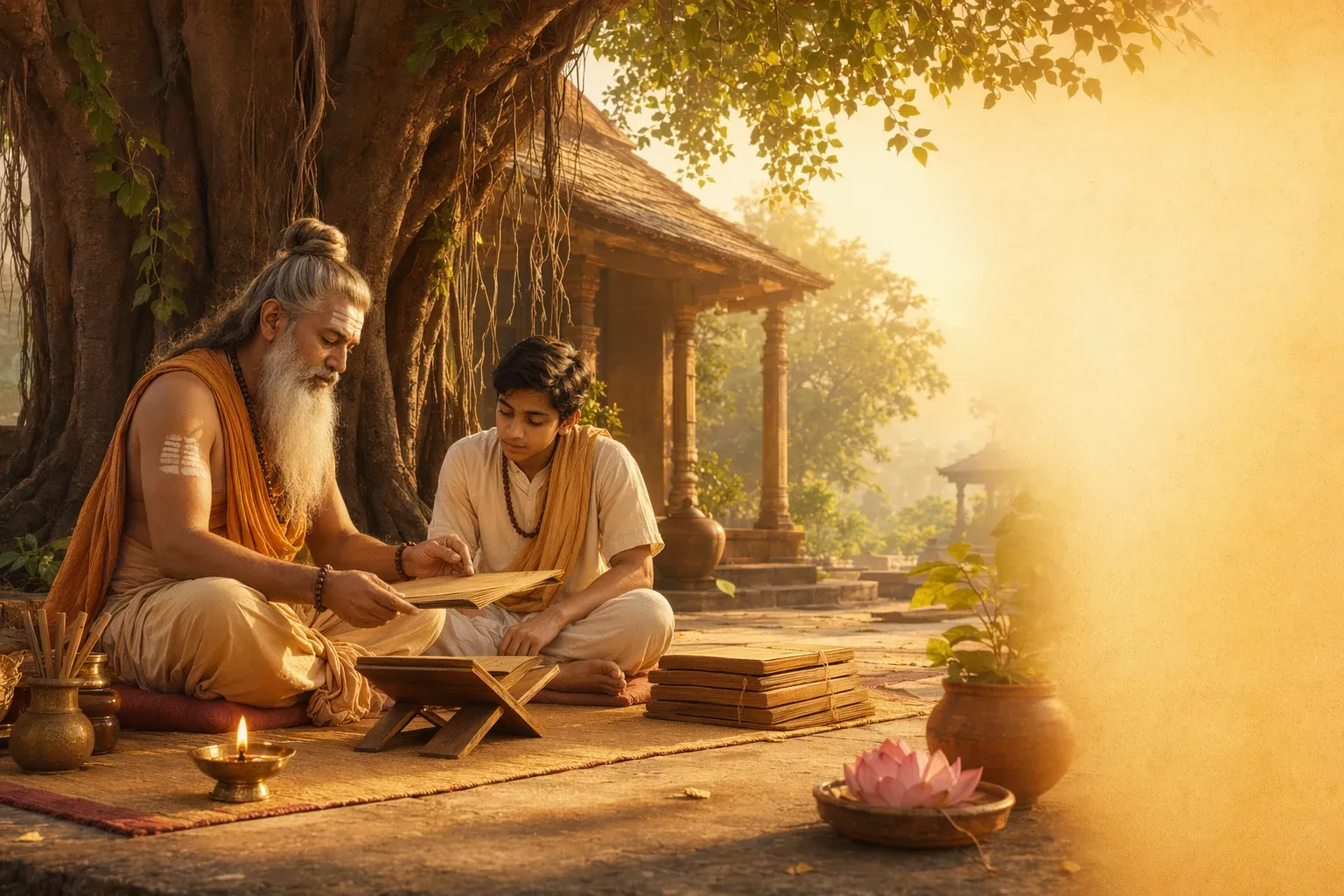
Guru Shishya Parampara sounds like a grand phrase, but the basic idea is easy to understand. A guru is a teacher who carries knowledge through study, practice and lived discipline. A shishya is a learner or disciple who receives that knowledge with attention, humility and effort. Parampara means a continuing line or tradition. Put together, Guru Shishya Parampara means a teacher-student lineage in which knowledge is passed from one generation to another through close learning.
This tradition is often connected with spiritual education, but it is not limited to temples or scriptures. In India, similar teacher-student relationships shaped Vedic chanting, Vedanta, yoga, classical music, dance, Ayurveda, crafts, martial arts and many other skills. The common thread is not just information. It is training of the mind, body, voice, character and judgement.
The meaning of guru, shishya and parampara
The word guru is commonly understood as a teacher, guide or mentor. In many Hindu traditions, the guru is respected because they help remove confusion and guide the learner toward knowledge. But respect does not mean blind obedience. A true teacher also carries responsibility: to teach honestly, correct kindly, live with integrity and not misuse the learner’s trust.
A shishya is more than a student sitting in a class. The shishya learns by listening, repeating, asking, observing and practising. In an older setting, the learner might live near the teacher or spend long hours in the teacher’s environment. In a modern setting, the same spirit can appear when a music student practises one raga for months, a yoga student learns posture with breath and restraint, or a craft apprentice watches how a master handles tools.
Parampara means continuity. It says that knowledge is not floating alone. It comes through people, memory, practice and responsibility. In Indian classical music, for example, a gharana may preserve a special way of singing or playing. In Vedic recitation, oral methods protect sound, accent and sequence. In philosophy, commentaries and conversations keep older ideas alive while allowing new questions.
Why learning was often personal
Before printing, recordings and online classes, many forms of knowledge had to be learned directly. A book can carry words, but it cannot fully show tone, timing, pronunciation, posture, breath, touch or emotional control. That is why close teaching mattered. The learner could hear how a mantra was chanted, how a note curved in a raga, how a hand moved in sculpture, or how a question was handled in debate.
UNESCO’s note on the tradition of Vedic chanting gives a good example. It describes how Vedic verses were traditionally transmitted orally and how learners were taught complex recitation methods so that sound, accent and pronunciation stayed as accurate as possible. This does not mean every Indian tradition worked in exactly the same way. It shows why careful person-to-person training became so important in some knowledge systems.
Gurukul, ashram and other learning spaces
Many people imagine Guru Shishya Parampara only as a gurukul in a forest. That image comes from real memories of residential learning, but it is only one part of the story. A gurukul usually refers to a place where learners lived with or near the teacher, helping with daily life and studying as part of a disciplined routine. The aim was not simply to pass exams. Learning included habits, service, attention, self-control and respect for knowledge.
Across India, learning also happened in homes, monasteries, mathas, temples, courts, village spaces, akharas, music houses and artisan families. A Sanskrit student, a Buddhist monk, a veena player, a temple architect and a wrestler may not have shared the same schedule, but all could depend on long practice under guidance. So it is better to think of Guru Shishya Parampara as a family of learning models, not one single school design.
A simple example from everyday learning
Imagine a tabla student learning a new composition. The teacher does not only say, “Here are the beats.” The teacher may clap the tala, recite the bols, correct the student’s wrist movement, ask them to repeat slowly, and then explain when the composition should be used. The student learns sound, timing, discipline and taste. The same pattern appears in Bharatanatyam abhinaya, Hindustani vocal training, Vedic recitation, yoga practice and even traditional crafts such as weaving or bronze casting.
This is why the tradition values patience. Some knowledge cannot be rushed. A learner may understand a sentence in one day but take years to embody it well. The teacher’s role is to protect depth; the student’s role is to keep practising without arrogance.
Spiritual tradition and historical context
In spiritual literature, the guru is often treated with deep reverence. Texts and stories describe the teacher as a guide who helps the learner cross ignorance. The Upanishadic image of sitting near a teacher reminds us that learning was dialogic: questions, silence, examples and direct instruction mattered. The Bhagavad Gita is also remembered through the conversation between Krishna and Arjuna, though that is a sacred narrative rather than a normal classroom scene.
Historically, we should be careful not to make one neat claim about all of India. Different regions, castes, communities, sects and periods had different access to education. Some lineages were open in certain ways and restricted in others. Some teachers were householders, some renunciants, some performers, some scholars, some artisans. A respectful view accepts the beauty of the tradition without pretending it was identical everywhere or perfect for everyone.
What the tradition can mean today
Today, most learners go to schools, colleges or online courses. That is not the opposite of Guru Shishya Parampara. The old model can still teach us three useful things. First, learning becomes deeper when there is regular practice, not only quick content. Second, a good mentor notices details that a video cannot notice. Third, knowledge should shape character: patience, honesty, humility and responsibility matter.
At the same time, modern learners should keep healthy boundaries. Respect for a teacher should never remove personal safety, questioning, consent or accountability. A real guru or mentor does not demand worship for ego. They help the student grow stronger, clearer and more responsible.
Questions people ask
What is Guru Shishya Parampara?
It is the Indian teacher-student lineage in which knowledge, skill and discipline are passed from a guru to a shishya through close guidance, practice and continuity.
What is the meaning of guru shishya?
Guru means teacher or guide, while shishya means student or disciple. Together, the phrase points to a learning relationship built on trust, effort and responsibility.
Is it only about religion?
No. It is important in spiritual traditions, but similar mentor-disciple learning also appears in music, dance, yoga, crafts, martial arts and other knowledge systems.
In one line: Guru Shishya Parampara is not just an old educational custom. It is India’s reminder that real learning is carried by people, practice, memory and character.