
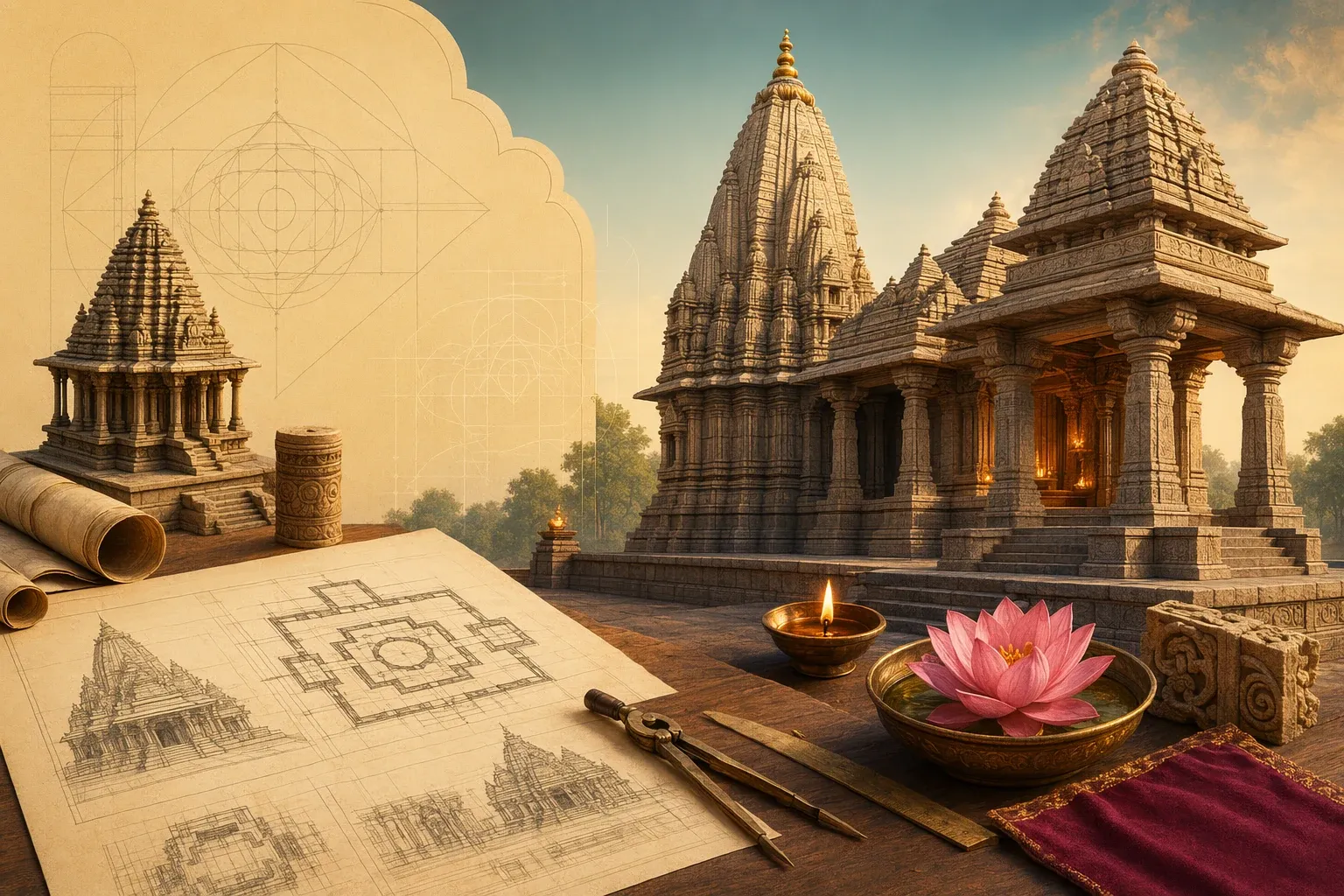
Indian temple architecture can feel overwhelming at first. There are Sanskrit terms, regional styles, dynasties, sculptures, towers, gateways, tanks, and long histories attached to almost every famous temple. But the basic idea is beautifully simple: a temple is designed as a sacred place where a devotee moves from the ordinary world toward the presence of the deity.
That is why a Hindu temple is not planned like a normal hall or monument. Its rooms, tower, pathway, images, doors and outer walls all work together. Some parts are practical, like a mandapa where people gather. Some are symbolic, like a mountain-like tower rising above the sanctum. Some are regional, shaped by local stone, climate, dynasties and craft traditions. Once you understand these layers, temples become much easier to read.
The heart of the temple
The most important space in many Hindu temples is the garbhagriha, literally the “womb chamber”. This is the sanctum where the main image or symbol of the deity is placed. In many temples it is small, dark and inward-facing. That is not a weakness of design. It creates a feeling of concentration. The devotee is not meant to treat it like a museum gallery; the space points attention toward darshan, the act of seeing and being seen by the deity.
In front of the sanctum there is often an antarala, a small vestibule, and then a mandapa, a pillared hall. The mandapa may be modest in an early shrine or large and richly carved in later temples. In some places it becomes a space for music, recitation, festival movement, teaching or community gathering. The temple is therefore both intensely sacred and socially alive.
Towers, gateways and the sense of ascent
One of the easiest ways to recognise temple architecture is to look upward. In many north Indian temples, the tower above the sanctum is called a shikhara. In many south Indian temples, the tower over the sanctum is called a vimana. These terms are not just labels. They tell us how different regions imagined sacred height.
A Nagara temple of north India often has a curving shikhara that rises like a mountain peak. A Dravida temple of south India usually has a stepped, pyramidal vimana. In many later south Indian temple towns, the most dramatic vertical feature may be the gopuram, the tall gateway tower at the entrance of the enclosure. So when someone says “temple tower”, the next question should be: which region, which period, and which part of the temple?
Three style families beginners should know
Indian temple architecture is often introduced through three broad style families: Nagara, Dravida and Vesara. This is a useful map, but it should not be treated like a rigid box. Real temples are shaped by local workshops, royal patronage, materials, older sacred sites and changing ritual needs.
Nagara is mostly associated with northern India. Common clues include a sanctum under a rising shikhara, a raised platform in many examples, and less emphasis on huge enclosing gateways than in the south. Khajuraho in Madhya Pradesh, the Sun Temple at Modhera in Gujarat, and many Odisha temples show important Nagara-related developments, though each region has its own vocabulary.
Dravida is associated with south India. It often includes an enclosure wall, a central axis through gateways, a pyramidal vimana, dvarapalas or guardian figures, subsidiary shrines and sometimes a temple tank. Pallava monuments at Mamallapuram, Chola temples such as Brihadeshwara at Thanjavur, and later temple towns like Madurai show how this tradition expanded over time.
Vesara is usually discussed in relation to the Deccan, especially Karnataka and nearby regions. It is often described as a creative meeting of northern and southern ideas, but that phrase can be too simple. Chalukya, Rashtrakuta and Hoysala builders did not merely mix two formulas; they experimented with plans, pillars, ceilings, star-shaped platforms and sculptural surfaces. Aihole, Pattadakal, Belur, Halebid and Somnathpura are good places to begin.
Stone, region and dynasties mattered
Temples look different across India because India itself is not one landscape. Rock-cut cave temples, structural stone temples and later temple towns each need to be read in their own material context. In some regions builders used sandstone; elsewhere granite, schist, basalt, chlorite, brick or laterite were more available. A Chola granite temple in Tamil Nadu does not feel like a finely carved Hoysala soapstone temple in Karnataka. A terracotta temple in Bengal expresses a different material world from a stone temple at Khajuraho.
Royal dynasties also shaped temple design. The Guptas are important in the history of early structural temples. The Chandelas are strongly associated with Khajuraho. The Pallavas developed major rock-cut and structural works in Tamil country. The Cholas built on a grand stone scale, with inscriptions that also tell us about gifts, administration and ritual life. The Hoysalas created highly detailed temple surfaces in Karnataka. Each dynasty used architecture to express devotion, power, memory and artistic skill.
Sculpture is part of the architecture
Many beginners separate “architecture” and “sculpture”, but in Indian temples they are deeply connected. Sculptures appear on walls, pillars, doorframes, ceilings and exterior projections. Some images are devotional, showing deities and their stories. Some are protective, like dvarapalas at entrances. Some are auspicious, such as river goddesses or couples. Some show dancers, musicians, warriors, animals, floral patterns and scenes from everyday imagination.
This does not mean every sculpture has one secret meaning. A temple wall is more like a sacred visual world. Tradition, local storytelling, patron taste and craft practice all meet there. The safest way to understand it is to ask: where is this image placed, what deity or story is it connected with, and what period or region produced it?
Sacred symbolism without exaggeration
Temple design is often interpreted symbolically. The rising tower may suggest a mountain. The plan may relate to ideas of cosmic order, direction and sacred geometry. The movement from outer space to sanctum can feel like an inward journey. These are meaningful ways to experience temple architecture, especially within Hindu traditions of worship.
At the same time, we should avoid turning every detail into a dramatic miracle claim. Temples were built by human communities: architects, sculptors, donors, kings, priests, workers and devotees. Their achievement becomes more impressive, not less, when we respect the real craft, planning and historical context behind it.
A beginner’s way to read any temple
When you visit or study a temple, begin with five questions. First, where is the sanctum and what deity is central? Second, what is above the sanctum: a shikhara, a vimana or another form? Third, how does a visitor move from entrance to deity? Fourth, what regional clues do you see in the material, tower, gateway, wall and sculpture? Fifth, what examples from history help place it: Gupta, Pallava, Chola, Chandela, Chalukya, Hoysala, Vijayanagara or another tradition?
With these questions, temple architecture stops being a list of difficult words. It becomes a living map of Indian art, devotion and regional creativity. A temple is a place of worship, but it is also a record of how people imagined sacred space in stone, brick, wood, sculpture and movement across many centuries.
What is Indian temple architecture?
Indian temple architecture is the design tradition of temples in India, especially the way sacred spaces are planned around the deity, devotee movement, towers, halls, sculpture and regional building styles. It includes famous Hindu temple forms such as Nagara, Dravida and Vesara, along with many local variations.
What is Hindu temple architecture?
Hindu temple architecture refers to temple design connected with Hindu worship and sacred symbolism. Its core spaces often include the garbhagriha for the main deity, a mandapa for gathering, a tower such as shikhara or vimana, and sculptural programmes linked to deities, stories, guardians and auspicious imagery.