
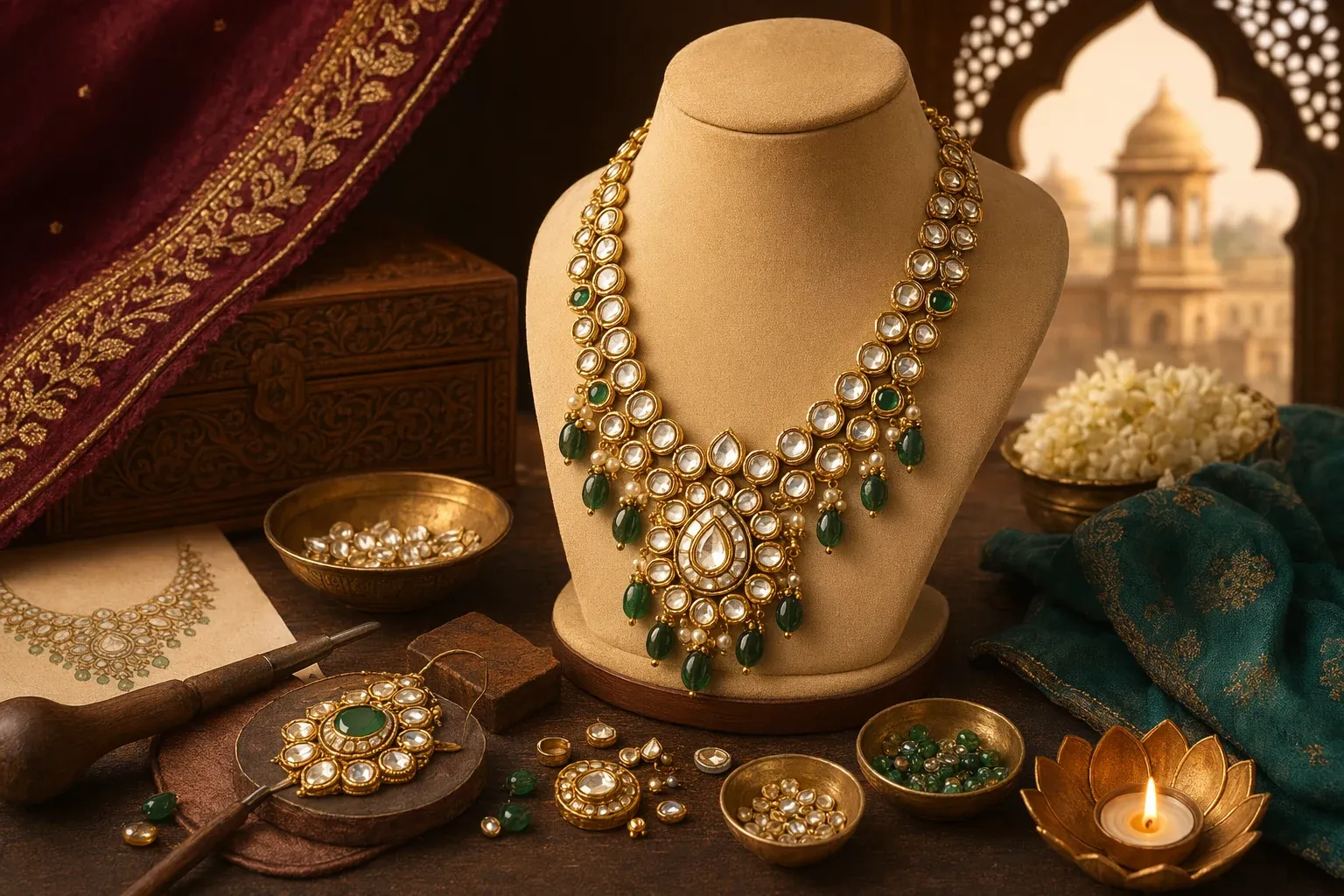
A Kundan necklace is easy to recognise in wedding photos, but harder to explain in one line. It is not only “a heavy bridal necklace” or “a royal-looking set”. Kundan refers to a style of setting stones with highly refined gold, and the finished piece often carries a soft glow that feels different from modern claw-set jewellery. This guide keeps the craft, history and buying vocabulary simple for beginners.
If you are comparing necklace names while shopping or studying costume history, keep this guide beside Traditional Indian Necklace Types: Chokers, Haar, Kundan, and More, What Is Traditional Indian Jewellery? A Beginner Guide, and Types of Indian Jewellery Explained Simply because Kundan is one craft style within a much larger Indian jewellery vocabulary.
Kundan is a setting, not just a necklace shape
A Kundan necklace is a necklace made using the Kundan style of gemstone setting, where stones are held in place with highly refined, soft gold. In everyday shopping language, people use “Kundan necklace” for a broad family of Indian bridal and festive necklaces with a royal look: uncut-looking stones, enamel backs, pearls, red and green accents, and a glowing gold frame. But the most important point is this: Kundan is not only a design mood. It is a jewellery-making technique.
The Victoria and Albert Museum describes Kundan as pure, soft, 24-carat gold used by Mughal court goldsmiths to set precious stones into complex designs, sometimes even into fragile enamelled surfaces, jade, or crystal. That tells us why the technique is admired. Instead of using obvious claws like many modern settings, the gold is worked around the stone. The result can look smooth, rich, and almost painted with light.
How a Kundan piece is made
The making of a traditional Kundan piece usually involves several specialists. A framework is prepared, the design is shaped, a base or lac support may be used, stones are placed, and thin strips of soft gold are pressed around them. The back may carry meenakari, or enamel work, often with floral colours that only the wearer sees closely. This hidden back decoration is one reason Kundan jewellery feels luxurious: even the unseen side receives attention.
In a necklace, the central pendant, side units, borders, and drops may all be built from many small settings. Pearls or beads may hang from the lower edge. The stones may include diamonds, rubies, emeralds, sapphires, glass, crystal, or synthetic stones depending on budget and authenticity. So two necklaces can both be called Kundan while belonging to very different quality levels.
The Mughal and Rajasthan connection
Kundan is strongly associated with Mughal court taste and with jewellery centres such as Jaipur. Mughal-period jewellery loved symmetry, flowers, fine stone setting, enamel, and luxury objects that looked beautiful from every side. Rajasthan, with its courtly traditions and skilled jewellery workshops, became one of the great homes of Kundan and meenakari work. Gujarat and other regions also contributed to this wider craft world.
It is tempting to call every Kundan piece “ancient royal jewellery”, but that can become marketing hype. A better way is to say that the style carries courtly and Indo-Persian influences, developed through Indian goldsmith skill, and remains popular in weddings because it looks ceremonial without needing a crown. It gives a bride or wearer a sense of occasion.
Kundan, Polki, and Meenakari are related but different
Many people confuse Kundan and Polki. Polki usually refers to uncut or minimally cut diamonds used in jewellery. Kundan refers to the setting technique using soft refined gold. A Polki necklace may use Kundan setting, so the words can overlap, but they are not identical. If the stones are uncut diamonds, the piece may be described as Polki Kundan. If the stones are glass, synthetic, or coloured gems, it may still use a Kundan-like style, but it is not diamond Polki.
Meenakari is enamel work, often found on the back or reverse side of Kundan pieces. Flip a good necklace and you may see red, green, blue, white, or floral enamel patterns. This back work is not “extra paint”. It is part of the artistry. In some pieces, the front shows stones and gold, while the back shows a secret garden of enamel.
Why brides love Kundan necklaces
Kundan necklaces suit weddings because they look grand, photograph well, and pair beautifully with lehengas, sarees, shararas, and anarkalis. A choker frames the neck; a longer rani haar creates a royal vertical line; layered Kundan pieces can make a simple outfit feel ceremonial. The soft gold frame and stone glow also work with red, maroon, ivory, emerald, pastel, and gold outfits.
The significance is not only fashion. Bridal jewellery in India often marks family blessing, status, memory, and auspiciousness. A Kundan necklace may be bought for the wedding, borrowed from an elder, or chosen because it echoes a regional look. The same necklace can later become an heirloom for festivals and family ceremonies. That emotional afterlife is why people care about quality and care.
How to judge quality before buying
Begin with honesty about the category. Is it fine jewellery, silver-based jewellery, gold-plated fashion jewellery, or imitation? Ask what metal is used, what stones are used, whether diamonds are natural, lab-grown, glass, or synthetic, and whether any certificate is provided. Check the back, not only the front. Good finishing on the reverse, clean stone setting, secure links, smooth edges, and a comfortable clasp all matter.
Be cautious with vague claims such as “real royal Kundan” without metal details, stone details, invoice, hallmark where applicable, or return policy. For expensive purchases, buy from a trustworthy jeweller and ask for written information. For fashion jewellery, focus on design, comfort, plating quality, and safe storage rather than pretending it is heirloom gold.
Care and styling basics
Kundan jewellery dislikes rough handling, sweat, perfume, moisture, and pressure. Wear it after makeup and perfume, not before. Wipe gently with a soft dry cloth. Store it flat in a padded box, away from direct sunlight and humidity. Do not scrub enamel backs or soak the necklace in water. If stones loosen, take it to a jeweller rather than using glue at home.
For styling, match the necklace weight with the outfit neckline. A choker works with a deep or open neckline. A long rani haar suits plain blouses and high-impact bridal looks. If the necklace is heavy, keep earrings balanced rather than painfully large. Good styling lets the craft breathe. Kundan is already rich; it does not need noise around it.
A simple way to remember Kundan
A Kundan necklace is the glow of stones held by soft gold, shaped by courtly craft and Indian wedding imagination. Understand the technique, respect the difference between Kundan, Polki and Meenakari, and buy according to truth rather than hype. Then the necklace becomes more than a shiny accessory. It becomes a small lesson in how Indian hands turned metal, stone and colour into celebration.
Common questions
What is the significance of a Kundan necklace?
The significance of a Kundan necklace comes from its refined gold setting, courtly craft associations, bridal use, and heirloom value. It often represents celebration, family blessing and festive elegance.
What are the different types of traditional Indian necklaces?
Traditional Indian necklaces include chokers, rani haars, manga malai, temple necklaces, Kundan necklaces, Polki necklaces, pearl haars, satlada-style necklaces, mangalsutra forms and regional silver necklaces.
How can you tell if Indian jewelry is authentic?
Choose earrings by balancing weight, colour and neckline. Heavy Kundan chokers usually pair well with medium jhumkas or studs, while a lighter necklace can carry larger chandbalis.