
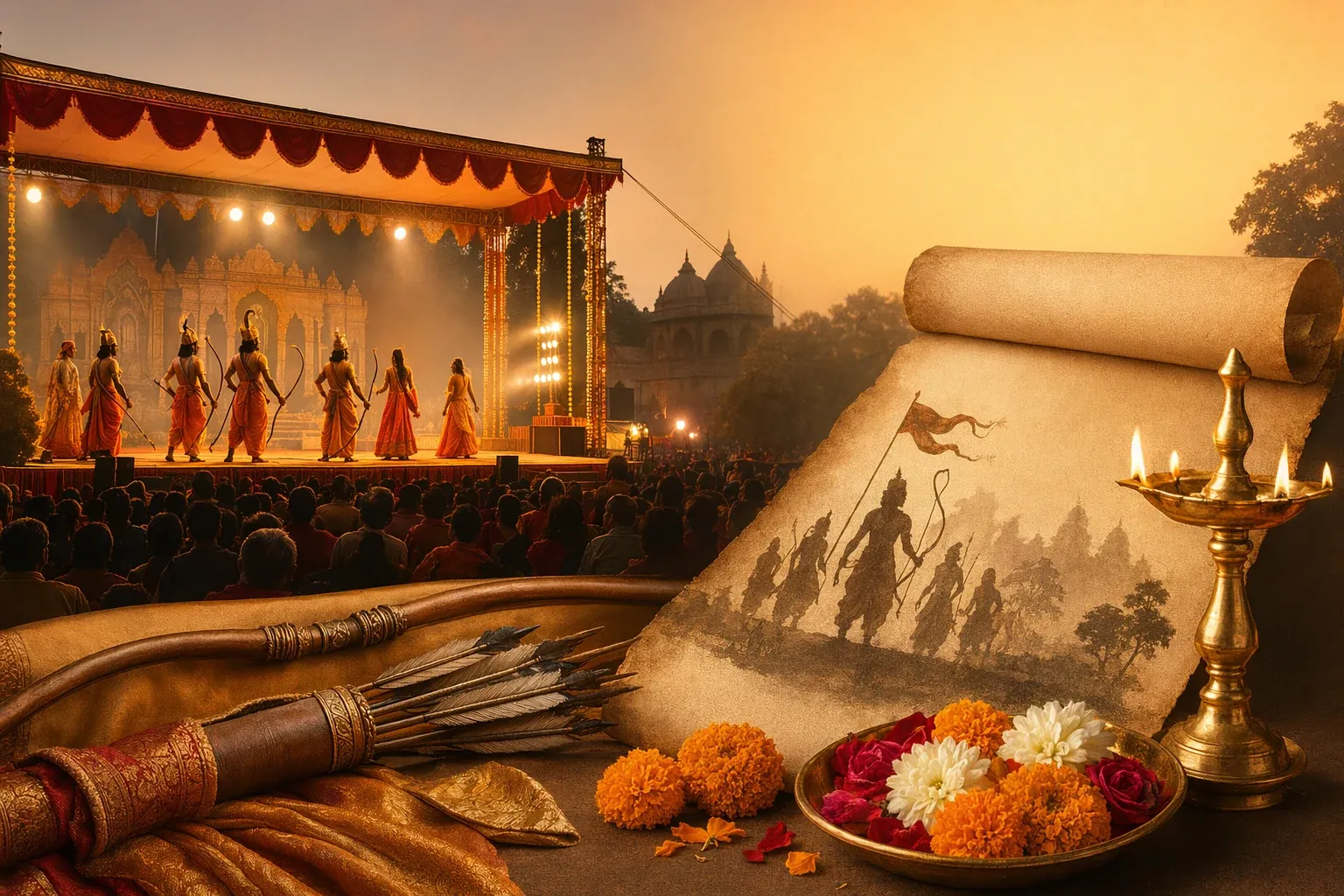
Ramlila is usually celebrated during the days leading up to Dussehra, also called Vijayadashami. In many places, performances happen during Navratri and conclude with Rama’s victory over Ravana near the festival day.
The exact dates change every year because Hindu festival dates follow the lunar calendar. Local organisers also adjust timing according to venue availability, community custom, permissions, weather, and crowd management.
The simple answer
Ramlila is most commonly performed in the Navratri-Dussehra period. Some performances run for a few evenings, some for nine or ten days, and some famous traditions continue for much longer depending on local practice.
Why the dates change each year
Dussehra does not fall on the same Gregorian calendar date every year. It is observed according to the Hindu calendar, so the English calendar date shifts. That is why a Ramlila that happened in October one year may not match the exact same date next year.
Beginners should check current local announcements instead of relying on memory. Community posters, temple notices, municipal updates, official venue pages, or trusted local groups are usually more useful than old search results.
How long Ramlila can last
A neighbourhood Ramlila may be organised over a few evenings, focusing on the most familiar scenes. A larger city performance may run through the festival period. Some famous traditions are longer and more elaborate, with carefully structured episodes and strong local identity.
The duration also depends on whether the performance is mainly devotional, theatrical, procession-based, or linked with a major public ground. There is no single length that defines all Ramlila.
What happens on the final day
The final day often connects with Ravana Dahan and Vijayadashami. Crowds gather to watch the symbolic defeat of Ravana, and the mood becomes festive, emotional, and public. For many children, this is the most memorable part of the season.
But the final day is best understood as the conclusion of a moral journey. The fire is a symbol. It points to the inner work of reducing ego, anger, greed, and injustice in our own lives.
Why Ramlila still matters today
Ramlila still matters because it keeps the Ramayana in public memory without requiring every viewer to begin with a long book. A child may first notice Hanuman’s energy, Ravana’s towering presence, Rama’s bow, or the lights of Dussehra; later, the same child can ask deeper questions about duty, courage, ego, and devotion.
It also protects a community habit of learning together. In a time when culture is often consumed alone on a phone, Ramlila gathers people in one place. Elders explain scenes, young performers learn roles, volunteers serve quietly, and the story becomes something shared rather than only watched.
A simple beginner checklist
When you watch or read about Ramlila, ask five simple questions: which Ramayana episodes are being shown, which local language or style is used, how the performance connects with Dussehra, what values the scene teaches, and how the organisers keep the event respectful and safe.
This checklist helps beginners avoid confusion. Ramlila is not only a date, not only Ravana Dahan, not only theatre, and not only religious ritual. It is a layered tradition where story, devotion, performance, public space, and family memory meet.
If you remember only one practical idea, remember this: Ramlila becomes clearer when you hold two truths together. It is a devotional remembrance for many viewers, and it is also a public art form shaped by local people, local language, and local care.
How to watch or discuss Ramlila respectfully
Ramlila is a living tradition, so it deserves more care than a quick “stage show” label. Many people attend it with devotion, family memory, and respect for Rama, Sita, Hanuman, Lakshmana, and the wider Ramayana world. Even when a local production looks simple, it may carry years of community effort.
A respectful viewer does not mock accents, costumes, masks, older sound systems, or slow pacing. The audience often knows the story already; they are not only waiting for suspense. They are participating in remembrance, festival atmosphere, moral reflection, and shared cultural memory.
Common mistakes to avoid
Do not reduce Ramlila to only Ravana Dahan. The burning of the effigy is famous, but the larger performance includes exile, devotion, friendship, difficult choices, battle, return, and the victory of dharma over adharma. The meaning becomes richer when the whole arc is remembered.
Do not assume every Ramlila looks the same. Some are dramatic and elaborate, some are devotional and slow, some use local dialects, some are linked with temples, and some are organised in public grounds by neighbourhood committees. Variety is part of the tradition.
Common beginner questions
Is Ramlila always during Navratri?
Most popular performances are linked with the Navratri-Dussehra period, but local traditions and schedules can vary.
How many days does Ramlila last?
It may last a few days, nine or ten days, or longer in famous traditional centres.
Where should I check exact Ramlila dates?
Use current local announcements, venue pages, temple notices, community posters, or official festival updates for that year.
Related reading on Bhaktilipi
For more context, read Navratri and Dussehra 2025 Guide and Ramayana Story Summary for Beginners on Bhaktilipi.
A calm takeaway
The simple way to understand Ramlila is to see story, devotion, theatre, music, community, and festival life working together. It keeps the Ramayana visible in public memory, especially for children and young readers who may first learn through scenes, songs, costumes, and questions.
A good beginner approach is to enjoy the colour and drama without losing the deeper point. Ramlila asks us to remember courage with humility, strength with restraint, and celebration with respect for the people who keep the tradition alive.