The aim is beginner-friendly clarity: Indian cultural context, practical usefulness, and careful language without unsupported miracle claims.
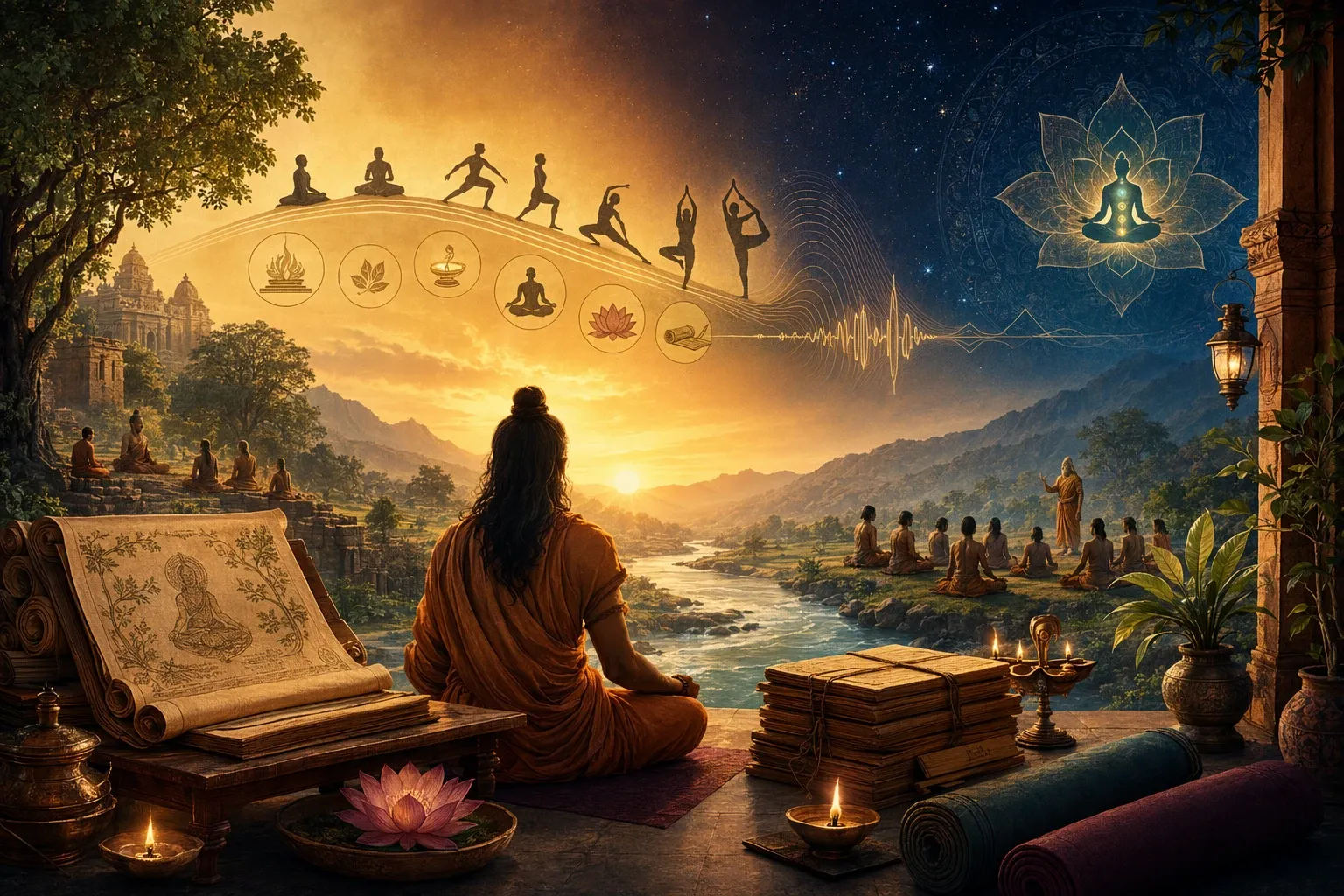
No single person “invented” yoga like a modern product. Yoga developed in India over a long period through sages, teachers, practitioners, oral traditions, texts, and lived practice.
Patanjali is very important because the Yoga Sutras present a concise and influential system of Yoga philosophy. But Patanjali did not create every yoga posture, breathing method, devotional path, or modern yoga style.
Why the word invented can mislead
When we ask who invented yoga, we may imagine one founder, one date, and one official manual. Indian knowledge traditions usually did not grow like that. They grew through guru-shishya teaching, memory, debate, practice, and commentary.
So a better question is: how did yoga develop, and which teachers shaped it? That question gives a more honest answer than forcing all of yoga into one name.
Early Indian roots
Yoga ideas appear across ancient Indian thought: discipline, meditation, breath control, sense restraint, liberation, and inner knowledge. These ideas appear in different forms in texts, traditions, and practices.
The roots are not limited to gym-style postures. Early yoga was deeply connected with questions such as suffering, freedom, mind, action, self-knowledge, and spiritual discipline.
Patanjali’s role
Patanjali is traditionally associated with the Yoga Sutras, a compact text that defines yoga in relation to calming and mastering the movements of the mind. The text became central to classical Yoga philosophy.
Calling Patanjali the “father of yoga” is common in popular speech, but it should be understood carefully. He systematised an important path; he was not the sole creator of every yoga tradition.
Modern global yoga
Modern yoga around the world includes posture classes, fitness styles, therapeutic adaptations, meditation groups, teacher trainings, and spiritual communities. Some are close to Indian traditions; others are heavily modernised.
This global spread is powerful, but it can also create confusion. A respectful beginner should learn both the modern practice and the Indian background, not separate yoga from its roots.
Beginner takeaway
Yoga belongs to a long Indian inheritance, not one marketing brand. If someone asks who created yoga, the safest answer is: many Indian sages and practitioners developed it over time, and Patanjali gave one of its most important philosophical forms.
That answer is simple, respectful, and historically more careful than naming one “inventor” with fake certainty.
Key takeaway
Why yoga is not a one-person invention
It is tempting to ask for one inventor because school history often gives us neat names and dates. Yoga does not fit that pattern. It grew through many generations of Indian seekers, teachers, householders, renunciants, poets, philosophers, and practitioners. Some practices were about discipline and meditation, some about breath and body, and some about devotion, self-knowledge, or liberation.
A better way to say it is this: yoga developed in India over a long period, and different communities shaped different parts of it. Patanjali is important because the Yoga Sutras gave a compact philosophical structure to yoga, especially the discipline of calming the mind. That is different from saying he invented every yoga posture or every later style.
Where Patanjali fits
Patanjali is traditionally connected with the Yoga Sutras, a short but powerful text that systematises Yoga as a path of practice and insight. The famous line “yogaś citta-vṛtti-nirodhaḥ” points to calming the movements of the mind. This is why Patanjali matters so much in discussions of yoga history.
For a deeper beginner explanation, read our Yoga Sutras of Patanjali guide for Sanskrit context and then compare it with our what is yoga guide.
Ancient roots, modern forms
Modern yoga classes often focus on postures, flexibility, fitness, and stress relief. Ancient yoga literature, however, is much wider. It includes ethics, meditation, concentration, breath, devotion, self-study, and freedom from inner confusion. This does not make modern posture yoga fake; it simply means the tradition has many layers.
When we respect that history, we avoid two mistakes: claiming yoga was invented recently, and pretending every modern studio class is identical to ancient practice. Yoga is both a living tradition and a changing global practice.
Common mistakes about yoga history
One mistake is to use modern fitness yoga as the only lens for the whole tradition. Posture-based practice is important today, but yoga also includes meditation, ethics, self-study, breath, devotion, and philosophical inquiry. If we only look at gym-style yoga, the older Indian context becomes invisible.
Another mistake is to turn Patanjali into a simple founder figure. Patanjali deserves respect, but the tradition is bigger than one author. The Yoga Sutras are a major milestone, not the birth certificate of every yoga practice.
How to answer the question simply
If someone asks, “Who invented yoga?”, a careful answer is: yoga developed in ancient India over many centuries; no single person invented it; Patanjali systematised an important philosophical form of yoga in the Yoga Sutras; and modern yoga later changed as teachers adapted it for new audiences.
That answer is short, accurate, and respectful. It gives India its proper place, honours Patanjali without exaggeration, and leaves room for the many streams of practice that shaped yoga over time.
Why this matters today
Yoga is now global, so history matters. When people practise something from another culture, they do not need to become experts overnight, but they should avoid careless claims. Saying “yoga is just stretching” erases its roots. Saying “nothing has changed since ancient times” ignores how living traditions evolve. The middle path is better: learn, practise safely, and give credit honestly.