
# Who Is Vishnu in Hinduism? A Simple Beginner Guide
Vishnu is one of the most loved and widely worshipped deities in Hindu tradition. For a beginner, the simplest way to remember him is this: Vishnu is associated with protection, balance, and the restoration of dharma when life becomes unstable. That does not make him a distant cosmic manager. In stories, temple worship, songs, and household devotion, Vishnu is approached as compassionate, patient, majestic, and close to those who seek shelter.
The word “preserver” is often used for Vishnu, but it needs a careful reading. Preservation is not merely keeping things unchanged. In Hindu thought, the world moves through change, conflict, forgetting, renewal, and return. Vishnu protects the conditions that allow life, duty, goodness, and spiritual growth to continue. Sometimes that protection is gentle. Sometimes it arrives through a powerful avatar who confronts cruelty or confusion.
Vishnu in the wider Hindu picture
Many Hindus learn about Vishnu alongside Brahma and Shiva. A simple teaching presents Brahma with creation, Vishnu with preservation, and Shiva with transformation or dissolution. This threefold explanation is useful for beginners, but Hindu practice is richer than a chart. In Vaishnava traditions, Vishnu or Narayana is worshipped as the Supreme Being. In many other Hindu families, Vishnu is honoured together with Shiva, Devi, Ganesha, Surya, and other forms of the divine.
This is why a beginner should avoid turning Vishnu into a competition with other deities. Hindu traditions often speak through relationships rather than rivalry. Vishnu can be understood through stories of cosmic protection, through the devotion of Lakshmi-Narayana, through the love for Rama and Krishna, and through the temple image that invites darshan.
Why Vishnu is called Narayana
Narayana is one of Vishnu’s important names. It is often explained as the divine resting in, supporting, or connected with the waters and beings of existence. In devotional use, Narayana feels intimate and complete: the one who shelters life and receives the love of devotees. You may hear “Om Namo Narayanaya” as a mantra of surrender, remembrance, and peace.
Names matter in Hindu worship because they carry different moods. Vishnu may sound formal and theological. Narayana may sound deeply devotional. Hari suggests the one who removes suffering or takes away what binds the heart. Govinda and Krishna carry the sweetness of cowherd, guide, friend, and beloved. The same divine reality is approached through many names because devotion has many doors.
Avatars: why Vishnu comes to the world
One of the best-known ideas connected with Vishnu is avatara, a descent of the divine into the world. The Dashavatara, or ten famous avatars, includes forms such as Matsya, Kurma, Varaha, Narasimha, Vamana, Rama, Krishna, Buddha in some lists, and Kalki in future-oriented traditions. The point is not only a list to memorise. The deeper idea is that when dharma is threatened, divine help can appear in a form suited to the need of the time.
Rama shows dignity, duty, courage, and moral struggle. Krishna shows wisdom, playfulness, friendship, statecraft, and the teaching of the Bhagavad Gita. Narasimha protects Prahlada in a dramatic story about devotion under pressure. Vamana humbles pride through a small form that becomes immeasurable. Each avatar teaches through a different emotional and ethical setting.
For a fuller overview, read Bhaktilipi’s guide to Vishnu avatars and the Dashavatara. Beginners can also compare how Vishnu is understood through place in Vaikuntha, Kshira Sagara, and Shesha.
Vishnu’s symbols in simple language
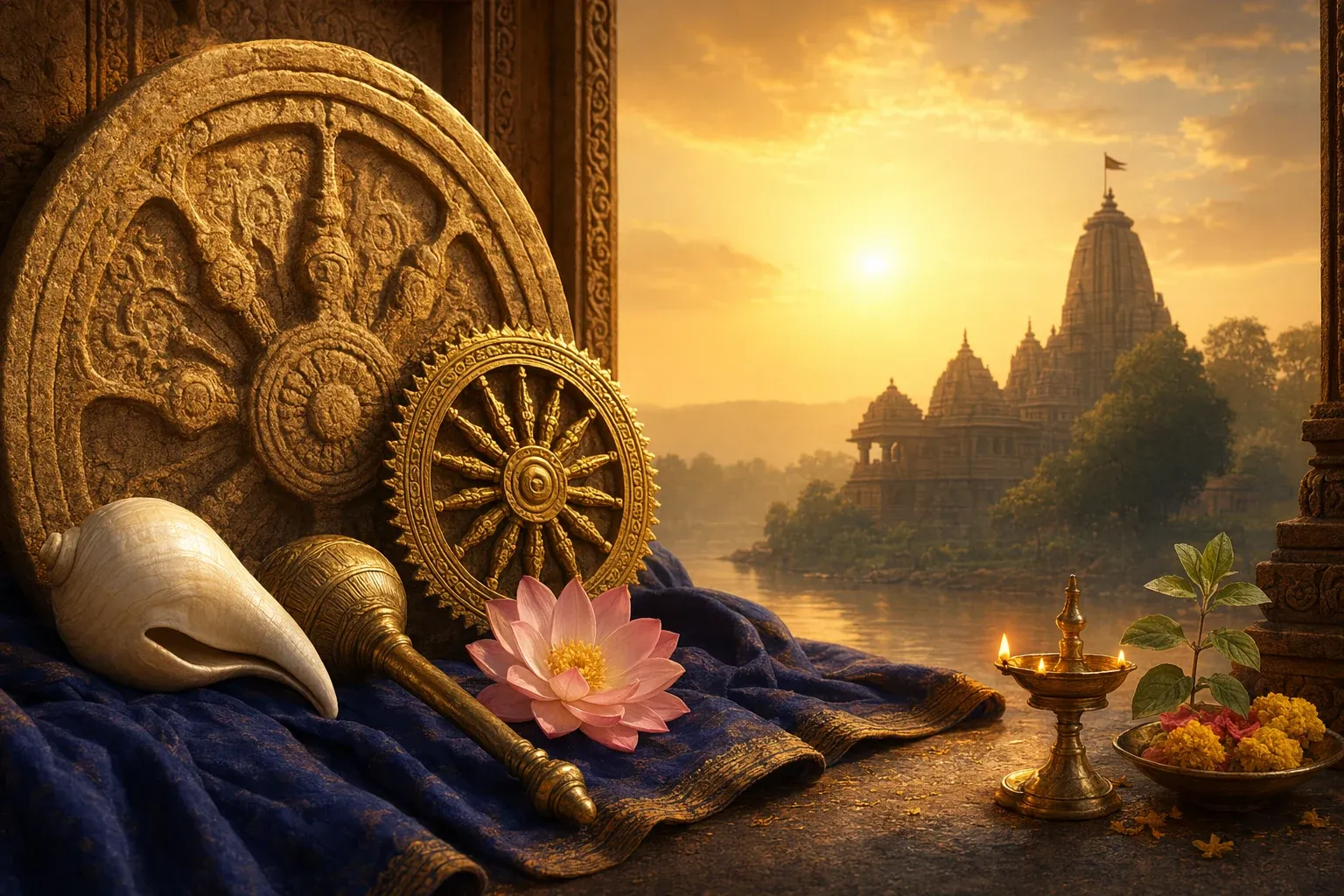
Vishnu is often shown with four arms, holding the shankha, chakra, gada, and padma: conch, discus, mace, and lotus. These are not random ornaments. The conch suggests sacred sound and awakening. The chakra points to divine order, sharp awareness, and protection. The mace suggests strength used for justice, not cruelty. The lotus suggests purity, beauty, and spiritual unfolding even in muddy conditions.
His calm posture is also important. Vishnu’s power is not usually shown as restless aggression. It is steady, composed, and alert. In many images he rests on Shesha, the cosmic serpent, with Lakshmi near him. This scene does not mean inactivity. It shows the universe held in a deeper order, where rest and power belong together.
Lakshmi and Vishnu
Vishnu is frequently worshipped with Lakshmi. Their pairing is often called Lakshmi-Narayana. Lakshmi represents fortune, beauty, nourishment, grace, and auspicious abundance. Vishnu represents sustaining order and protective compassion. Together they show that prosperity is most meaningful when joined with dharma, and order is most beautiful when joined with grace.
This relationship is not only a mythic marriage. It shapes temple worship, household prayers, festival imagination, and devotional poetry. If you want to understand the pair more closely, see Vishnu and Lakshmi: marriage, meaning, and Lakshmi-Narayana.
How devotees worship Vishnu
Devotion to Vishnu can be grand or very simple. Some people visit temples dedicated to Vishnu, Rama, Krishna, Venkateswara, Jagannath, or Narayana. Others chant names, read the Bhagavad Gita, recite Vishnu Sahasranama, sing bhajans, keep Ekadashi fasts, or place a small image at home. The point is not to perform everything. The point is remembrance with sincerity.
A beginner can start with a clean place, a small lamp or flower if appropriate, and a short prayer such as “Om Namo Narayanaya.” Reading one story of Rama or Krishna with attention is also a form of learning. Hindu devotion is not only about asking for help. It is about shaping the mind toward steadiness, gratitude, courage, humility, and care.
What Vishnu teaches a beginner
Vishnu’s stories ask a practical question: what preserves goodness when life becomes difficult? Sometimes the answer is patience. Sometimes it is wise action. Sometimes it is protection of the vulnerable. Sometimes it is the courage to return to dharma after confusion.
For beginners, Vishnu can be understood as the divine presence that does not abandon the world. He is remembered when people seek balance, moral direction, protection, and hope. His many names, avatars, and symbols may look complex at first, but they point toward one accessible idea: life is worth protecting, and dharma must be renewed again and again.
Simple takeaway
Vishnu is not just “the preserver” as a textbook label. He is the sheltering, ordering, compassionate form of the divine who appears through names, symbols, avatars, temples, songs, and personal devotion. Start with that clear center. Then learn the details slowly: Narayana, Lakshmi, avatars, Vaikuntha, the conch, the chakra, and the living practices of devotees. The beginner path becomes easier when Vishnu is seen not as a puzzle of many facts, but as a guide to protection, balance, and faithful remembrance.