
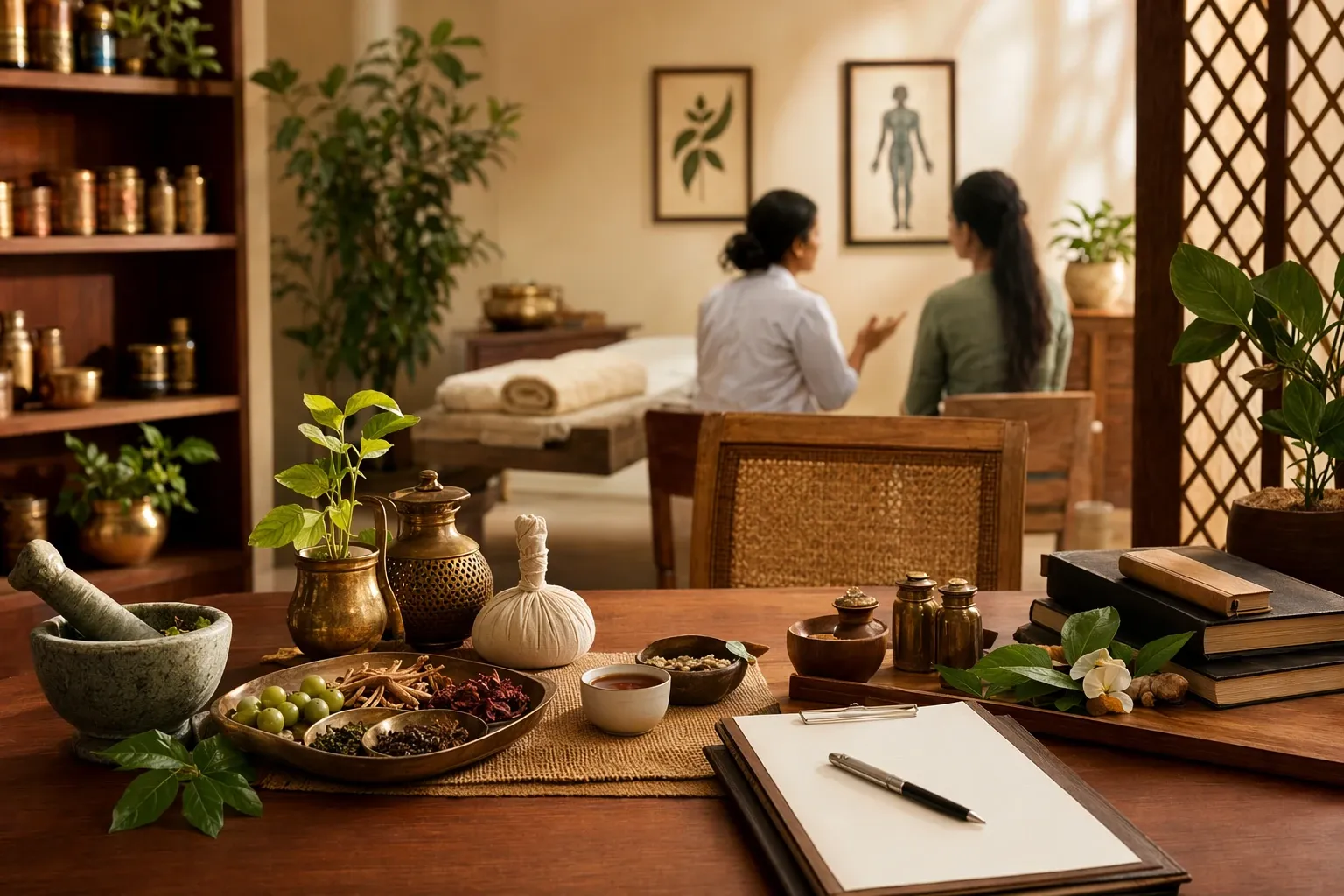
Many people search for an Ayurveda doctor only when they are confused by clinic names, online consultations, wellness claims, or treatment promises. This guide gives beginners a safe, practical way to understand qualifications, consultation basics, red flags, and how Ayurveda can fit responsibly alongside modern healthcare.
This article is for cultural and educational understanding. It is not medical advice, diagnosis, or a replacement for qualified health care.
Simple answer
If you search “Ayurveda doctor near me,” look for a qualified practitioner, proper clinic or hospital setup, clear communication, and realistic claims. A consultation is not just buying a product; it is a professional health interaction.
Beginners should know what to ask, what to carry, and which red flags to avoid before trusting any clinic, hospital, online consultation, or wellness centre.
Who is an Ayurveda doctor in India?
In India, Ayurveda has formal education and regulation through recognised systems. Many practitioners study BAMS and related postgraduate fields. Rules and titles can vary by country, so local regulation matters.
For a beginner, the practical point is to check qualifications, registration where applicable, experience, and whether the practitioner explains both benefits and limits honestly.
If you are still learning the basics, first read our Ayurveda for beginners guide. For a simple everyday example of how Ayurveda appears in home wellness culture, see our guide to traditional spices in Ayurveda before comparing products, clinics, or consultation claims.
Clinic, hospital, and online consultation
A clinic may handle outpatient consultation. A hospital may have broader facilities, inpatient care, pharmacy, procedures, and multiple specialists. Online consultation can be useful for guidance, but it has limits because physical examination may be needed.
For emergency symptoms—severe chest pain, stroke signs, uncontrolled bleeding, breathing difficulty, high fever with danger signs, severe allergic reaction—do not wait for a routine Ayurveda appointment. Use emergency medical care.
First consultation: what happens
A first consultation may include questions about digestion, sleep, appetite, bowel habits, lifestyle, stress, medical history, current medicines, and symptoms. Some practitioners may examine pulse, tongue, eyes, skin, or other signs in traditional ways.
Carry previous reports, prescriptions, allergies, and a clear list of symptoms. Do not hide allopathic medicines or supplements; mixing treatments without disclosure can be risky.
Can Ayurveda doctors do surgery?
Searches often ask whether Ayurveda doctors can do surgery. The historical Sushruta tradition includes surgical knowledge, and modern legal permission depends on current regulation, qualification, jurisdiction, and specific procedure.
A safe article should not give legal-medical advice for one country or state without checking current rules. Ask the institution and verify official regulations for the exact context.
Red flags
Be cautious if someone promises guaranteed cure for everything, tells you to stop prescribed medicines suddenly, refuses to explain ingredients, sells only expensive packages, mocks every other medical system, or uses fear to pressure you.
A good consultation should make you feel informed, not trapped. Ayurveda’s dignity is protected by responsible practice.
Key takeaway
Ayurveda is best learned with respect and responsibility: appreciate the Indian tradition, start with simple habits, and seek qualified guidance for health decisions.
Additional beginner context
The next sections add plain-language context so the article is more useful as a complete beginner guide.
A beginner-friendly way to read this
This guide is mainly about Ayurveda Doctors, Clinics and Consultations: What Beginners Should Know. The useful way to read it is not as a final verdict, but as a beginner-friendly map: learn the key idea, notice the context, and then connect it with the wider Indian cultural world. Important terms in this article include Ayurveda, Doctors, Clinics, Consultations, Should. The central angle is: Reframe near-me and doctor queries into an ethical guide: qualifications, what to expect, red flags, and how Ayurveda can fit responsibly with modern healthcare.
Ayurveda is best understood as a traditional Indian knowledge system about balance, routine, food, season, body type, and disciplined living. For beginners, it becomes confusing when every idea is treated like a quick cure. A better reading is cultural and educational: notice how the tradition links daily habits with digestion, rest, environment, and self-observation.
What to remember
Health-related topics need especially careful language. This article should not be read as personal medical advice, a diagnosis, or a reason to stop treatment. If someone has a health condition, takes medicine, is pregnant, or wants to use herbs or supplements, the sensible next step is to speak with a qualified professional. Tradition and safety should work together, not against each other.
For modern readers, the safest approach is to keep curiosity and humility together. A tradition can be meaningful without being reduced to a slogan, and a complex topic can be made simple without pretending that every region, family, school, or teacher follows the exact same wording.
For Bhaktilipi readers, the takeaway is simple: learn the concept first, avoid miracle claims, and treat Ayurveda as a serious cultural tradition that deserves patience. The value is not in copying random online tips, but in understanding why moderation, rhythm, food context, and consistency are repeated so often in Ayurvedic thinking.
Where to go next
For a wider base before going deeper, read our Ayurveda beginner guide. It gives the surrounding context so this article feels less isolated.
More context for careful readers
Common misunderstandings to avoid
A common mistake is to treat Ayurveda Doctors, Clinics and Consultations: What Beginners Should Know as only one sentence or one social-media definition. In reality, Ayurveda topics usually carry many layers: language, practice, regional memory, family tradition, teacher explanation, and modern interpretation. A beginner guide should simplify the entry point, but it should not erase that depth.
Another mistake is to assume that one version explains every community. Indian traditions often travel through many regions and languages, so examples may differ. That does not make the topic confused; it means the tradition is alive and has been remembered in more than one way.
The safest reading habit is to keep the main idea clear and hold details gently. Start with what the word means, then notice where it appears, who practices or discusses it, and what value it is trying to teach. This makes Ayurveda Doctors, Clinics and Consultations: What Beginners Should Know easier to remember without forcing a narrow answer.
Why this matters today
This topic still matters because young readers are meeting Indian culture through school, family stories, social media, travel, music, health conversations, and festival posts. Without context, the same idea can look either too mysterious or too casual. A clear explanation helps readers respect the subject without feeling lost.
For Bhaktilipi readers, the practical value is not just information. The goal is better cultural literacy: knowing enough to ask good questions, avoid lazy stereotypes, and recognise why earlier generations preserved these ideas through stories, songs, rituals, debates, art, and daily habits.
Good learning also means knowing the limits of a short article. This guide gives a reliable starting point, but deeper study can come from teachers, trusted books, temple or community elders, museums, performances, and careful reading of primary traditions where possible.
Simple takeaway
If you remember only one thing, remember this: Ayurveda Doctors, Clinics and Consultations: What Beginners Should Know becomes meaningful when the definition, the cultural setting, and the human purpose are read together. That balanced view protects the topic from both blind rejection and blind romanticisation.
Use this article as a first map. Revisit the key words, compare them with real examples, and keep learning patiently. Dharma-oriented learning is not about collecting facts quickly; it is about understanding what those facts ask us to value and practice.