
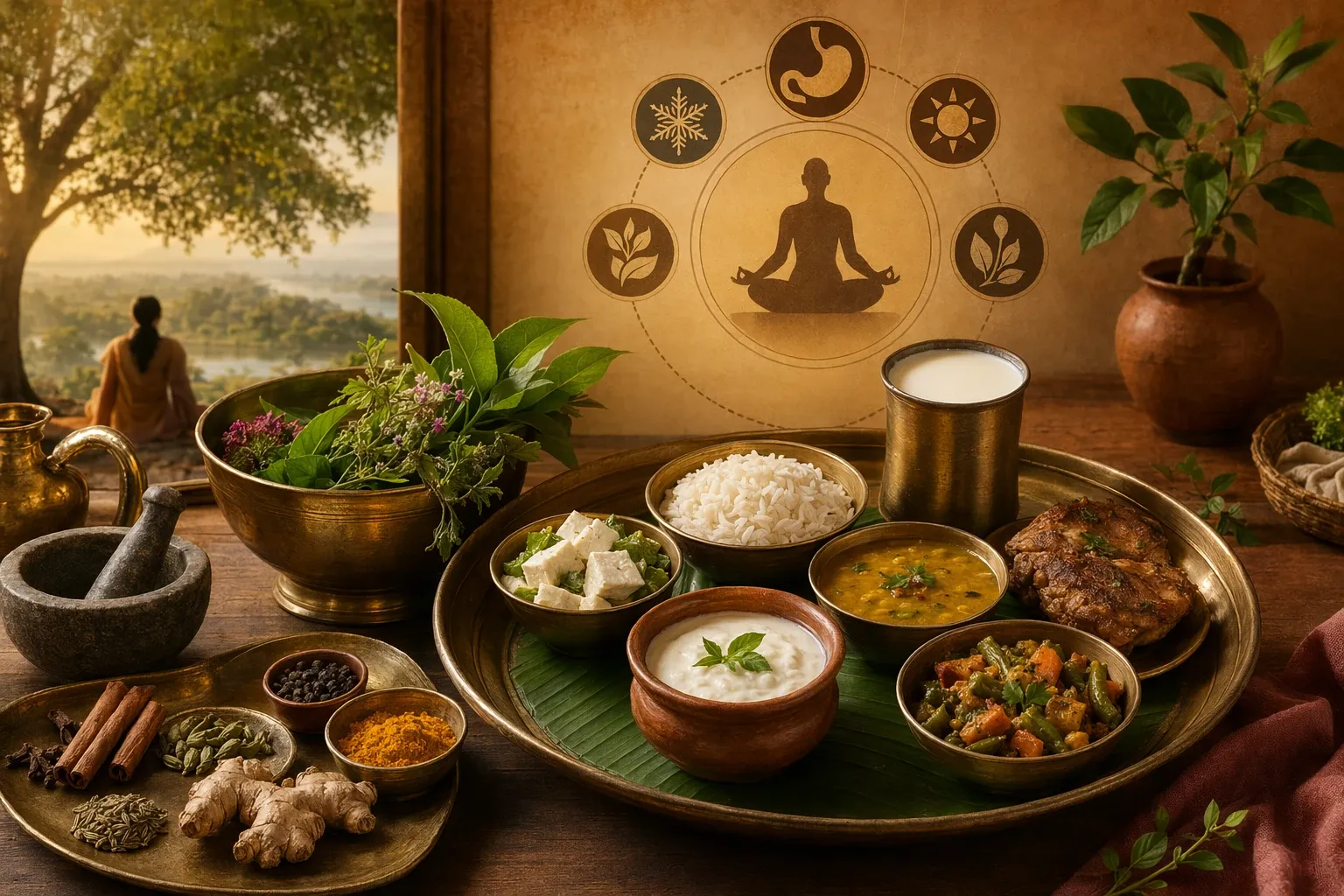
Ayurveda does not treat food as a simple list of forbidden and allowed items. It looks at digestion, season, constitution, preparation, quantity, combinations, and personal context, so questions about milk, curd, paneer, protein, or non-veg need careful answers rather than viral one-line rules.
This guide explains Ayurveda as cultural and educational knowledge, not medical advice. For illness, pregnancy concerns, chronic conditions, allergies, medicines, or therapeutic diets, a qualified health professional matters.
Simple answer
Ayurveda does not look at food only as calories or macros. It asks about agni, meaning digestive fire in the traditional framework, as well as season, constitution, preparation, quantity, freshness, combinations, and personal tolerance.
This is why simple internet rules like “Ayurveda says never eat X” can be misleading. Context matters. A food may be suitable for one person, time, or preparation and unsuitable in another situation.
Milk, curd, and paneer
Milk, curd, and paneer appear in many Indian food discussions. Ayurveda traditionally gives detailed attention to dairy: how it is prepared, when it is taken, what it is combined with, and who is taking it.
If someone says “Ayurveda says no to milk” or “Ayurveda says no to curd,” pause. The more accurate answer is that Ayurveda gives conditions and cautions, not always one blanket rule for everyone. Modern issues like lactose intolerance also need practical attention.
Protein and non-veg
Ayurveda includes discussions of different foods, including animal foods, in traditional contexts. It does not always match modern vegetarian/non-vegetarian debates exactly because advice depends on health state, region, strength, digestion, ethics, and purpose.
For young readers, the safe takeaway is: do not use Ayurveda to shame people or justify unhealthy extremes. Food choices can involve health, culture, family, ethics, and medical needs.
Agni and mindful eating
Agni is a key concept. In simple terms, Ayurveda asks whether your body is digesting food well and whether your meals support energy, clarity, and steadiness.
Mindful eating can include regular meals, chewing properly, avoiding constant distraction, noticing heaviness or discomfort, and choosing freshly prepared food when possible. These basics are more useful than obsessing over viral rules.
Why internet food rules can mislead
Short videos love certainty: “never combine this,” “this food is poison,” “this one herb fixes everything.” Ayurveda is more nuanced than that. It studies person, place, season, age, habit, and condition.
Also, health conditions such as diabetes, kidney disease, allergies, eating disorders, digestive disorders, pregnancy, or medication interactions require professional advice. Do not self-prescribe a diet from social media.
Responsible beginner approach
Use Ayurveda as a way to become more attentive: How does a meal affect your energy? Do you eat with hurry or gratitude? Are your food choices seasonal, balanced, and suitable for your life?
For a wider base, read our Ayurveda beginner guide. If you want the broader tradition context, this Vedic knowledge guide explains how Ayurveda is often discussed alongside Indian knowledge systems.
If you need a therapeutic diet, consult a qualified professional. If you are simply learning culture, begin with respect, moderation, and curiosity.
Key takeaway
Ayurveda is best learned with respect and responsibility: appreciate the Indian tradition, start with simple habits, and seek qualified guidance for health decisions.
Additional beginner context
The next sections add plain-language context so the article is more useful as a complete beginner guide.
A beginner-friendly way to read this
This guide is mainly about What Does Ayurveda Say About Food? Milk, Curd, Protein and Non-Veg. The useful way to read it is not as a final verdict, but as a beginner-friendly map: learn the key idea, notice the context, and then connect it with the wider Indian cultural world. Important terms in this article include Ayurveda, Say, About, Food, Milk. The central angle is: A balanced food-culture explainer that avoids fear-mongering: explain context, season, digestion, combinations, and moderation in Ayurveda.
Ayurveda is best understood as a traditional Indian knowledge system about balance, routine, food, season, body type, and disciplined living. For beginners, it becomes confusing when every idea is treated like a quick cure. A better reading is cultural and educational: notice how the tradition links daily habits with digestion, rest, environment, and self-observation.
What to remember
Health-related topics need especially careful language. This article should not be read as personal medical advice, a diagnosis, or a reason to stop treatment. If someone has a health condition, takes medicine, is pregnant, or wants to use herbs or supplements, the sensible next step is to speak with a qualified professional. Tradition and safety should work together, not against each other.
For modern readers, the safest approach is to keep curiosity and humility together. A tradition can be meaningful without being reduced to a slogan, and a complex topic can be made simple without pretending that every region, family, school, or teacher follows the exact same wording.
For Bhaktilipi readers, the takeaway is simple: learn the concept first, avoid miracle claims, and treat Ayurveda as a serious cultural tradition that deserves patience. The value is not in copying random online tips, but in understanding why moderation, rhythm, food context, and consistency are repeated so often in Ayurvedic thinking.
Where to go next
For a wider base before going deeper, read our Ayurveda beginner guide. It gives the surrounding context so this article feels less isolated.
More context for careful readers
Common misunderstandings to avoid
A common mistake is to treat What Does Ayurveda Say About Food? Milk, Curd, Protein and Non-Veg as only one sentence or one social-media definition. In reality, Ayurveda topics usually carry many layers: language, practice, regional memory, family tradition, teacher explanation, and modern interpretation. A beginner guide should simplify the entry point, but it should not erase that depth.
Another mistake is to assume that one version explains every community. Indian traditions often travel through many regions and languages, so examples may differ. That does not make the topic confused; it means the tradition is alive and has been remembered in more than one way.
The safest reading habit is to keep the main idea clear and hold details gently. Start with what the word means, then notice where it appears, who practices or discusses it, and what value it is trying to teach. This makes What Does Ayurveda Say About Food? Milk, Curd, Protein and Non-Veg easier to remember without forcing a narrow answer.
Why this matters today
This topic still matters because young readers are meeting Indian culture through school, family stories, social media, travel, music, health conversations, and festival posts. Without context, the same idea can look either too mysterious or too casual. A clear explanation helps readers respect the subject without feeling lost.
For Bhaktilipi readers, the practical value is not just information. The goal is better cultural literacy: knowing enough to ask good questions, avoid lazy stereotypes, and recognise why earlier generations preserved these ideas through stories, songs, rituals, debates, art, and daily habits.
Good learning also means knowing the limits of a short article. This guide gives a reliable starting point, but deeper study can come from teachers, trusted books, temple or community elders, museums, performances, and careful reading of primary traditions where possible.
Simple takeaway
If you remember only one thing, remember this: What Does Ayurveda Say About Food? Milk, Curd, Protein and Non-Veg becomes meaningful when the definition, the cultural setting, and the human purpose are read together. That balanced view protects the topic from both blind rejection and blind romanticisation.
Use this article as a first map. Revisit the key words, compare them with real examples, and keep learning patiently. Dharma-oriented learning is not about collecting facts quickly; it is about understanding what those facts ask us to value and practice.