
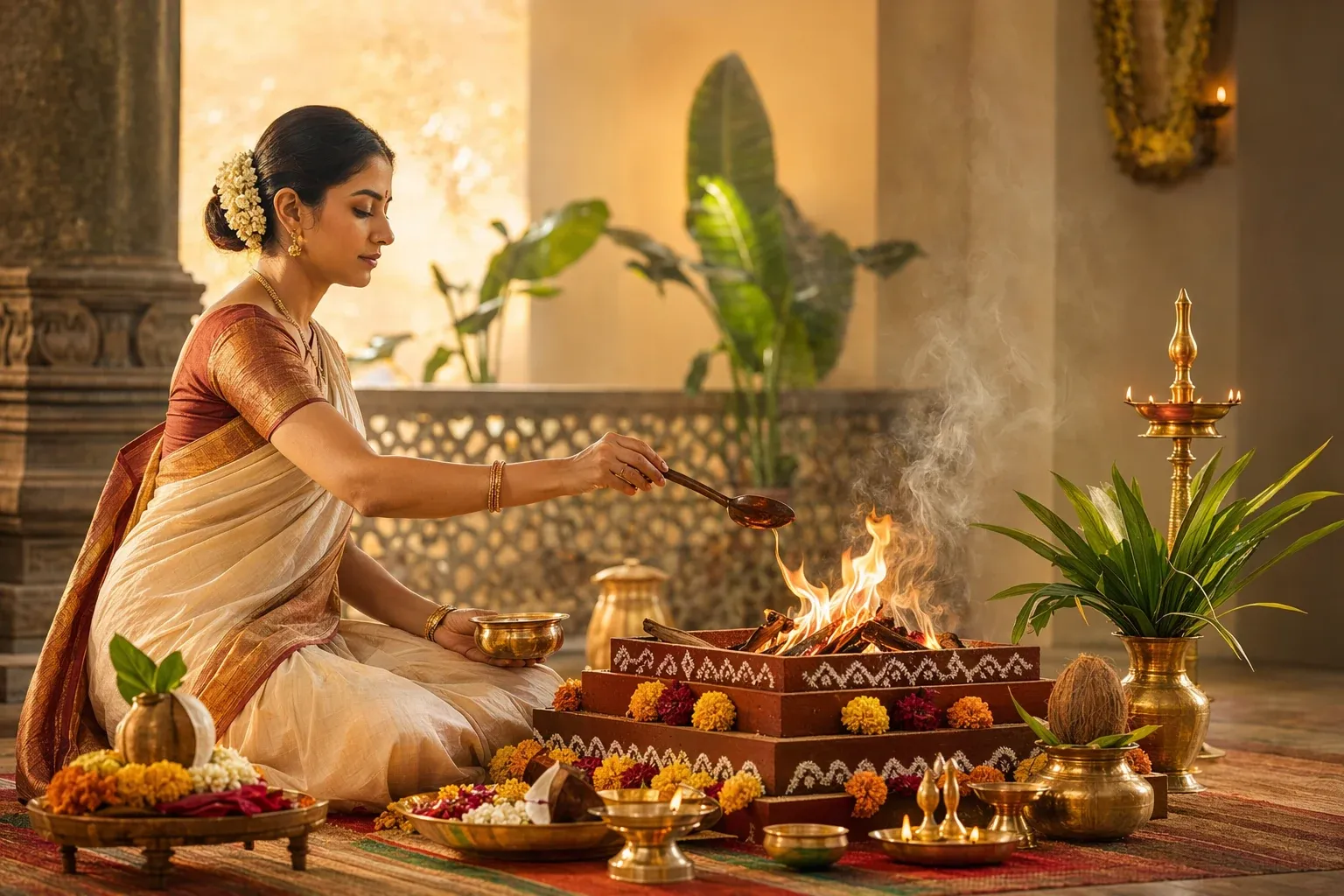
Can women perform yajna? The honest answer is: it depends on the kind of yajna, the tradition being followed, the family context, the role being discussed, and the guidance of qualified elders or teachers. A one-line “yes” or “no” usually creates more confusion than clarity.
Women have participated in sacred life in many ways across Hindu families, regions, and sampradayas. Some rites are performed by husband and wife together. Some household practices are led or maintained by women. Some formal Vedic priestly roles may have stricter rules in particular traditions. A respectful answer has to notice all of this without insulting anyone’s faith.
Start with what yajna means
Yajna means sacred offering, disciplined action, gratitude, and responsibility. Many yajnas involve fire, mantra, offerings, and ritual sequence, but the deeper idea is offering with reverence. If this broader meaning is new to you, our Yajna meaning guide gives the basic foundation.
Once we understand that, the women-and-yajna question becomes more precise. Are we asking whether women can sit near the fire? Offer samagri? Chant? Participate with family? Lead a home ritual? Serve as a formal priest in a specific Vedic rite? Different questions may receive different answers depending on tradition and setting.
Participation is not only one role
In many homes, women participate actively in puja, vrata, lamp lighting, mantra, bhajan, temple visits, festival preparation, and family rites. In many yajna or havan settings, women may sit with family, offer ahuti, pray, and take sankalpa according to local custom. In some rituals, the role of the wife is considered important because household dharma is not seen as only an individual act.
At the same time, not every ritual role is identical everywhere. Some communities reserve certain priestly functions for trained ritual specialists. Some lineages have specific rules about who recites particular mantras or performs particular actions. That variation should be described calmly, not weaponized.
Formal Vedic rites and home practice are different
A major source of confusion is mixing formal Vedic rites with simple home devotional practice. A large, formal yajna may require trained priests, exact procedure, lineage-specific rules, and careful preparation. A small home havan or family prayer may follow a simpler tradition taught by elders or a trusted guide.
So, when someone asks “Can women perform yajna?” the next question should be “Which yajna, in which tradition, and in what role?” That is not avoidance. It is respect for the diversity of Hindu practice. Our guide to a simple home yajna done safely is useful for understanding why context and guidance matter.
Avoid two extreme claims
The first extreme claim is that women were never connected to yajna or sacred ritual. That is too sweeping and does not reflect the lived reality of many Hindu families. Women have preserved prayers, festivals, songs, vows, food offerings, household sacred spaces, and devotional discipline across generations.
The second extreme claim is that every role has always been exactly the same everywhere. That is also too sweeping. Hindu practice is not one flat system. It includes Vedic, Puranic, Tantric, temple, regional, family, and sampradaya traditions, each with its own rules and memory.
How to ask respectfully in your own family
If you want to participate in a yajna, ask with humility rather than internet anger. You can ask: What tradition are we following? What role can I take? Is this a home rite or a formal rite? Who is guiding the procedure? Are there safety rules? Are there mantras I should learn properly before chanting?
This approach protects both devotion and dignity. It allows women to be included where the tradition allows participation, while also respecting specific ritual boundaries where a family or sampradaya follows them sincerely.
Safety and preparation still matter
Whether the participant is a woman or a man, fire rituals need care. Ventilation, adult supervision, safe materials, health conditions, clothing, children, pets, and local rules all matter. Sacredness does not cancel practical safety. If you are learning about materials, see our Yajna samagri guide for beginner context.
Also remember that online videos cannot replace a qualified teacher for formal rites. Watching a clip may show the outer sequence, but mantra, sankalpa, pronunciation, intention, and tradition require guidance.
What beginners should remember
Women’s participation in yajna cannot be answered well by a slogan. In many contexts, women do participate meaningfully. In some formal roles, rules may vary by lineage, ritual type, and community. The respectful path is to learn the specific context before making a claim.
A good Hindu answer should protect both tradition and dignity. It should honour women’s living contribution to sacred life, avoid careless generalizations, and encourage sincere seekers to learn from trusted elders, priests, teachers, and family practice.
A balanced answer for young readers
For young readers, the most balanced answer is this: do not let anyone use tradition as an excuse to insult women, and do not use modern confidence as an excuse to mock sincere tradition. Hindu life has always been carried by families, teachers, mothers, fathers, priests, elders, devotees, and communities together. Women’s sacred contribution is not small just because every role is not described in the same way everywhere.
If you are a woman who wants to learn yajna, begin with study, pronunciation, safety, and humility. Ask a trusted teacher what is appropriate in your sampradaya or family practice. If a role is open, learn it properly. If a specific formal role is restricted in your tradition, ask what forms of participation are encouraged instead. The goal is not online victory; the goal is sincere sadhana, dignity, and clarity.
If you are answering this question for someone else, be careful with tone. A dismissive answer can hurt genuine seekers. A careless answer can create confusion around formal rites. The better response is patient: name the variation, honour women’s devotion, respect trained guidance, and keep the door open for learning.