
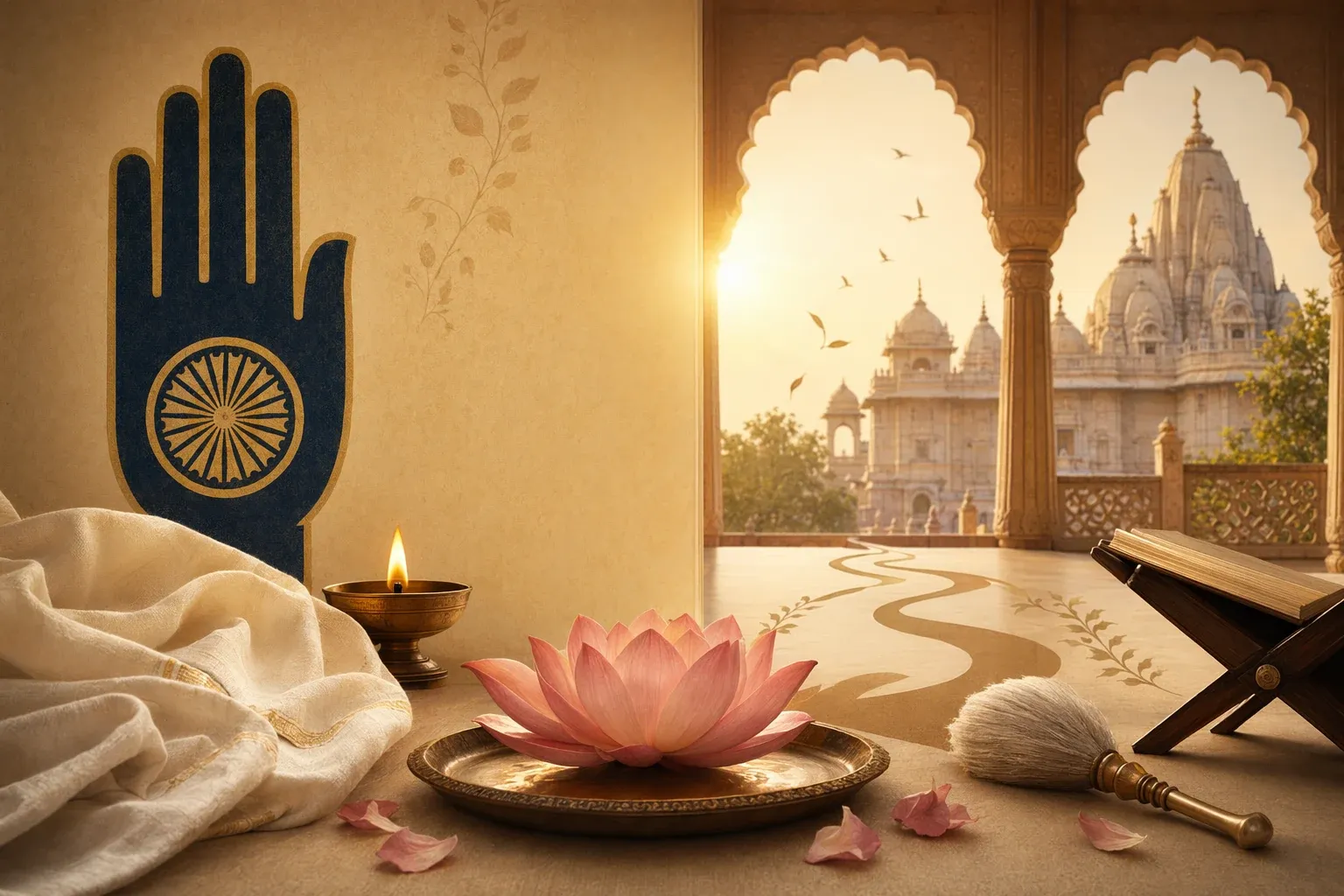
Jainism does not centre on a creator God who makes, rules, and controls the universe. Instead, it teaches a universe governed by its own nature, where souls are bound by karma and can become liberated through right faith, right knowledge, and right conduct. That makes Jainism very different from traditions where God is the supreme creator and saviour.
But this does not mean Jainism has no worship, no temples, or no devotion. Jains revere Tirthankaras, Arihants, Siddhas, teachers, scriptures, and the qualities of liberated beings. Prayer in Jainism is often about honouring perfection and awakening those qualities within oneself.
No creator-God focus
In Jain thought, the universe has no beginning created by a single divine ruler. Souls have always existed, matter has always existed, and karma operates according to moral and spiritual law. No creator God grants liberation by favour, and no one can remove the consequences of action without the soul’s own purification.
This is why Jainism can sound unusual to readers who assume every religion must be centred on a God who creates the world. Jainism is religious, devotional, ethical, and spiritual, but its theology is not creator-God centred.
Who Jains revere
Jains revere Tirthankaras, especially Mahavira as the 24th Tirthankara of the present time cycle. They also honour Arihants, Siddhas, Acharyas, Upadhyayas, and Sadhus in the famous Namokar Mantra. These are not worshipped as creators of the universe. They are honoured as perfected beings, spiritual guides, and embodiments of the path.
A Tirthankara shows the crossing place over samsara. A Siddha is a liberated soul free from karma. An Arihant has conquered inner enemies and attained perfect knowledge. These categories help beginners understand why Jain worship feels reverent but not creator-focused.
What prayer means in Jainism
Jain prayer is often less about asking for worldly favours and more about bowing to purity, remembering the path, asking for inner strength, confessing mistakes, and cultivating humility. A devotee may visit a temple, offer worship, recite mantras, perform pratikraman, listen to teachings, fast, or practise charity.
The aim is not to persuade a deity to cancel karma. The deeper aim is to purify intention, reduce ego, and move closer to the qualities represented by the liberated ones.
Is Mahavira the god of Jainism?
Mahavira is not the creator God of Jainism. He is revered as a Tirthankara and liberated teacher. Calling him “the god of Jainism” can mislead beginners because it imports assumptions from other religious frameworks. A better sentence is: Jains deeply revere Mahavira as the 24th Tirthankara and a model of liberation.
How this differs from Hindu worship
Many Hindu traditions centre devotion to forms of God such as Vishnu, Shiva, Devi, Ganesha, or others. Jainism shares Indian sacred language and temple culture in broad ways, but its idea of divine perfection is different. For broader comparison, our Jainism and Hinduism comparison context can be paired with a basic understanding of dharma and Indian traditions.
The difference should be explained respectfully. Jainism is not “less religious” because it lacks a creator God. It is a demanding path of liberation with devotion, ethics, ritual, philosophy, and community life.
Why Jains still visit temples
If Jainism is not creator-God centred, a beginner may wonder why temples matter. Temples create a focused space for remembering the path. The image of a Tirthankara is calm, detached, and meditative. It teaches through posture and presence: reduce ego, purify conduct, and move toward freedom.
Temple worship can include bathing the image, offering rice or flowers, lighting lamps, reciting mantras, circumambulation, and quiet reflection. The outer actions vary, but the inner meaning is aspiration. The devotee is not feeding a needy deity; the devotee is training the mind to honour liberated qualities.
Prayer without bargaining
Many people learn prayer as asking for success, protection, marks, money, health, or victory. Jain prayer can include personal emotion, but its ideal form is not bargaining. It is closer to reverence, confession, gratitude, and self-correction. The famous Namokar Mantra bows to spiritual excellence rather than asking for a specific worldly reward.
This can feel refreshing for modern readers. Jain worship says: look at the highest possibility of the soul, then ask whether your own habits are moving toward or away from that freedom.
Karma makes personal responsibility central
Because Jainism does not rely on a creator God to forgive or erase karma by command, personal responsibility becomes very strong. Actions, intentions, passions, and habits matter. Liberation cannot be outsourced. Teachers can show the path, scriptures can guide, and community can support, but the soul must purify itself.
This gives Jain prayer a serious ethical mood. Bowing before a Tirthankara is also a mirror: if such purity is possible, what am I doing with my anger, greed, carelessness, and attachment today? Worship becomes a call to transform conduct.
This also explains why Jain ethics can feel demanding. If no outside creator simply cancels the moral weight of action, then every choice matters. Speech, food, anger, business, and consumption become spiritual issues. Jain worship keeps that responsibility visible.
What beginners should remember
For wider Indian religious vocabulary, our dharma guide can help beginners see why traditions may share words while teaching different theology.
Jainism does not believe in a creator God who controls the universe, but it has deep reverence for liberated beings and spiritual teachers. Jain worship points the devotee toward self-purification, non-violence, humility, and liberation. The focus is not “please change my fate”, but “may I become pure enough to be free from bondage”.