
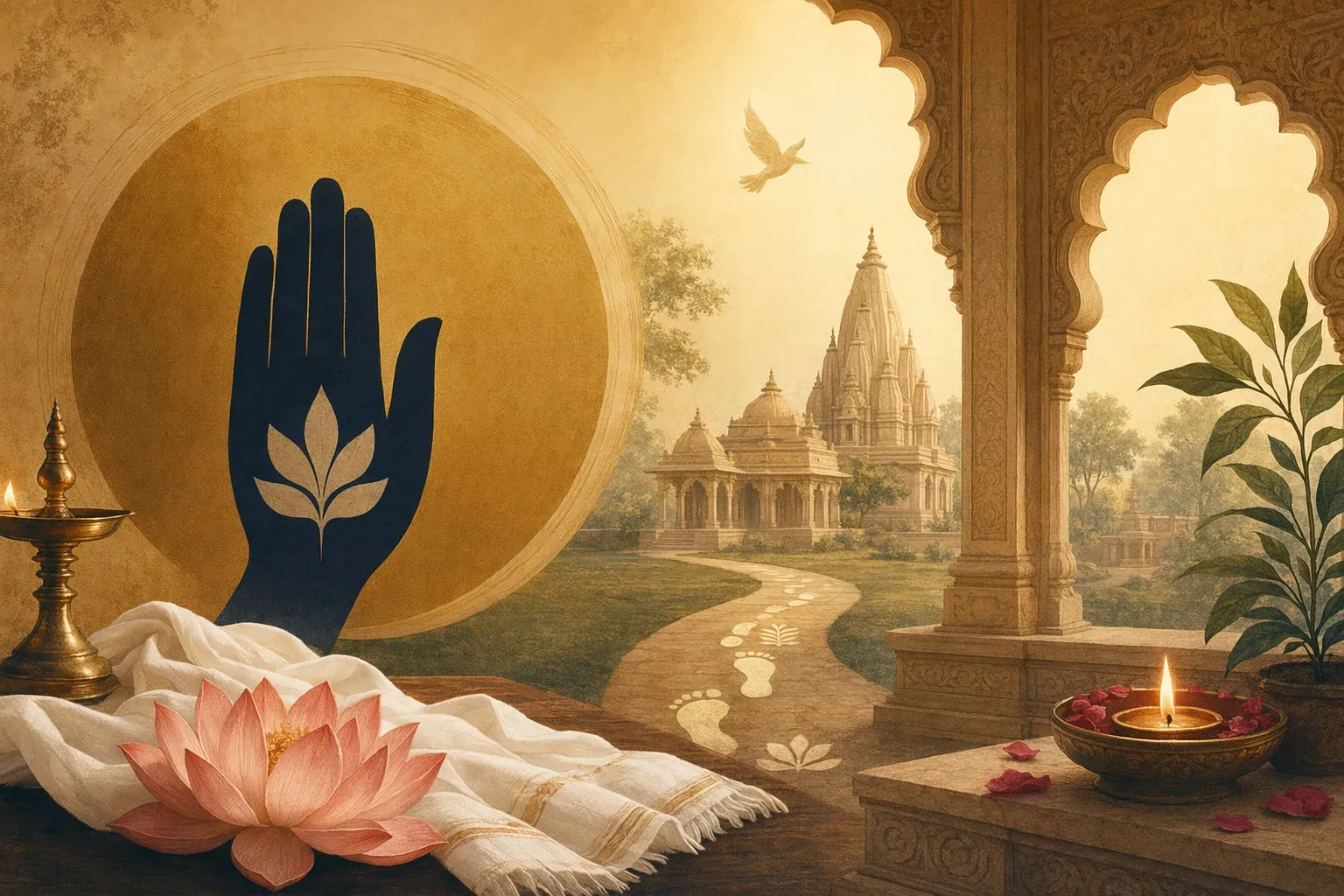
Jainism is an ancient Indian dharma tradition centred on ahimsa, self-discipline, karma, compassion, and liberation. It teaches that every living being has spiritual value, and that the soul becomes free by reducing violence, attachment, anger, greed, and ignorance.
For beginners, Jainism is easiest to understand as a path of careful living. It does not ask only what a person believes in the mind; it asks how a person eats, speaks, earns, travels, consumes, and treats other beings. That is why Jain ideas can feel surprisingly modern, especially in conversations about non-violence, ecology, restraint, and ethical choices.
Simple meaning of Jainism
The word Jain comes from jina, meaning a spiritual conqueror: one who has conquered inner enemies such as attachment, anger, pride, and greed. Jains revere Tirthankaras, great teachers who show the path across the difficult river of worldly bondage. Mahavira, who lived in ancient India, is remembered as the 24th Tirthankara of the present time cycle.
Jainism is not a branch of another religion, and it is not just a philosophy of vegetarianism. It is a complete religious and ethical tradition with scriptures, monks, nuns, lay communities, temples, festivals, pilgrimage, vows, rituals, and a deep theory of karma and liberation.
Ahimsa: the heart of Jain practice
Ahimsa means non-violence, but in Jainism it goes far beyond “do not hurt people”. It includes care toward animals, insects, plants, speech, thought, and intention. This is why many Jains follow vegetarianism, and why stricter practitioners may avoid root vegetables, night eating, or professions that cause harm. The level of practice varies between monks, nuns, and householders.
Ahimsa is not weakness. It is disciplined strength. It asks a person to pause before causing harm for convenience, anger, taste, profit, or habit. Even when complete harmlessness is difficult in ordinary life, the Jain path asks people to reduce harm as much as possible.
Karma, soul, and liberation
Jainism teaches that souls, called jivas, are real and eternal. Karma is not only a moral saying; in Jain thought it is a subtle bondage that attaches to the soul through actions, passions, and ignorance. Liberation, or moksha, means the soul becomes completely free from karmic bondage and rises to its pure, perfected state.
Bhaktilipi readers may already know karma from Hindu and popular Indian contexts. Our karma meaning guide explains the broader idea, but Jainism has its own precise understanding of karma, discipline, and liberation.
How Jainism is lived today
Jain communities today are found across India and the world. Many are known for temple devotion, business ethics, charity, education, vegetarian food culture, fasting, festival observances, and support for monks and nuns. Important festivals and practices include Paryushan, Mahavir Jayanti, pratikraman, fasting, temple worship, and listening to discourses.
Not every Jain lives identically. Some are very strict, some are moderate, and some are culturally connected while still learning. Like other living traditions, Jainism includes regional, sectarian, family, and personal variation.
Common misunderstandings
One misunderstanding is that Jainism is simply “extreme vegetarianism”. Food discipline is important, but it is only one part of a larger path of self-control and compassion. Another misunderstanding is that Jains worship “many gods” in the same way as creator deities. Jain reverence is more focused on perfected beings and liberated teachers who show the path.
A third misunderstanding is that Jainism rejects the world out of negativity. A better way to say it is that Jainism takes the consequences of action very seriously. It teaches restraint not because life is hated, but because life is precious.
The three jewels of Jainism
A classic way to understand Jain practice is through the three jewels: right faith, right knowledge, and right conduct. Right faith means trusting the truth of the path as taught by the enlightened ones. Right knowledge means understanding reality clearly, including soul, karma, and the consequences of action. Right conduct means living in a disciplined way that reduces harm and attachment.
These three belong together. Belief without conduct becomes empty, knowledge without humility becomes pride, and conduct without understanding can become mechanical. Jainism asks for inner transformation, not only outer identity.
Anekantavada and careful thinking
Another important Jain idea is anekantavada, often explained as the many-sided nature of reality. It teaches that ordinary human viewpoints are limited, so we should speak with care and avoid arrogant certainty. This does not mean “anything is true”. It means truth is deep, and our descriptions should be humble.
For young readers, this is one of Jainism’s most useful lessons. Online arguments often reward extreme statements. Jain thinking reminds us that restraint belongs not only in food and lifestyle, but also in language, judgement, and debate.
How to approach Jainism as a beginner
A good first approach is to avoid two extremes. Do not reduce Jainism to food rules alone, and do not treat it as only abstract philosophy. The tradition joins everyday discipline with deep metaphysics. What a person eats, how they speak, how they earn, and how they react to anger are all connected to the soul’s journey.
If you meet Jain friends or visit a Jain temple, ask with humility rather than assumptions. You may find differences between Shvetambara, Digambara, Sthanakvasi, Terapanthi, regional, and family practices. Those differences do not cancel the shared centre: ahimsa, karma, restraint, and liberation.
What beginners should remember
If you are comparing Indian traditions more widely, our dharma guide and Upanishads beginner guide can help you see shared vocabulary while still respecting Jainism’s distinct path.
Jainism is a living Indian tradition of non-violence, self-discipline, karma, and liberation. Its most famous value is ahimsa, but its full vision includes the soul, Tirthankaras, vows, community life, worship, and careful ethical action. For young readers, its lasting challenge is simple and powerful: live so that your freedom does not depend on harming others.