
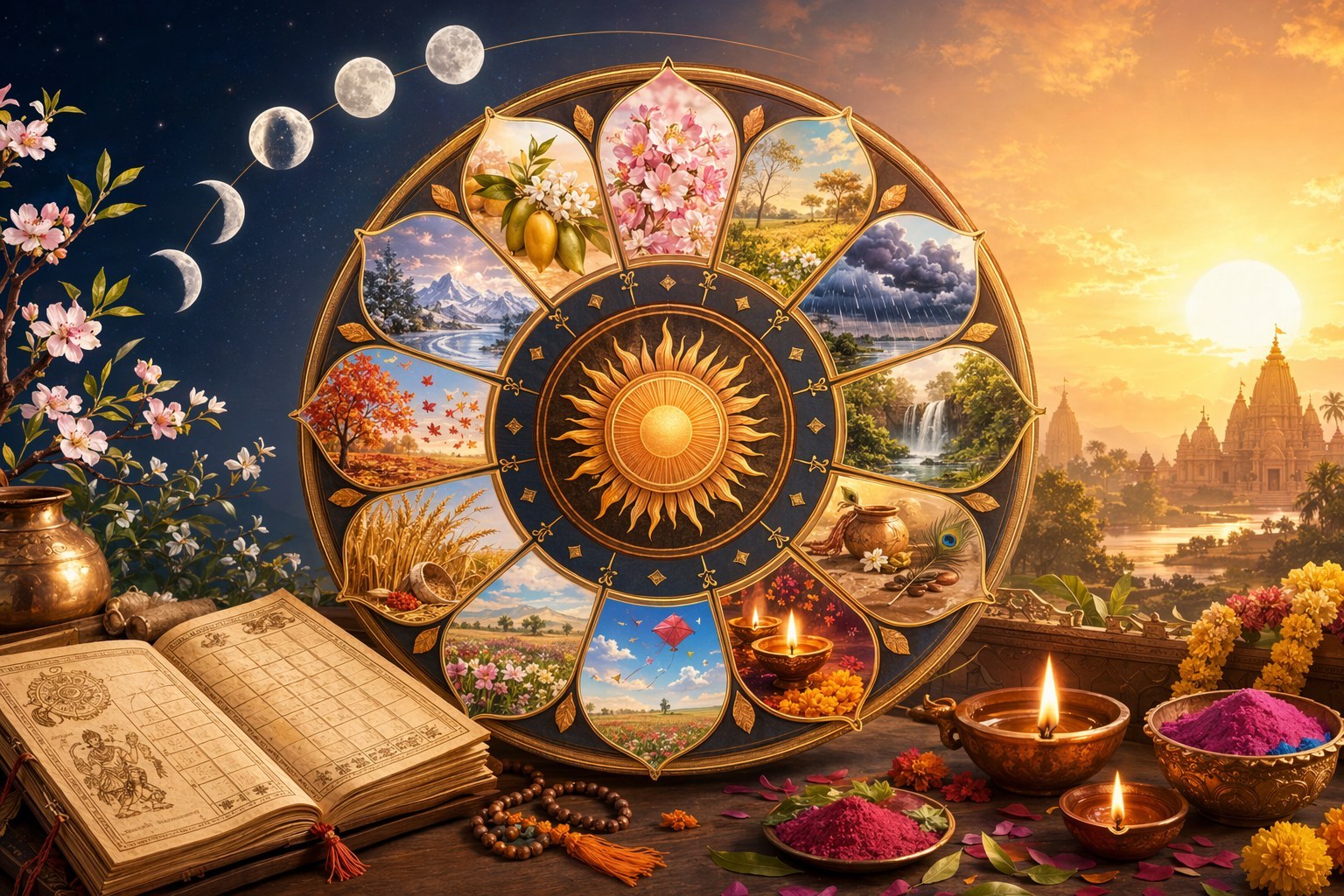
If the Hindu calendar feels like a beautiful but confusing puzzle, the month names are a great place to start.
You may have heard words like Chaitra, Shravan, Kartik, and Phalguna during festivals, vrat kathas, school projects, or family conversations. These are not random poetic names. They are part of a traditional way of measuring time through the Moon, the Sun, seasons, and culture.
Here is the simple Bhaktilipi guide to the 12 Hindu months, from Chaitra to Phalguna, without making it feel like an astronomy exam.
What are the 12 Hindu months?
The common lunar month names used in many Hindu calendars are:
| Order | Hindu month | Simple memory hook |
|---|---|---|
| 1 | Chaitra | Spring energy; many New Year traditions begin around this time |
| 2 | Vaishakha | Warm-season month; linked with sacred bathing and charity in many traditions |
| 3 | Jyeshtha | Peak summer feeling in many parts of India |
| 4 | Ashadha | Monsoon begins; Guru Purnima and Chaturmas associations in many calendars |
| 5 | Shravana / Shravan | A deeply devotional month, especially for Shiva worship in many regions |
| 6 | Bhadrapada | Ganesh Chaturthi season in many calendars |
| 7 | Ashwin / Ashvina | Navratri and Durga Puja season in many traditions |
| 8 | Kartik / Kartika | Diwali period and a major devotional month in many traditions |
| 9 | Margashirsha / Agrahayana | Early winter month; praised in several devotional contexts |
| 10 | Pausha | Winter month with regional observances |
| 11 | Magha | Known for Magh snan/charity traditions in many places |
| 12 | Phalguna | Holi season and the closing month before Chaitra in many lunar calendars |
Spellings can vary in English. For example, Vaishakha may be written as Vaisakha, Shravana as Shravan, Ashvina as Ashwin, and Kartika as Kartik.
Quick memory trick: festivals can help you remember the months
A simple way to remember Hindu months is to connect them with festivals and seasons. This is not a perfect rule for every region, but it is very useful for beginners.
- Chaitra — spring and New Year feeling in many traditions, such as Ugadi/Gudi Padwa/Chaitra Navratri contexts.
- Shravana — devotion to Shiva is especially visible in many parts of India.
- Ashwin — Navratri and Durga Puja are major cultural markers.
- Kartik — Diwali and Kartik devotion make it easy to remember.
- Phalguna — Holi helps many people remember the end of the lunar-year cycle.
Important: India is diverse. A festival’s exact date can depend on tithi, region, local sunrise, and panchang rules. So use these as memory hooks, not as strict date formulas.
Which Hindu month comes first?
In many lunar Hindu calendar traditions, Chaitra is treated as the first month of the year. That is why several New Year celebrations happen around Chaitra Shukla Pratipada in different regional traditions.
But this is where Hindu timekeeping gets interesting: not every Indian calendar starts the year in the same way. Some regional and solar calendars use different starting points. That is why Tamil New Year, Malayalam calendar traditions, Bengali calendar traditions, Vikram Samvat, and other systems can feel different even though they are part of the broader Indian calendar world.
Are Hindu months lunar or solar?
Many Hindu religious calendars are lunisolar. That means they pay attention to both the Moon and the Sun.
- The Moon helps define tithi, paksha, and lunar months.
- The Sun helps keep the calendar connected with seasons.
- An extra month, called Adhik Maas, is added from time to time so lunar months do not drift too far away from seasonal rhythm.
This is why Hindu festival dates often move on the Gregorian calendar. The festival logic is usually based on tithi and lunar month, not fixed English dates like 1 January or 15 August.
How does a Hindu month work?
A simple way to understand it: a lunar month is built around the Moon’s cycle and divided into two halves called paksha.
- Shukla Paksha — the bright half, when the Moon grows toward Purnima.
- Krishna Paksha — the dark half, when the Moon moves toward Amavasya.
Each paksha has about 15 tithis, so a lunar month has 30 tithis. This is why festival names often sound like a formula: month + paksha + tithi. For example, “Kartik Amavasya” or “Chaitra Shukla Pratipada.”
Amanta vs Purnimanta months: why calendars can disagree
AnswerThePublic surfaced this as a clear beginner question, and it is worth explaining simply.
- Amanta system: the lunar month ends with Amavasya, the new moon.
- Purnimanta system: the lunar month ends with Purnima, the full moon.
Because of this, the same tithi can sometimes be placed under different month names depending on the regional calendar tradition. That does not mean one family is “wrong” and another is “right”. It usually means they are following different panchang traditions.
The 12 Hindu months in simple English
1. Chaitra
Chaitra is often associated with spring, freshness, and New Year beginnings in many Hindu traditions. Chaitra Navratri also makes this month culturally important.
2. Vaishakha
Vaishakha continues the spring-to-summer rhythm. It is linked with sacred bathing, charity, and devotional observances in many traditions.
3. Jyeshtha
Jyeshtha often carries the feeling of intense summer. Think heat, endurance, and the approach of the monsoon.
4. Ashadha
Ashadha is strongly connected with the monsoon mood in many parts of India. Guru Purnima and Chaturmas associations make it spiritually meaningful.
5. Shravana
Shravana, commonly called Shravan, is one of the most recognizable Hindu months. Many people connect it with Shiva worship, Monday vrats, and a deeply devotional atmosphere.
6. Bhadrapada
Bhadrapada is remembered by many people because of Ganesh Chaturthi. It is a month where home worship, community celebration, and cultural devotion become very visible.
7. Ashwin
Ashwin or Ashvina is famous for Navratri, Durga Puja, and Dussehra season in many traditions. It carries the energy of Shakti, victory, and festive preparation.
8. Kartik
Kartik or Kartika is one of the most beloved months because Diwali often falls in this period in many calendars. Kartik is also considered a powerful month for devotion, lamps, bathing, and charity in many traditions.
9. Margashirsha
Margashirsha, also called Agrahayana in some contexts, is an early-winter month. It has strong devotional associations and is remembered in many cultural traditions.
10. Pausha
Pausha is a winter month. Like many Hindu months, its local festivals and observances can vary across regions.
11. Magha
Magha is associated with winter-to-spring transition and practices such as sacred bathing and charity in many places. Magh Mela traditions make the name familiar to many readers.
12. Phalguna
Phalguna is the month many people remember because of Holi. It closes the cycle before Chaitra begins again in many lunar-calendar traditions.
Why Hindu months do not match fixed English dates
A Gregorian month like January always starts on January 1. A Hindu lunar month does not work like that. It depends on lunar phases, tithi, and regional panchang rules.
So Chaitra does not permanently equal one fixed English month, and Kartik does not permanently equal one fixed English month. They usually fall around certain seasons, but the exact Gregorian dates shift each year.
How to read Hindu month names in a panchang
- Check the location, because panchang calculations depend on sunrise and local timing.
- Find the month name, such as Chaitra or Kartik.
- Check the paksha: Shukla or Krishna.
- Check the tithi: Pratipada, Ekadashi, Purnima, Amavasya, etc.
- For actual puja, vrat, or muhurat timing, follow a trusted local panchang or a knowledgeable family/community source.
For learning, the month list is enough. For ritual timing, never depend only on a random social-media forward.
A simple Bhaktilipi takeaway
The 12 Hindu months are not just old calendar words. They are cultural memory. They connect seasons, festivals, devotion, family routines, and the rhythm of Indian life.
Start with the order: Chaitra, Vaishakha, Jyeshtha, Ashadha, Shravana, Bhadrapada, Ashwin, Kartik, Margashirsha, Pausha, Magha, Phalguna. Then slowly connect each month with its season and festival mood.
Once you understand that, the Hindu calendar stops feeling like code and starts feeling like a living map of time.
FAQs
What are the 12 Hindu months?
The 12 common Hindu lunar months are Chaitra, Vaishakha, Jyeshtha, Ashadha, Shravana, Bhadrapada, Ashwin, Kartik, Margashirsha, Pausha, Magha, and Phalguna.
Which is the first Hindu month?
In many lunar Hindu calendar traditions, Chaitra is considered the first month. However, regional and solar calendars may follow different New Year systems.
Are Hindu months lunar or solar?
Many Hindu religious calendars are lunisolar, meaning they use lunar months while also staying connected with the solar year and seasons.
What is the difference between Amanta and Purnimanta months?
In the Amanta system, the lunar month ends with Amavasya. In the Purnimanta system, the lunar month ends with Purnima. This is one reason calendars can differ by region.
Why do Hindu month dates change every year?
Hindu lunar months follow Moon-based timing and tithis, while the Gregorian calendar follows fixed solar months. Because the systems do not match exactly, dates shift on the English calendar.
Which Hindu month is Diwali in?
Diwali is commonly associated with Kartik Amavasya in many traditions, but exact observance details can vary by region and panchang.
Which Hindu month is Holi in?
Holi is commonly associated with Phalguna, especially around Phalguna Purnima and the following celebration, but local traditions can vary.