
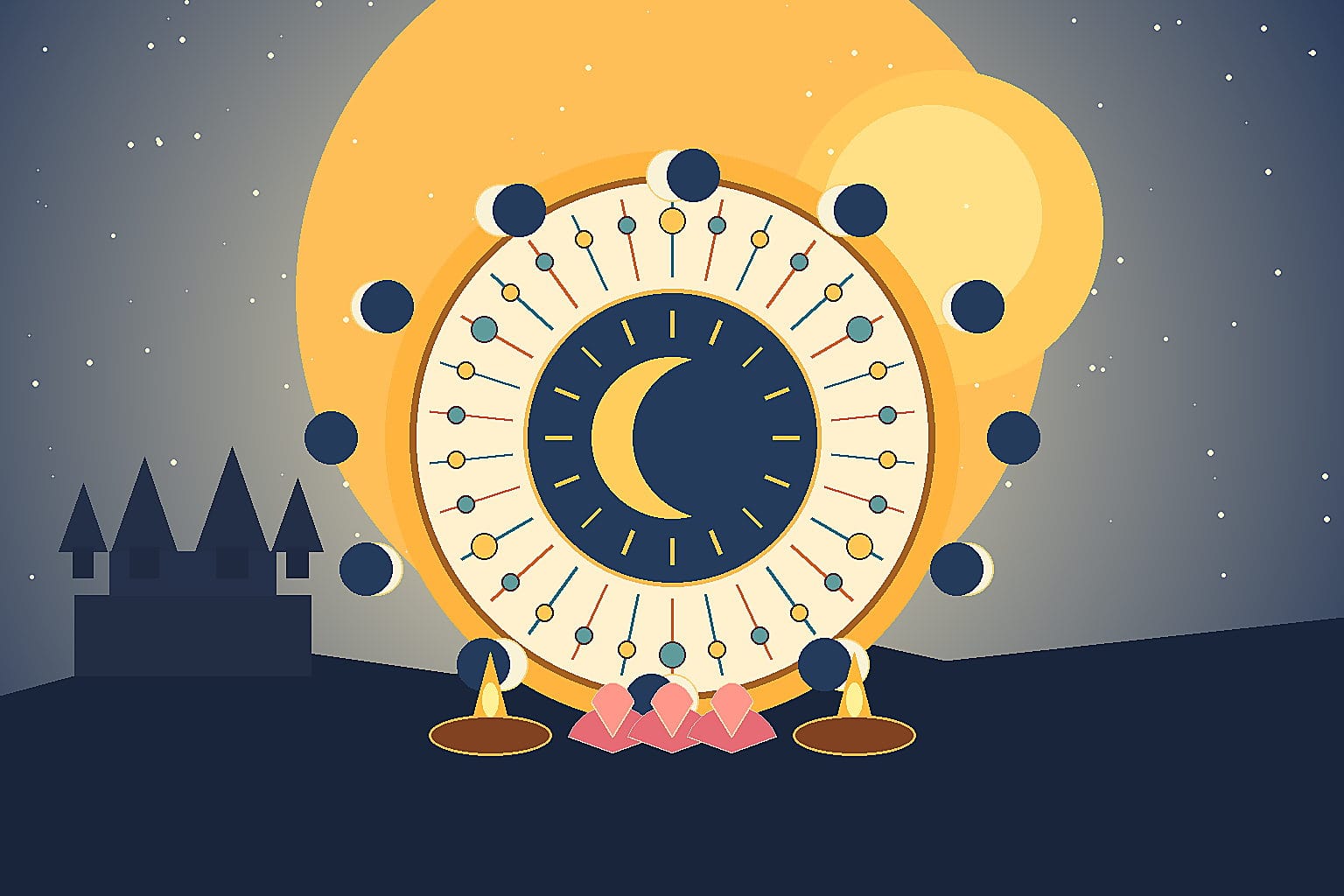
If you have ever checked a panchang and seen words like Ekadashi, Amavasya, or Purnima, you have already met the idea of tithi.
In simple words, a tithi is a lunar date in the Hindu calendar. It is not exactly the same as a normal calendar date like “26 May,” because it is based on the changing angle between the Moon and the Sun.
Think of it like this: the Gregorian calendar mainly asks, “What date is it after midnight?” The Hindu panchang asks a deeper sky-based question: “What is the relationship between the Sun and the Moon right now?” That lunar relationship gives us the tithi.
Tithi meaning in simple words
Tithi (तिथि) means a lunar day or lunar date. In Hindu calendar usage, it is one of the most important parts of the panchang, the traditional Hindu almanac.
A tithi is calculated from the longitudinal angle between the Moon and the Sun. When that angle increases by 12 degrees, one tithi is completed. Since a full circle is 360 degrees, one lunar month has 30 tithis.
That sounds technical, but the idea is simple: a tithi measures the Moon’s changing relationship with the Sun.
Why is tithi not the same as a normal date?
A normal civil date usually runs from midnight to midnight. A tithi does not have to do that.
A tithi can begin in the morning, afternoon, evening, or night. It can also end before the next sunrise, or continue across two sunrises. This is why festival dates can sometimes feel confusing when we compare a Hindu calendar with a regular phone calendar.
For many Hindu observances, the important question is not only “What date is printed on the calendar?” It is also “Which tithi is active at the correct time according to the panchang?”
How is a tithi calculated?
The basic calculation is:
A tithi is completed every time the angular distance between the Moon and the Sun increases by 12 degrees.
There are 30 such steps in a lunar month:
- 15 tithis in Shukla Paksha, the waxing half of the Moon
- 15 tithis in Krishna Paksha, the waning half of the Moon
Because the Moon’s motion is not perfectly uniform, the length of a tithi is not fixed like a 24-hour day. It is usually close to a day, but it can be shorter or longer.
What are Shukla Paksha and Krishna Paksha?
Paksha means a fortnight or side of the lunar month. The Hindu lunar month is divided into two pakshas.
- Shukla Paksha: the bright/waxing half, when the Moon grows from Amavasya toward Purnima
- Krishna Paksha: the dark/waning half, when the Moon reduces from Purnima toward Amavasya
So when someone says “Shukla Ekadashi” or “Krishna Ashtami,” they are naming both the tithi and the lunar half in which it falls.
What are the 30 tithis?
The tithi names repeat in both pakshas. The first fourteen names are common, and the fifteenth changes depending on the paksha.
| Number | Tithi name | Simple note |
|---|---|---|
| 1 | Pratipada | First tithi |
| 2 | Dwitiya | Second tithi |
| 3 | Tritiya | Third tithi |
| 4 | Chaturthi | Fourth tithi |
| 5 | Panchami | Fifth tithi |
| 6 | Shashthi | Sixth tithi |
| 7 | Saptami | Seventh tithi |
| 8 | Ashtami | Eighth tithi |
| 9 | Navami | Ninth tithi |
| 10 | Dashami | Tenth tithi |
| 11 | Ekadashi | Eleventh tithi |
| 12 | Dwadashi | Twelfth tithi |
| 13 | Trayodashi | Thirteenth tithi |
| 14 | Chaturdashi | Fourteenth tithi |
| 15 | Purnima or Amavasya | Full Moon or New Moon tithi |
In Shukla Paksha, the fifteenth tithi is Purnima, the full moon. In Krishna Paksha, the fifteenth tithi is Amavasya, the new moon.
Why does tithi matter for puja, vrat, and festivals?
Many Hindu festivals and vrats are connected to a specific tithi. For example, Ekadashi is connected with the eleventh tithi, Chaturthi with the fourth tithi, Purnima with the full moon tithi, and Amavasya with the new moon tithi.
This is also one reason Hindu festival dates can shift on the Gregorian calendar each year. The festival follows the tithi, not a fixed January-to-December date.
For ritual timing, families often check a reliable panchang, temple calendar, or local tradition. Location can matter too, because sunrise and tithi timings are calculated for a place.
What is death tithi or punya tithi?
Death tithi usually means the lunar tithi on which a person passed away. In many families, yearly remembrance rituals are observed by tithi rather than by the English calendar date.
Punya tithi is often used respectfully for the death anniversary or remembrance day of a revered person, saint, family elder, or public figure.
This can be emotionally important, so it is best not to guess. If the exact observance matters, check the family’s tradition and a reliable local panchang.
Are some tithis auspicious or inauspicious?
Different traditions associate different tithis with different kinds of activities. Some tithis are especially loved for vrat, puja, study, charity, or remembrance. Some may be avoided for certain new beginnings depending on the custom being followed.
But we should not oversimplify this into “this tithi is always good” or “that tithi is always bad.” Hindu practice is regional, family-based, and context-sensitive. Dharma is not just a checklist; intention, timing, tradition, and the nature of the action all matter.
Where can you check today’s tithi?
You can check today’s tithi in a panchang, temple calendar, or a trusted Hindu calendar website/app. For practical use, choose a source that lets you set your city or location.
If you are checking a festival, vrat, shraddha, or muhurat, avoid relying only on a generic screenshot. Use a panchang that clearly shows the tithi start and end time for your place, or ask a knowledgeable family priest or local temple.
A simple Bhaktilipi takeaway
A tithi is the Hindu calendar’s lunar date. It is based on the Moon-Sun angle, not only on midnight-to-midnight clock time.
Once you understand tithi, many things become easier: why Ekadashi moves, why Purnima and Amavasya matter, why festival dates shift, and why the panchang is still so important in Hindu cultural life.
In short: a regular date tells you where you are on the civil calendar. A tithi tells you where you are in the rhythm of the Moon.
FAQs
What is the basic meaning of tithi in Hinduism?
Tithi means a lunar day or lunar date in the Hindu calendar. It is calculated from the changing angular distance between the Moon and the Sun.
What is tithi called in Hindi and Sanskrit?
In Hindi and Sanskrit, it is written as तिथि. In English, it is usually explained as a lunar day or lunar date.
What is the difference between date and tithi?
A normal date usually runs from midnight to midnight. A tithi follows the Moon-Sun relationship and can begin or end at different times of the day.
How many tithis are there in a lunar month?
There are 30 tithis in a lunar month: 15 in Shukla Paksha and 15 in Krishna Paksha.
Why do Hindu festivals follow tithi?
Many Hindu festivals and vrats are linked with lunar timing. That is why the festival follows the relevant tithi instead of always falling on the same Gregorian calendar date.
Where should I check today’s tithi?
Use a reliable panchang or Hindu calendar source that supports your city/location. For rituals, check with your family tradition, local temple, or priest.
Sources and further reading
- Wikipedia — Tithi (used for basic astronomical definition and tithi list cross-checking)
- Wikipedia — Panchangam (used for panchang context and five-limb almanac overview)
- India Meteorological Department — Rashtriya Panchang / Positional Astronomy Centre (for authoritative panchang publication context)
- Bhaktilipi — Hindu Calendar for Beginners