
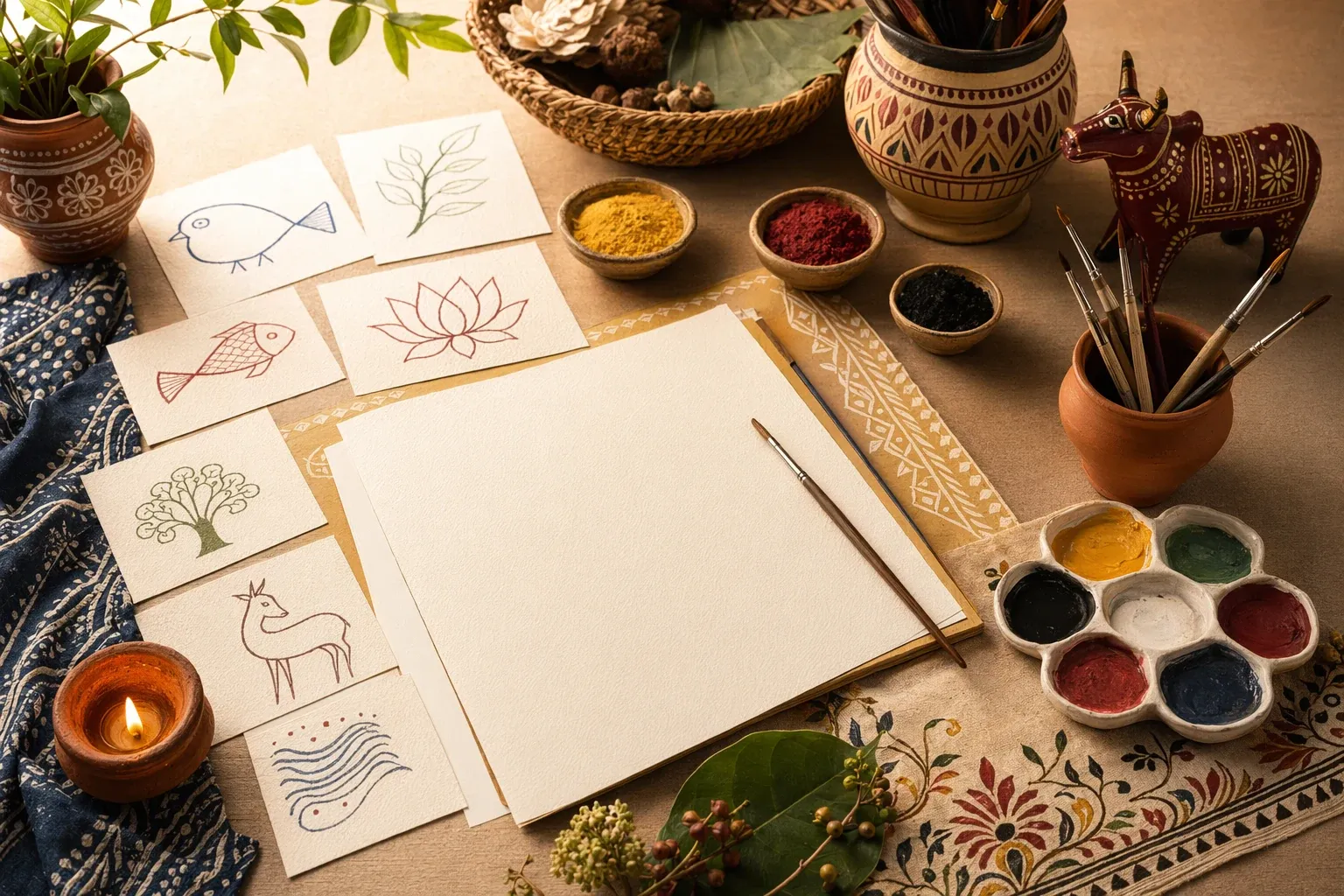
Start drawing Indian folk art with simple borders, animals, trees, and balanced compositions while learning the cultural care behind each tradition. This article introduces the subject in clear language for readers who want cultural context, visual clues, and practical appreciation.
Begin with respect before the first line
Learning to draw Indian folk art can be joyful, but it should begin with respect. These traditions are not generic doodle styles. Many designs come from homes, rituals, festivals, community memory, and devotional settings. A beginner can practise motifs, borders, animals, and compositions while still naming the tradition honestly. The aim is not to claim mastery after one page, but to develop careful eyes, patient hands, and appreciation for the artists who keep these forms alive.
Choose one tradition for one practice session
Instead of mixing every Indian motif at once, choose one tradition for a single page. Try a Warli-inspired village scene, a Madhubani-inspired fish and border study, or a Gond-inspired animal filled with dots and lines. This keeps your practice clearer. Each tradition has its own rhythm. Warli depends on geometry and spacing; Madhubani often fills surfaces densely; Gond patterns make animal bodies feel alive from within.
Simple tools are enough
You do not need expensive materials to begin. A pencil, eraser, black pen, ruler, and a few colours are enough for early practice. Use plain paper first. If you later explore natural pigments, handmade paper, cloth, or brushes, do so as a deeper study. For now, the most important tools are observation and patience. Draw slowly enough that repeated lines become steady rather than rushed.
Warm up with borders
Borders are a gentle entry into folk art drawing because they teach rhythm. Make a frame using triangles, leaves, dots, waves, small flowers, or alternating lines. Keep the spacing regular but not mechanical. A handmade border should feel alive. Once the border is ready, the centre of the page feels more intentional. In many traditions, the border is not just decoration; it creates a protected visual space.
Try a Warli human figure
For a Warli-inspired figure, draw a small circle for the head, two triangles meeting at the waist for the body, and simple lines for arms and legs. A group of such figures can dance, farm, play drums, or carry baskets. The charm comes from posture. A lifted arm or bent knee can make the figure feel active. Learn more about the tradition through Warli art for beginners before making elaborate scenes.
Draw a fish with patterned filling
A fish is a good motif for Madhubani-inspired practice. Begin with an almond shape, add a tail, place a round eye, and divide the body into sections. Fill each section with lines, dots, scales, leaves, or tiny curves. The goal is not realism. The goal is abundance and rhythm. Fish often connect with water, fertility, and prosperity, as explained in our guide to symbols and meanings.
Build a tree of life
A tree of life can teach balance. Draw a trunk rising from the bottom centre, then create branches that spread evenly across the page. Add leaves, birds, flowers, fruit, or small animals. Keep repeating shapes, but vary their size slightly. The tree should feel full, not stiff. This motif helps beginners understand how folk art can turn nature into a complete world rather than a background object.
Use pattern to fill, not to clutter
Many beginners fill every space too quickly. Pattern is powerful when it supports the subject. In a Madhubani-inspired drawing, dense filling can be beautiful, but the eye still needs paths to travel. In a Gond-inspired animal, dots and dashes should follow the body’s movement. In Warli-inspired scenes, open space is part of the elegance. Ask whether each mark strengthens the image or only adds noise.
Create a village scene
A simple village scene can include a hut, a tree, two people, a bird, a sun, and a border. Decide the main action first. Are people dancing, drawing water, planting, celebrating, or welcoming guests? Place the largest shape first, then add smaller details. Folk art often shows events clearly and symbolically, so the scene does not need perspective like a realistic landscape. Clarity matters more than depth.
Colour with a limited palette
A limited palette helps beginners. Try red, black, yellow, green, and blue for a Madhubani-inspired page, or brown paper with white pen for Warli-inspired practice. Gond-inspired work can use brighter colour fields with patterned interiors. Choose colours with awareness. Some traditions historically used natural pigments, while modern artists may use acrylics. Colour is not only decoration; it creates mood, contrast, and regional memory.
Avoid careless sacred copying
Some images are devotional or ritual in origin. If you copy a deity, shrine cloth, marriage motif, or ceremonial wall design without context, the result may feel careless. For early practice, use general motifs such as borders, animals, trees, dancers, and village scenes. When you do study sacred subjects, learn their names, setting, and significance. Respect means allowing some designs to remain more than drawing exercises.
Credit your inspiration
If you share your practice online or in a classroom, write what inspired it. Say Warli-inspired study, Madhubani-inspired fish practice, or Gond-inspired pattern exercise. This small habit matters because it points viewers toward the tradition instead of presenting the design as a personal invention. It also encourages you to learn from actual artists, museums, books, workshops, and community sources.
A calm practice plan
Make three pages over three days. On the first page, draw borders and repeated motifs. On the second, draw one animal or tree and fill it with pattern. On the third, create a small scene with people, nature, and a frame. Keep your first pages. Folk art learning rewards repetition, and you will see your line become more confident. The beauty is in steady practice, not instant perfection.
Let drawing become looking
The best result of beginner drawing is not only a finished page. It is a better way of looking. After drawing a border, you notice borders in old paintings. After drawing a fish, you see how differently each tradition shapes water life. After drawing a dancer, you notice rhythm in a line. Drawing becomes a doorway into appreciation, and appreciation becomes more respectful when it remains curious.
Continuing the journey
For related reading, see Warli art for beginners. Let the next artwork you see become a patient conversation with region, maker, material, symbol, and use. Indian folk art rewards slow attention, and every careful question adds depth to the first moment of visual delight.