
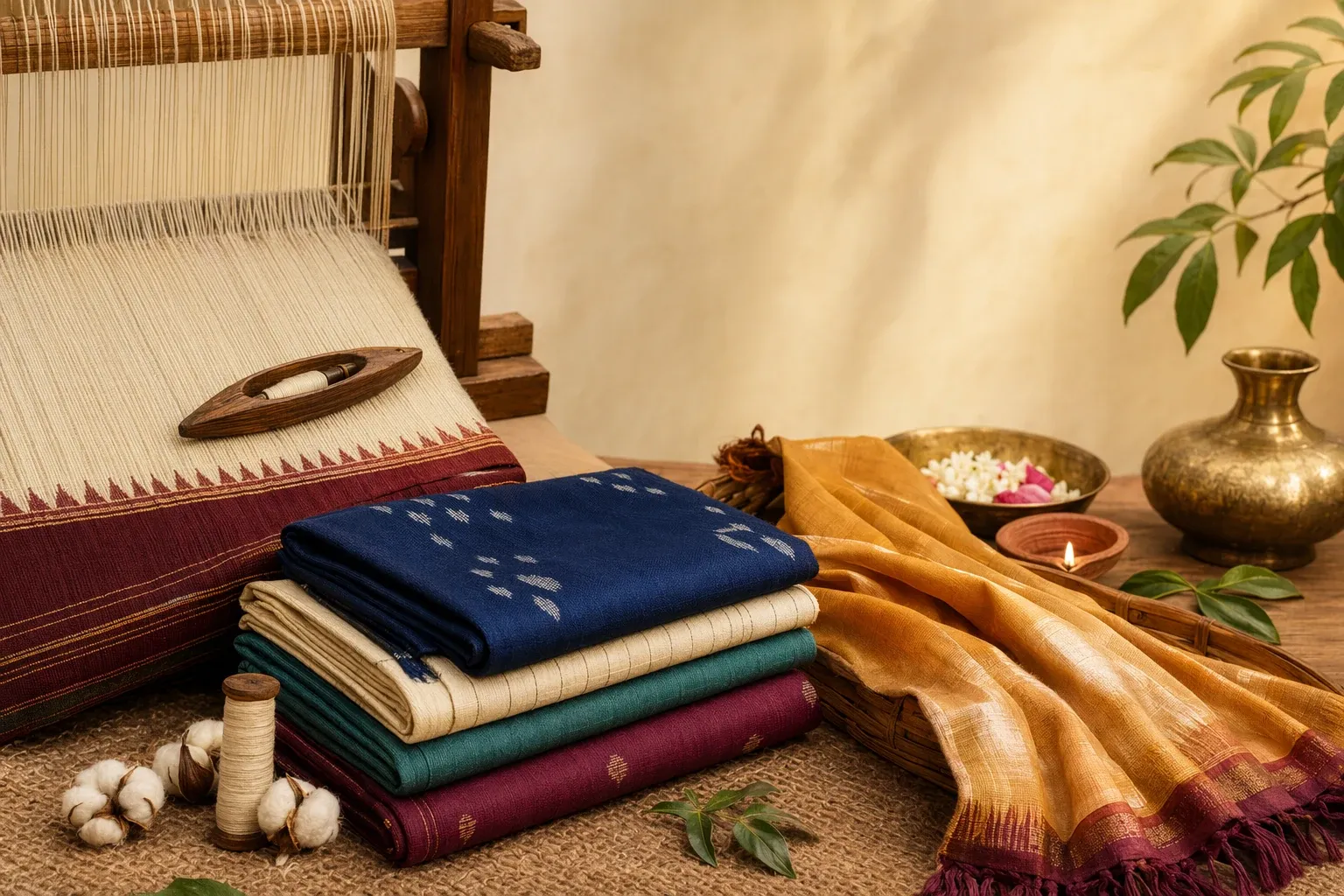
A genuine handwoven fabric rarely shouts for attention. It reveals itself slowly through texture, small irregularities, the behaviour of yarn, and the way motifs sit inside the cloth. Indian weaving traditions are vast, from Banarasi brocade and Kanjeevaram silk to Ikat, Jamdani, Chanderi, Maheshwari, Tangaliya, Paithani, Kota Doria, Muga silk, and many local cotton weaves. A beginner can feel overwhelmed, especially because machine-made fabrics often imitate handloom names. The aim is not to become an expert overnight, but to learn the practical signs that help you ask better questions.
Handwoven cloth is made by interlacing warp and weft on a loom operated by a weaver. The process can be simple or extremely complex. It may involve pre-dyed yarn, extra weft motifs, supplementary borders, zari, tie-dye patterning, or fine count cotton. Because human rhythm guides the loom, handwoven fabric often has personality. It may not be mathematically identical from one inch to the next, and that is part of its beauty.
Begin with the selvedge
The selvedge is the finished edge running along the length of the fabric. In many handwoven textiles, the selvedge has a firm, integrated look because it is formed as part of the weaving. It may show tiny variations, slight waviness, or changes in tension. A cut edge, by contrast, may fray more easily. Some powerloom fabrics also have neat selvedges, so this sign is not enough by itself, but it is a good place to begin.
On saris and dupattas, observe how the border meets the body. In many handwoven pieces, the transition has depth because the border is woven into the structure rather than printed on top. In some traditions, joins or changes in weaving direction may be visible if you know where to look. The edge can tell you whether the cloth was built patiently or decorated after production.
Look for living irregularities, not careless defects
Handwoven fabric may contain minor slubs, changes in yarn thickness, or tiny shifts in spacing. These are not the same as damage. A broken thread, stain, hole, or loose snag is a defect; a small rhythm change is often part of handloom character. The fabric may have a gentle unevenness when held against light. In a fine handwoven cotton or silk, the surface can feel alive rather than flat.
Machine cloth often repeats with perfect regularity. Printed imitation motifs may sit on top of the cloth without changing the weave. In a woven motif, the pattern is part of the fabric structure. Turn the cloth over and see whether the design has a corresponding presence on the back. With brocade, Jamdani, Ikat, and extra-weft work, the reverse can be especially revealing.
Study the motif from both sides
Indian handwoven textiles use many different methods to create motifs. In Ikat, the yarn is tied and dyed before weaving, so the pattern may have feathered edges where colours meet. This blur is not a printing mistake; it is a signature of the technique. In Jamdani, motifs are inserted by hand with supplementary weft, often giving a floating, delicate appearance. In brocade, metallic or silk threads create rich patterns that are woven into the cloth.
A printed copy may show the motif clearly on the front but faintly or not at all on the back. It may also repeat with a mechanical sameness. Handwoven motifs can repeat, of course, but they often carry tiny differences in alignment or density. If the fabric claims to be handwoven, the reverse side should support the story.
Feel the yarn and drape
Touch is one of the best teachers. Handwoven cotton may feel breathable and slightly textured. Handwoven silk can have body, warmth, and a natural fall that differs from synthetic shine. Woollen shawls may show nuanced fibre texture rather than a uniform plastic smoothness. With time, you learn to distinguish crispness, softness, weight, and elasticity.
Do not rely only on shine. Artificial fibres can be very shiny, while real silk can be understated. A very low price for a complex silk brocade or an elaborate handwoven sari should make you pause. Handwork takes time. If the price seems impossibly low, the piece may be machine-made, blended, second-quality, or mislabelled. Price alone cannot prove authenticity, but it should match the labour claimed.
Ask specific questions
A trustworthy seller should be able to answer basic questions: where was it woven, what fibre is used, what technique created the motif, whether zari is real or tested, whether the piece is handloom, powerloom, or mill-made, and how to care for it. Vague answers are not always dishonest, but they are a warning sign when the price is high.
For named textiles, ask for the weaving centre or community context. Banarasi, Kanjeevaram, Chanderi, Maheshwari, Sambalpuri, Patola, Paithani, Kota Doria, and many other names refer to particular histories and techniques. Some have geographical indication protections or recognised clusters. A certificate can help, but it should be read along with the fabric itself.
Check labels without surrendering judgement
Labels such as handloom marks, cooperative tags, artisan group certificates, and store documentation can support a purchase. They are useful, especially for beginners. However, labels can be missing from genuine older pieces, and labels can also be misused. Treat documentation as one piece of evidence, not the whole case.
If you are buying online, look for close photographs of the front, reverse, selvedge, border, pallu or end panel, and texture. A seller who shows only glossy model images is not giving you enough information. For expensive purchases, request natural-light photographs and ask about returns. Genuine textile sellers often welcome informed questions.
Learn by comparing similar fabrics
One of the fastest ways to learn is to compare handwoven and machine-made versions side by side. Visit handloom exhibitions, museum shops, craft fairs, cooperatives, or trusted textile stores. Handle a handwoven cotton sari, then a mill-made imitation. Look at an Ikat where the pattern is in the yarn, then a printed Ikat-style fabric. The difference becomes clearer with direct comparison.
Bhaktilipi’s article on Indian textiles in modern fashion offers a wider look at how traditional fabrics enter contemporary wardrobes. For home use, the guide to Indian textiles for home decor can help you think beyond clothing.
Respect the labour behind the cloth
Authenticity is not only about avoiding fakes. It is also about respecting the person who made the fabric. A handwoven piece may represent days, weeks, or months of skill. Bargaining too aggressively with artisans can reduce a living tradition to a souvenir. At the same time, buyers deserve honest information. A respectful exchange protects both sides.
Beginners should remember that not every machine-made cloth is bad and not every handwoven cloth is perfect. Machine production has its own place in affordability and access. The problem begins when one is sold as the other. By observing selvedges, irregularities, motifs, reverse sides, yarn, drape, documentation, and seller knowledge, you can make wiser choices and slowly build a more sensitive eye for Indian handwoven fabrics.