
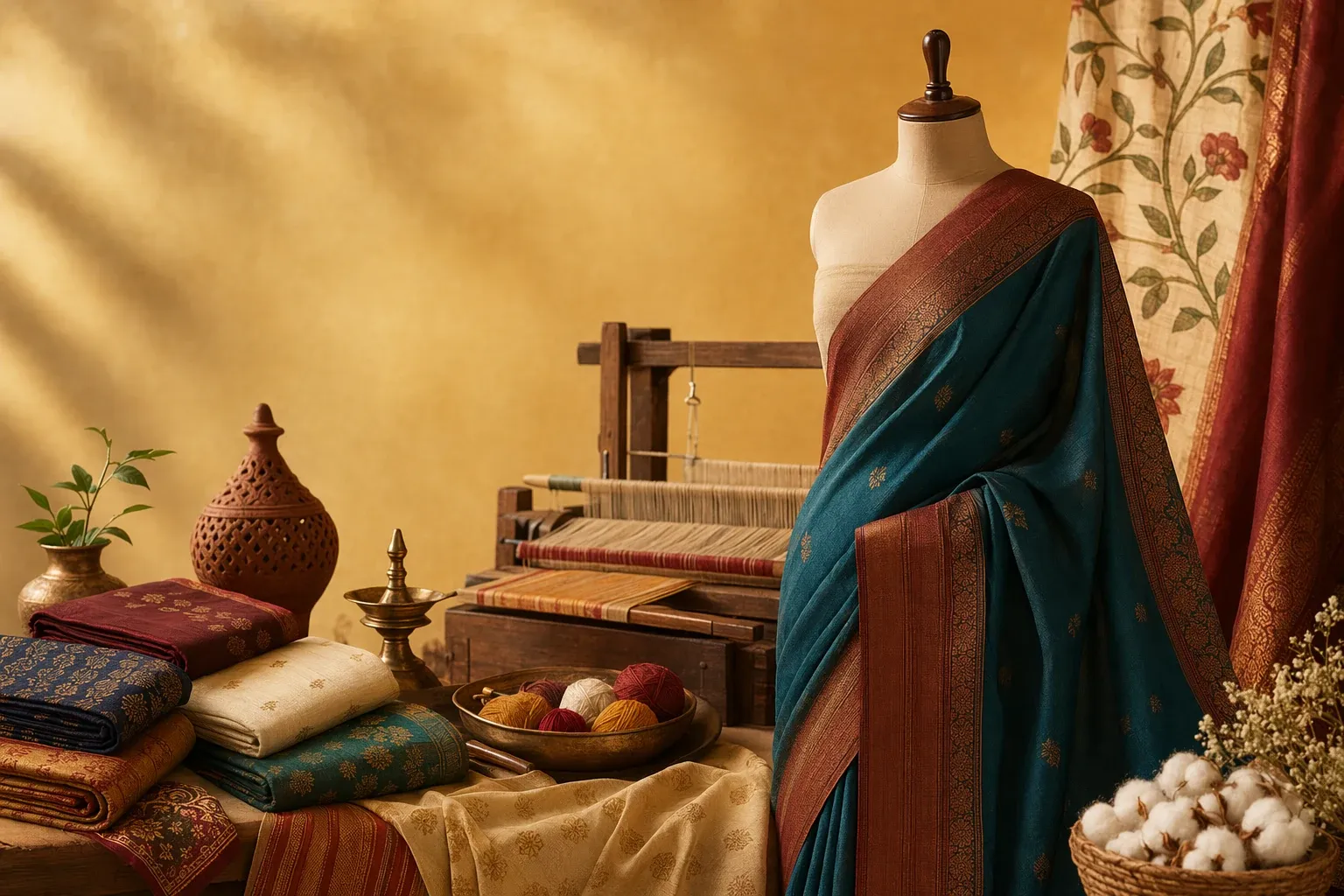
Indian textiles have always changed with time. A sari border may preserve an old motif while the blouse becomes experimental. A brocade once associated with courtly clothing may appear on a jacket. A handloom cotton once worn for comfort in a village may become a city dress, a shirt, or a relaxed co-ord set. Modern fashion does not keep Indian textiles alive by freezing them; it keeps them alive when designers, artisans, and wearers allow tradition to breathe without stripping it of meaning.
The phrase Indian textiles covers an enormous range: Khadi, Jamdani, Banarasi brocade, Kanjeevaram silk, Chanderi, Maheshwari, Ikat, Ajrakh, Kalamkari, Bandhani, Leheriya, Phulkari, Kantha, Chikankari, Kasuti, Kota Doria, Muga silk, Pochampally, Paithani, and many more. Each has a history of material, region, and labour. In fashion, the challenge is to use this richness with care rather than as a surface trend.
The sari remains contemporary
The sari is one of the clearest examples of continuity and reinvention. It can be worn in classic regional drapes, paired with contemporary blouses, styled with belts, layered with jackets, or adapted for movement in professional settings. A handwoven sari carries the memory of the loom, but the wearer gives it a present life.
Modern sari styling sometimes attracts debate. Some people worry that experimentation weakens tradition; others see it as proof that the garment remains relevant. Both concerns deserve attention. A respectful approach does not mock the garment or erase its roots. It asks how the drape can serve today’s body, climate, workplace, and personality while honouring the textile itself.
Handloom in everyday clothing
Handloom is often imagined as formal or ceremonial, but many Indian weaves are perfect for daily wear. Cotton handloom shirts, kurtas, dresses, trousers, skirts, and stoles can be breathable and durable. Khadi has moved from nationalist symbolism into slow fashion and casual clothing. Chanderi and Maheshwari can become light festive wear. Ikat can bring pattern to simple silhouettes without needing heavy embellishment.
The best modern pieces often let the textile lead. A strong Ikat does not need an overcrowded cut. A fine Jamdani panel benefits from quiet tailoring. A textured handloom cotton can look elegant in a clean shirt or wrap dress. When design respects the cloth’s behaviour, the final garment feels natural rather than forced.
Embroidery as detail, not costume
Indian embroidery traditions have entered modern fashion in many forms. Chikankari kurtas remain beloved for summer. Kantha appears on jackets, scarves, and dresses. Phulkari panels brighten contemporary silhouettes. Zardozi is still central to bridal and occasion wear, but designers also use smaller metallic accents on clutches, collars, and borders.
The danger is turning every regional stitch into a generic ethnic decoration. A mirror-work jacket, a Kantha coat, or a Chikankari dress should ideally acknowledge its craft language. Bhaktilipi’s beginner guide to Indian embroidery types is useful for recognising the difference between regional traditions rather than placing all handwork under one label.
Print traditions in new wardrobes
Block prints, Ajrakh, Kalamkari, Bagru, Sanganeri, Dabu, and other print traditions have adapted beautifully to modern clothing. Shirts, kaftans, summer dresses, trousers, scarves, and children’s wear often use hand-block or natural-dye inspired patterns. The charm comes from rhythm: slight variations in block placement, layered colour, and motifs rooted in local design memory.
However, mass printing can imitate the look without carrying the process. That does not mean all screen-printed or digitally printed clothes are unacceptable; affordability matters. The key is honesty. If a garment is hand-block printed, say so. If it is a print inspired by Ajrakh or Kalamkari, say that too. Respect begins with accurate language.
Weddings and the new heirloom
Indian weddings remain major spaces for textile splendour. Banarasi, Kanjeevaram, Paithani, Patola, Bandhani, Leheriya, brocade, and embroidered garments continue to mark important moments. At the same time, many families now choose lighter lehengas, re-wearable saris, restored heirlooms, or mixed separates that can be styled after the wedding.
This shift is important. A textile that can be worn again has a longer life. A grandmother’s sari may become a dupatta, a blouse, a jacket lining, or a framed textile panel. Careful adaptation can preserve memory while making the piece useful. The new heirloom is not always the most expensive garment; it is the one that keeps returning to the body and the family story.
Sustainability beyond slogans
Indian textiles are often discussed in the language of sustainability, but the reality is complex. Handloom can support livelihoods and reduce dependence on high-energy manufacturing, yet artisans still need fair pay, stable demand, safe dyes, and market access. Natural fibres can be wonderful, but cultivation, processing, and transport also matter. Slow fashion should not become a luxury label that praises artisans while underpaying them.
For buyers, sustainability begins with buying fewer, better-understood pieces. Ask whether you will wear the garment often. Learn how to wash and store it. Repair small tears. Rotate delicate fabrics. Choose versatile textiles that can move between occasions. A well-loved handloom kurta worn for years is more meaningful than a cupboard full of rarely used impulse purchases.
Designers as bridges
Many contemporary designers act as bridges between weaving communities and urban buyers. The most thoughtful ones collaborate over time, credit craft sources, allow artisan skill to influence design, and avoid demanding impossible uniformity. A textile tradition cannot survive if artisans are treated only as suppliers of exotic surfaces.
Good collaboration also allows innovation. Weavers may create new colour palettes, lighter weights, wider yardage, or fresh motifs while retaining technique. Fashion can open new markets for them. But innovation should be a conversation, not extraction. The cloth should not lose the identity that made it valuable in the first place.
Personal style with cultural memory
Modern fashion gives wearers freedom. A Banarasi skirt with a plain shirt, an Ajrakh jacket over denim, a Chikankari kurta with sneakers, a Khadi dress with silver jewellery, or a handloom stole over office wear can all be graceful choices. The point is not to follow a rigid rulebook. The point is to understand enough to wear the textile with affection and confidence.
Indian textiles stay alive when they are touched, draped, washed, repaired, gifted, altered, and remembered. They belong in museums, yes, but also in trains, classrooms, offices, festivals, markets, weddings, and ordinary evenings. Modern fashion becomes richer when it treats traditional fabric not as costume, but as living design carried forward by skilled hands and thoughtful wearers.