
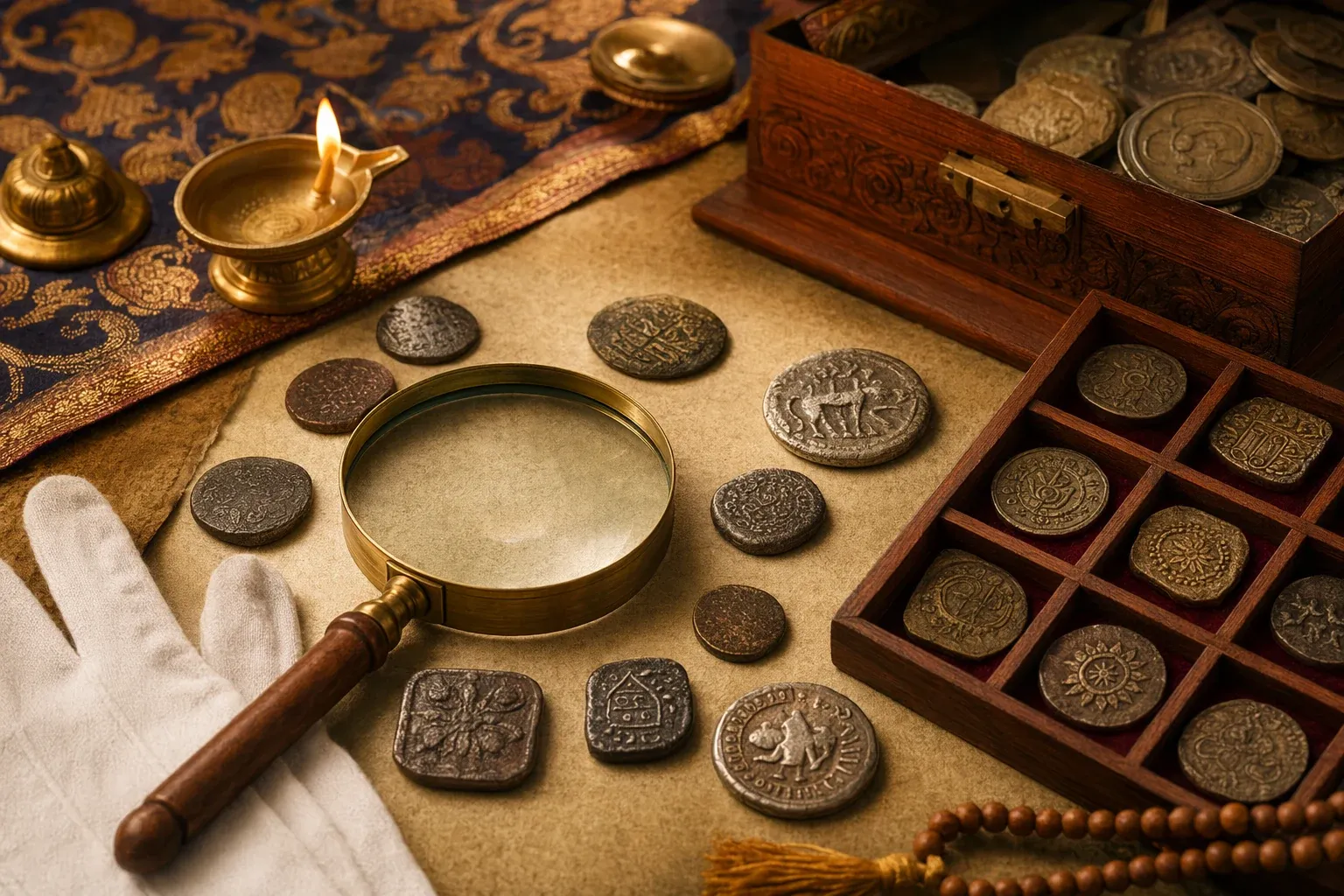
Identifying an old Indian coin begins with patience. Many people jump straight to value, but price is the last question, not the first. First you need a careful description. A coin with no description is only a guess; a coin with clear details can be compared with reliable references.
Place the coin on a soft surface in good light. Take clear photos of both sides without filters. Do not clean it. Then write down what you can see: date, denomination, script, symbols, metal colour, weight, diameter, edge, condition and any story about where it came from. These notes are the foundation of identification.
Read the visible clues
Dates are helpful, but old Indian coins may use different eras, scripts or worn markings. A date may be missing, unclear or not written in the modern style you expect. Scripts can include Devanagari, Persian, English, Brahmi, regional scripts and more. If you cannot read a script, do not invent a reading from a similar-looking letter.
Symbols also matter. Look for animals, wheels, flowers, rulers, deities, calligraphy, temples, weapons, geometric marks or state emblems. On some coins, the symbol may be more useful than a date. On others, the mint mark, ruler name or denomination is the key clue. Identification is usually a combination, not one magic sign.
Measure the coin
Weight and diameter are extremely useful. Two coins may look similar in a photo but differ in size or metal. A simple digital scale and caliper can help, as long as you use them gently. Record weight in grams and diameter in millimetres. If possible, note thickness and edge style too.
Metal colour can help, but it can mislead. A copper coin may look black or green after age. A silver coin may look dull. A plated souvenir may look impressive but have no historical value. Magnetism can help with modern coins, but it is not a complete test for authenticity.
Compare with reliable sources
Once you have details, compare the coin with trustworthy references: museum collections, numismatic books, government mint information, academic articles, reputable dealers, catalogues or recognised collector groups. Look for the full match, not just a similar picture. A similar symbol from a different period can lead you in the wrong direction.
Be careful with viral videos and price screenshots. Many posts exaggerate value to attract attention. A reliable identification should explain why the coin is what it is: metal, date, ruler or authority, mint, denomination, script and condition. If those details are missing, the claim is weak.
When to ask an expert
Ask for expert help if the coin appears ancient, rare, gold, silver, unusually heavy, linked to a known historical site, or inherited with a believable provenance. Also ask if you plan to sell, insure or donate it. A good expert will not only say a price; they will explain identification and authenticity concerns.
The best beginner habit is humility. Write what you know, mark what is uncertain, and protect the coin from damage. That approach keeps both history and value safer.
Learning Indian coins responsibly
The responsible way to learn Indian coins is to treat each coin as evidence before treating it as treasure. A coin may be financially valuable, but its first value is informational: it can show language, authority, exchange, technology, belief, design taste and public memory. This habit keeps the subject interesting without turning it into hype.
Beginners should also remember that India’s coin history is regional and layered. A coin from one region, dynasty or century may follow a very different standard from another. Do not force every coin into one national timeline. Ask where it may have circulated, who issued it, what language or symbol it carries, and what other evidence supports that reading.
Good coin study is slow. Make a small record for every coin you examine: photographs of both sides, weight, diameter, visible date, script, symbol, metal colour, mint mark, edge and condition. If the coin belongs to your family, add the family memory separately and label it as memory, not proof. This protects both emotion and evidence.
It is also important to avoid harmful habits. Do not clean old coins, do not scratch them for metal testing, do not believe dramatic price claims without verification, and do not buy objects with suspicious origins. Coins connected to archaeological sites or protected contexts may involve legal and ethical responsibilities. Respect for heritage matters more than quick ownership.
Finally, connect coins with the wider world around them. Coins become easier to understand when compared with inscriptions, ports, trade routes, scripts, monuments, literature and material culture. That wider view helps a beginner see coins not as isolated collectibles, but as small, durable witnesses to Indian history.
A useful first collection can be very simple. Choose a theme such as one denomination across different years, coins from one family box, commemorative issues, or coins that show different scripts and symbols. Arrange them with notes instead of chasing only expensive examples. This makes learning steady and keeps the focus on observation, not speculation.
If you later ask an expert for help, your notes will save time. Clear photographs, measurements and provenance allow a numismatist to compare the coin more responsibly. They also make it easier to separate a genuine uncertainty from a dramatic but unsupported claim. In a subject full of viral rumours, careful documentation is a quiet superpower.
For Bhaktilipi readers, the goal is simple: learn enough to ask better questions. A coin can be enjoyed as design, handled as family memory, studied as evidence, or preserved for future research. When those uses are kept separate, the article topic becomes practical instead of confusing, and the reader leaves with a safer next step.
Where to go next
To connect coins with wider Indian history, you can also read our how historians decipher inscriptions, Indian inscriptions beginner guide, and Sanskrit for beginners. These links are broader background, not required steps, and they help place coins beside other public historical evidence.