
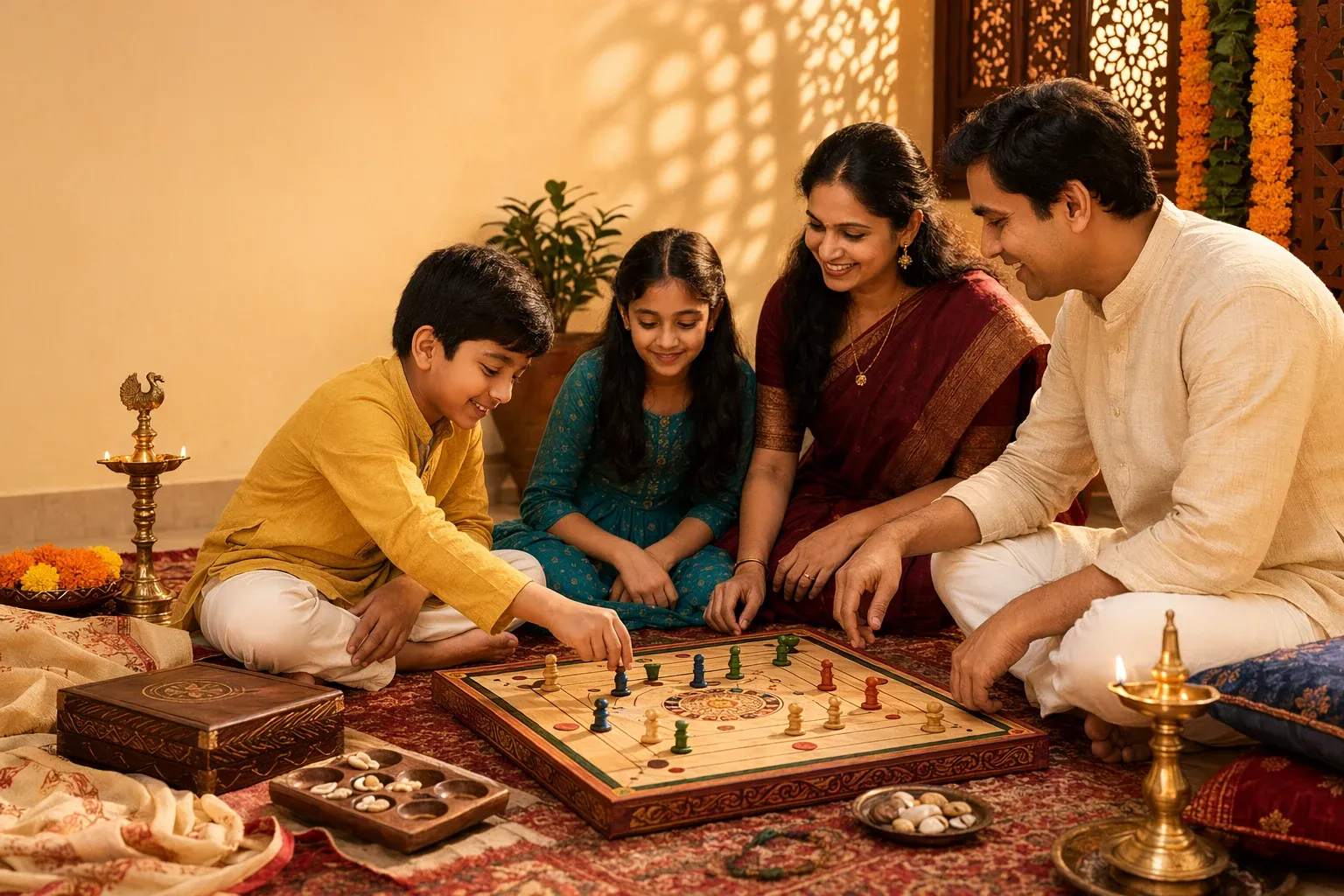
Indian board games are wonderful for kids and families because they make learning feel like play. A child may think they are only moving a piece, flicking a striker, or waiting for a lucky throw. But quietly, they are learning counting, patience, turn-taking, memory, risk, attention, and respect for rules. For parents and grandparents, these games can also become a gentle way to pass on culture without turning everything into a lecture.
The best family approach is simple: choose games that match the child’s age, explain the rules kindly, keep the mood playful, and treat winning as only one part of the experience. Indian board-game culture is rich enough to include strategy, chance, moral stories, dexterity, and counting. A family does not need pirated PDFs, shady downloads, or exaggerated “ancient secret” claims to enjoy it.
Why board games help children
Board games slow children down in a healthy way. They ask the child to wait, watch, count, decide, and accept the result. In a fast screen world, this is valuable. A simple throw in a race game teaches number movement. A carrom shot teaches hand control. A chess-like game teaches planning. A moral board like Gyan Chauper can open conversation about choices and consequences.
Games also teach emotional skills. A child learns that missing a shot is not the end of the world. A lucky throw should not make them arrogant. Losing should not become a tantrum. Winning should not become mockery. These are small lessons, but they build character over time.
Carrom for focus and hand control
Carrom is one of the easiest Indian tabletop games to introduce at home. Children enjoy the physical action: placing the striker, aiming, flicking, and watching the coin move. It builds hand-eye coordination and attention. It also creates instant feedback. If the angle is wrong, the piece misses. If the touch is too hard, the board position changes badly.
For younger children, families can simplify rules. Instead of strict scoring, begin with safe turns and basic pocketing. Teach them not to lean dangerously, not to put powder in the mouth, and not to fight over the striker. As they grow, introduce the queen, covering, fouls, and team play.
Pachisi-style games for counting and patience
Pachisi and Chaupar belong to the traditional family of Indian race games with cross-shaped movement. Traditional Pachisi uses cowrie-shell throws, while modern family versions may use dice or simplified boards. For children, the core learning is counting spaces, taking turns, and deciding which piece to move.
These games also teach patience because a player cannot control every throw. A child may be close to finishing and still get delayed. That can be frustrating, but it is also useful. The family can gently explain that life has chance, but our response should stay calm and fair.
Gyan Chauper for values and conversation
Gyan Chauper, connected in later global history with Snakes and Ladders, is one of the most interesting Indian game traditions for families. Its ladders and snakes can represent moral movement: good qualities lift a person, while harmful tendencies pull a person down. Jain, Hindu, and other versions have existed, so it should not be treated as one single fixed board for all India.
For kids, the value is conversation. A ladder can start a question: what does kindness do in real life? A snake can start another: what happens when greed or anger controls us? Keep it gentle. The goal is not to scare children, but to help them see that actions have consequences.
Chaturanga and chess for older children
Chaturanga is usually discussed as an early Indian ancestor within the chess family. The exact early rules are not fully certain, so most families will not begin by playing reconstructed Chaturanga. Instead, older children can learn chess and then understand the Indian historical background: the idea of a fourfold army, different pieces, strategy, protection, and long-term thinking.
Chess-like play is especially useful for children who enjoy puzzles. It teaches them to pause before acting, notice threats, protect important pieces, and think about consequences. The cultural story of Chaturanga adds meaning: strategy games are not foreign to Indian thought; they have deep roots here.
Counting games and regional memory
Some Indian families also know seed-and-pit counting games by regional names, such as Pallankuzhi or Ali Guli Mane-type games in South Indian contexts. These are not always called board games in the modern shop sense, but they use a board-like object and teach counting, distribution, memory, and planning.
Such games are excellent for children because the material can be simple: seeds, shells, beads, or small counters. They also connect children to regional household traditions, especially through grandmothers, aunties, and elders who may remember local rules.
How to choose by age and mood
For younger children, choose simple movement and dexterity: basic carrom turns, Ludo-like movement, or counting games. For middle-school children, add Pachisi-style strategy, memory games, and simple chess. For teenagers, introduce deeper chess, Carrom skill practice, mythology-themed storytelling games, or carefully researched modern Indian tabletop games.
Also choose by mood. If the family wants laughter, pick a race game. If the child needs focus, pick carrom. If they like stories, use a moral or mythology-themed board with respectful explanations. If they love puzzles, choose chess and then discuss Chaturanga.
Safe and respectful family play
Keep the game ethical. Avoid gambling framing with children. Do not turn every result into money, punishment, or humiliation. Explain that traditional games are meant to build joy, learning, and community. If a game uses deities, epics, sacred symbols, or moral teachings, treat them respectfully and give context.
When buying or downloading resources, be careful. Prefer legal products, clear rulebooks, safe websites, and creators who give cultural context. Avoid pirated PDFs, random downloads, and boards that use sacred images as decoration without understanding. Families can also make simple DIY boards for learning, as long as they are honest that it is a home version.
Questions people ask
What are some Indian board games for kids?
Good options include Carrom, Pachisi-style race games, Chaupar/Ludo-like family games, Gyan Chauper or Snakes-and-Ladders-style moral boards, chess with Chaturanga background, and regional counting games.
What skills do Indian board games build?
They can build counting, patience, focus, hand-eye coordination, memory, strategy, turn-taking, emotional control, and cultural curiosity.
Should families avoid chance-based games?
No. Chance-based games can be useful when played responsibly. They teach children to accept uncertainty, respond calmly, and make fair choices after an unpredictable result.
A simple family takeaway
Indian board games are not only a way to keep children busy. They are small, friendly classrooms for the mind and heart. A carrom board can teach focus. A Pachisi-style game can teach counting and patience. Gyan Chauper can teach consequences. Chess can teach planning. Most importantly, all of them can bring a family into one shared circle, where culture is learned through laughter, fairness, and play.