
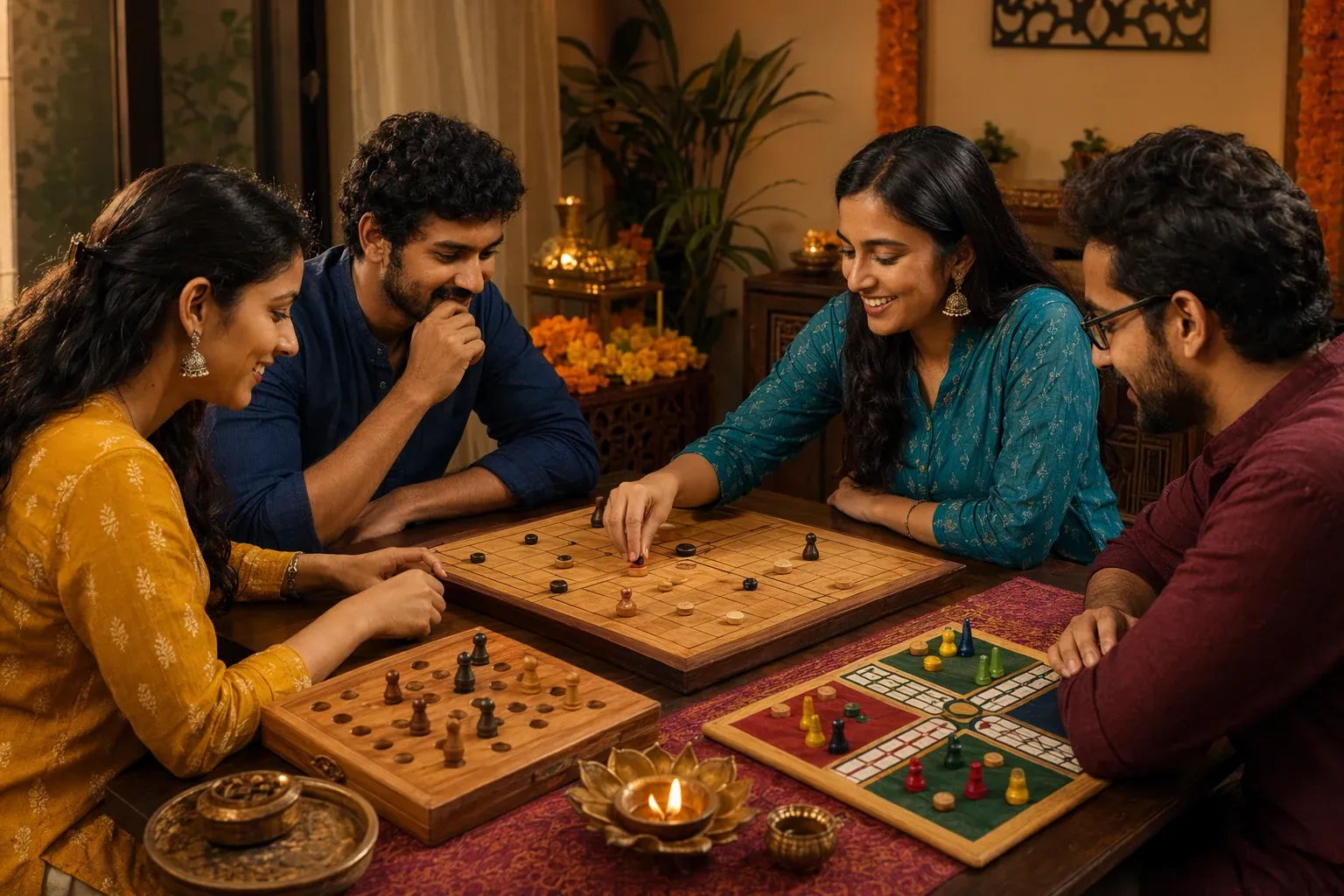
Indian board games are often introduced to children, but they are not childish. In fact, adults may understand them more deeply because grown-up life already contains planning, uncertainty, memory, negotiation, fairness, and ego management. A board game gives all of that in a smaller, safer space. You can make a choice, watch its consequence, lose with dignity, laugh at yourself, and try again.
For adults, the best Indian board games are not only about passing time. Chaturanga and chess-family play sharpen long-term thinking. Pachisi and Chaupar-style race games mix chance with judgement. Carrom trains touch, angle, focus, and emotional steadiness. Gyan Chauper turns movement on a board into a reminder about conduct and consequences. Together, these games show that Indian play culture can be relaxing, social, and intellectually alive at the same time.
Why adults should take play seriously
Modern adults often treat leisure as either passive scrolling or expensive entertainment. Traditional board games offer a different rhythm. They bring people around one table or one floor space. Everyone watches the same board. Everyone waits for a turn. The game asks for attention without becoming heavy. That is why a quiet evening with a board can feel more nourishing than another hour of random videos.
Play also lowers the pressure of conversation. Friends, siblings, couples, parents, and grandparents can sit together without needing a dramatic topic. The board becomes the shared centre. A small move creates jokes, reactions, advice, and memory. For adults who feel disconnected from family or community, this matters.
Strategy games and the habit of thinking ahead
Chaturanga is the classic Indian name that most strongly points toward strategy. The Sanskrit word caturaṅga means four-limbed or four-part, and in military language it is linked with the four divisions of an army: elephants, chariots, cavalry, and infantry. Historians usually discuss it as an early Indian ancestor within the chess family, while also being careful that the exact earliest rules are not fully certain.
For an adult player, the useful lesson is clear even when the old rule details are complex. Strategy games teach delayed thinking. You learn not to react to every threat with panic. You protect important pieces, create support, notice patterns, and accept that a tempting move may damage your position later. This is not only board wisdom. It is close to work, money, relationships, and leadership.
Chance games and mature risk-taking
Pachisi and Chaupar-style games are different. They do not give you full control. A throw of cowries or dice-like objects decides how far a piece can move, but you still decide which piece should use that result. This is why such games are not pure luck. They are chance plus judgement.
Adults often need exactly this lesson. Life gives a situation; we choose a response. A good throw can be wasted by arrogance. A bad throw can be handled wisely. A player who becomes angry at chance usually becomes careless. A player who stays calm can still improve the position. In a dharmic reading, the game quietly holds both daiva, the given condition, and purushartha, human effort.
Carrom and the discipline of touch
Carrom is a familiar Indian tabletop favourite because it is easy to begin and difficult to master. The board, striker, carrom men, queen, powder, pockets, and rebounds create a small world of skill. The movement is tiny, but the attention needed is serious. A little extra force can scatter the board. A soft touch can leave an easy chance for the opponent. A clean rebound can feel like geometry turning into joy.
For adults, carrom is especially good because it joins body and mind. It is not only calculation. It is aim, finger control, patience, and emotional balance. You can see someone’s temperament in the way they play: whether they rush, sulk, cheat, teach, tease kindly, or stay steady after a miss.
Memory, pattern, and probability
Many Indian board games quietly train memory. In a race game, you remember safe squares, vulnerable pieces, and the mood of other players. In carrom, you remember angles and common rebounds. In chess-family play, you remember positions and patterns. In counting games played with seeds or counters, common in several Indian regions, memory and distribution become part of the pleasure.
Probability also appears in simple ways. Which throw is likely? Which move gives two chances instead of one? Is it better to protect a piece or race ahead? Adults who enjoy puzzles, finance, planning, or negotiation can find these small probability questions surprisingly satisfying.
Social play without turning it into gambling
Indian tradition remembers both the joy and danger of play. The Mahabharata’s dice episode is a powerful warning about pride, manipulation, silence, and loss of judgement. That does not mean all games of chance are wrong. It means adults should keep play within maryada, a healthy boundary.
A good adult game night should avoid humiliating stakes, pressure, and addiction-like behaviour. Keep the focus on skill, laughter, learning, and friendship. If money enters the room, even a friendly game can change its emotional temperature. The safer path is to let the game train attention, not greed.
Choosing the right game for the group
If your group enjoys deep thinking, choose chess while learning the Chaturanga background. If the group wants laughter and suspense, choose Pachisi, Chaupar, or a legal family version of a cross-and-circle race game. If people enjoy hand skill, choose carrom. If the gathering includes elders or children, choose something with simple rules and flexible time.
The material also matters. A cloth board, wooden pieces, cowries, seeds, or a well-made carrom board can make play feel grounded. You do not need luxury, but you should respect the object. A game handled with care teaches care in return.
Adult questions about Indian board games
What are the classic board games of India?
Chaturanga, Pachisi, Chaupar, Gyan Chauper, and Carrom are among the most commonly discussed names, though they belong to different periods, regions, and styles of play.
Are Indian board games useful for grown-ups?
Yes. They can support focus, patience, counting, probability, memory, negotiation, emotional control, and social bonding. The value depends on how respectfully the group plays.
Which Indian board game is best for strategy?
For pure strategy, chess with the historical background of Chaturanga is the easiest starting point. Carrom also has strategy, but it adds touch and angle. Pachisi-style games add probability and risk.
The grown-up lesson
Indian board games for adults are not nostalgia alone. They are a practical way to slow down, think clearly, meet people face to face, and practise fairness in a low-stakes space. A small board can reveal how we handle luck, skill, rivalry, patience, and ego. That is why these games still belong in adult life.