
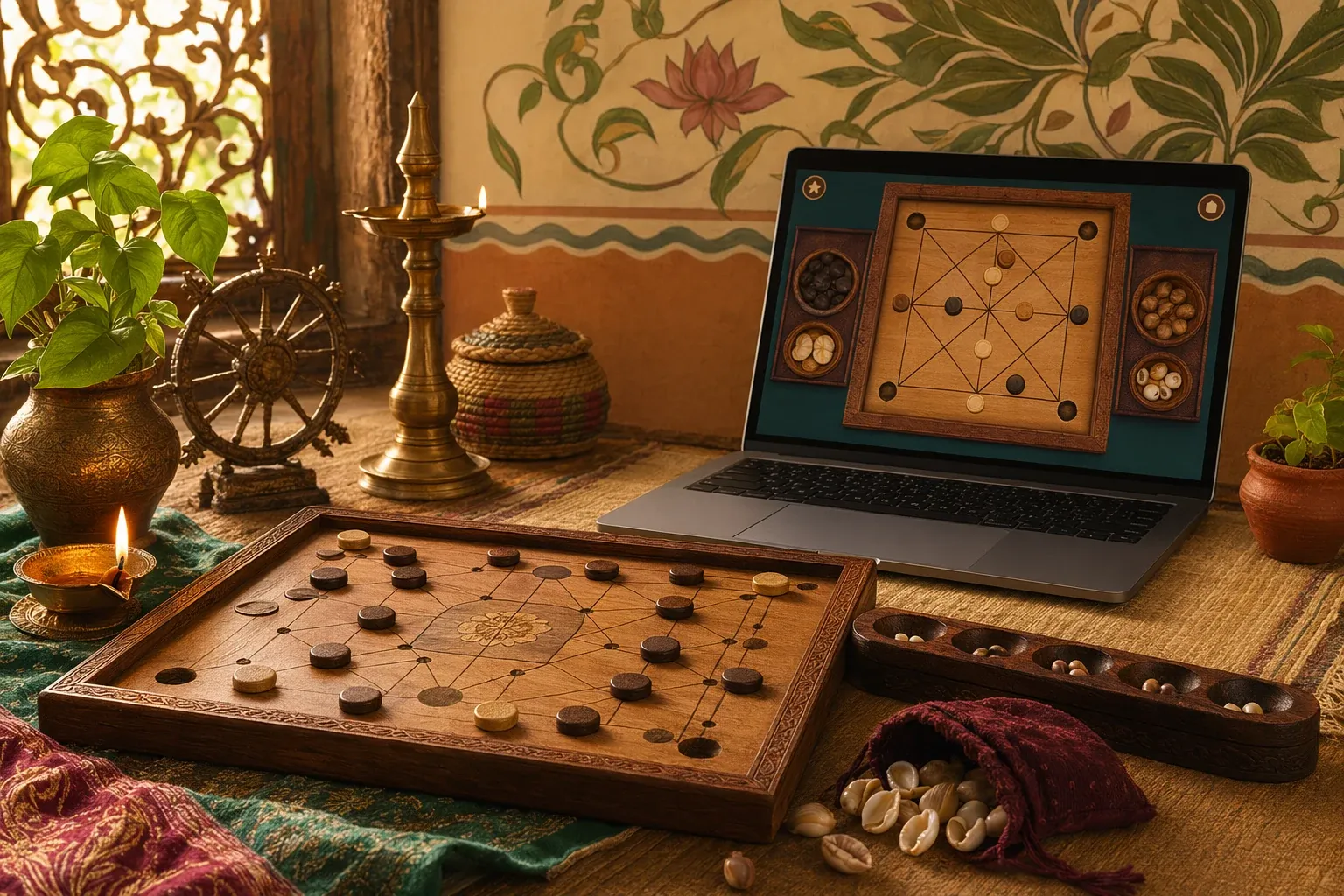
Searching for Indian board games online can be useful, but it can also become confusing very quickly. You may find shopping pages, rule summaries, videos, app versions, scanned boards, downloadable files, and social media claims about “ancient secrets.” Some resources are helpful. Some are careless. Some may be unsafe or illegal. The smart path is to learn the game without losing the culture around it.
Indian board games are not only rule systems. Chaturanga, Pachisi, Chaupar, Gyan Chauper, Carrom, and regional counting games carry history, materials, family memory, moral ideas, and social habits. If online learning reduces them to a quick download or a low-context app, something important disappears. The goal is not to reject digital learning. The goal is to use it wisely.
Names and game families come first
Before downloading anything, understand what you are looking for. Chaturanga points toward the history of chess-family strategy games, though the exact earliest rules are not fully certain. Pachisi and Chaupar belong to cross-shaped race-game traditions using cowries or dice-like throws. Gyan Chauper connects a race-game structure with moral and spiritual movement toward liberation. Carrom is a tabletop flicking game of Indian origin, popular in homes, clubs, and social spaces.
Knowing these families helps you avoid confusion. A modern Ludo app is not the same as learning traditional Pachisi. A chess app is not the same as reconstructing Chaturanga. A snakes-and-ladders board without moral context is not the same as understanding Gyan Chauper. The online version may still be fun, but you should know what it is and what it is not.
Legal and safe resources matter
Be careful with random files that promise free boards, paid rulebooks, or rare scans. Avoid pirated PDFs, suspicious downloads, and unknown apps that ask for too many permissions. A board game file is not worth exposing your phone, email, or payment information. If a resource belongs to a creator, publisher, museum, or archive, respect its rights.
Prefer official pages, museum or cultural portals, publisher websites, reputable educational videos, library resources, and clearly licensed material. If you are buying a physical board online, check seller reputation, materials, return policy, and whether the product explains cultural context. Cheap copies may be playable, but they may also erase artisans, designers, or source communities.
Learn rules and context together
A rule summary tells you how to move. Context tells you why the game matters. For Pachisi, learn about the cross-shaped board, cowrie-shell throws, counting, and its relationship with Chaupar and later Ludo-like games. For Carrom, learn the role of the striker, carrom men, queen, rebounds, and why it became so loved in South Asian homes and clubs. For Gyan Chauper, learn why ladders and snakes can represent moral movement, not only random progress.
This does not mean every game night must become a history class. Even two minutes of context can change the experience. Tell players where the game comes from, what is uncertain, and what values it may teach. That small act keeps culture alive.
Online videos can teach movement and technique
Videos are especially useful for games like carrom because movement matters. You can read about a striker, but watching finger placement, angle, cut shots, rebounds, and queen cover rules makes learning easier. For Pachisi-style games, a video can show board movement more clearly than a paragraph. For chess-family history, videos can help compare names and piece ideas.
Still, do not trust every video equally. Look for creators who explain sources, admit uncertainty, and avoid exaggerated claims. Be cautious when a video says a game is “exactly unchanged for thousands of years” without evidence. Tradition can be old and meaningful without needing inflated certainty.
Apps are convenient, but not complete
Apps can help you practise counting, turns, and basic strategy. They are convenient when family or friends are not available. But an app often removes the social body of the game: sitting together, touching the pieces, hearing the carrom strike, reading another player’s mood, and learning how to win or lose gracefully.
Use apps as practice, not replacement. If you learn Pachisi or a Ludo-like game online, try a physical board with family. If you practise chess online, read about Chaturanga and Indian chess history. If you watch carrom tutorials, sit at a real board when possible. Culture becomes stronger when digital learning returns to embodied play.
Protect children while learning online
For children, online board-game learning needs extra care. Avoid sites with gambling framing, aggressive ads, chat rooms with strangers, and in-app purchases designed to create pressure. Traditional games should teach patience and fairness, not addiction patterns. A family account, offline videos, or a parent-guided resource is safer than leaving a child alone with random apps.
Also keep sacred and cultural imagery respectful. If a game uses deities, epic scenes, or moral boards, explain them gently. Do not let children treat sacred images as disposable decorations. At the same time, keep the tone warm. Respect should feel natural, not frightening.
Buying Indian board games online
If you want a physical board, ask practical questions. Is the board durable? Are the pieces safe for the age group? Does the product credit artisans or designers? Does it explain the game’s cultural background? Are sacred symbols used thoughtfully? For carrom, board smoothness and piece quality matter. For cloth or printed boards, material and clarity matter. For mythology-themed games, cultural explanation matters.
When possible, support Indian creators, artisans, museums, educational publishers, or small businesses that handle culture with care. A slightly better product can last longer and teach more. The goal is not only to own a board, but to keep a tradition playable.
Digital archives and respectful citation
Museums and public archives may show old boards, paintings, and descriptions. These are excellent for learning, but they are not always free for commercial reuse. If you are a student, cite the archive. If you are a creator, check the licence. If you are sharing images on social media, credit the source. Respecting knowledge is part of respecting culture.
Also remember that an old image is not a complete rulebook. A board may survive without all original play habits. A caption may identify a game, but local rules may still vary. Use archives as evidence, not as a reason for overconfident claims.
Practical questions about online learning
Where can I learn Indian board games online safely?
Start with reputable cultural websites, museum pages, publisher rule pages, educational videos, and trusted app stores. Avoid suspicious downloads, pirated files, and sites that mix children’s games with gambling hooks.
Can I play traditional Indian board games online?
Some related games can be played online, especially chess, Ludo-like games, and carrom-style apps. But online versions may simplify or change traditional materials, rules, and cultural context.
How do I avoid culture-stripped copies?
Choose resources that explain names, history, symbols, regional variation, and respectful use. Support creators who credit sources and avoid turning sacred or traditional material into random decoration.
The safest learning path
The best way to learn Indian board games online is simple: research carefully, use legal resources, avoid unsafe downloads, credit creators, and return to real play whenever possible. Digital tools can open the door, but the culture lives when people sit together, move pieces with attention, and treat the game as more than a screen.