
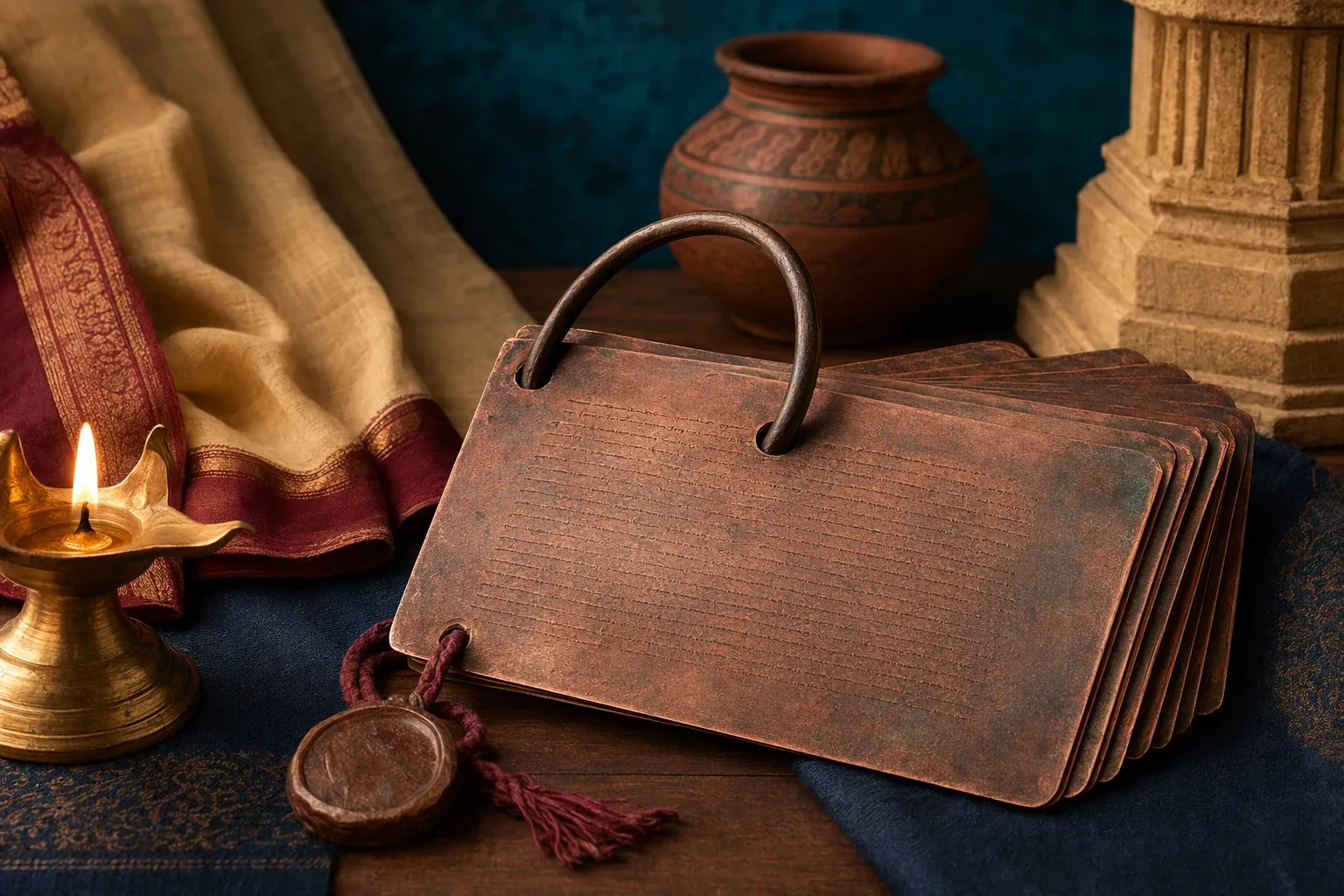
Indian copper plate inscriptions are official records written on thin copper sheets, usually joined with a ring and sometimes sealed with a royal emblem. Many of them preserve land grants, donations, village boundaries, tax exemptions, witnesses, royal titles, and religious gifts.
For beginners, the easiest way to understand them is this: a copper plate was not just “old writing on metal”. It was a durable public document. It could prove that land had been granted, explain who received it, describe what rights came with it, and show how kings, temples, villages, and learned communities were connected.
Why copper was used
Copper was stronger than palm leaf or paper and easier to preserve than a spoken promise. When a king or local ruler issued an important grant, the record needed to last. A copper plate could travel, be stored, be shown to officials, and survive for centuries if protected from damage.
Many copper plate records were made as a set of plates. Holes were placed near one edge, a ring passed through them, and a seal fixed the set together. The seal could carry a dynastic symbol, royal name, or emblem of authority. This physical form told people that the document was serious, official, and meant to be remembered.
What copper plates usually record
A typical copper plate grant may begin with an invocation, then describe the ruler, dynasty, genealogy, titles, or victories. After that, it explains the actual grant: who is giving, who is receiving, what land or income is involved, and what conditions apply.
- the name of the donor or ruler
- the recipient, such as a temple, Brahmana, monastery, or institution
- village names, field boundaries, rivers, tanks, trees, paths, or nearby settlements
- tax exemptions, rights, duties, and protections
- witnesses, officials, scribes, dates, seals, and sometimes warnings against violating the grant
Land grants and royal authority
Land grants were not only acts of generosity. They also showed authority. When a ruler gave land, exempted taxes, or supported a temple or learned person, the inscription made that decision visible and durable. It helped local officials know what had been granted and helped recipients defend their rights later.
This is why copper plates are valuable for political history. They show how kingdoms governed land, rewarded service, supported religious institutions, and communicated power. They also reveal that rule was not only about battles; it was also about records, revenue, villages, law, and memory.
What historians learn from them
Copper plate inscriptions help historians reconstruct names, dates, places, scripts, languages, administrative offices, social groups, religious institutions, and economic life. Sometimes a small grant can reveal a village name, a local official, a queen, a merchant, a temple servant, or a boundary that would otherwise be forgotten.
They are also useful for language history. A copper plate may use Sanskrit, Prakrit, Tamil, Kannada, Telugu, or another regional language depending on place and period. The script and language are not the same thing: script is the writing system, while language is what is being written. This distinction matters when reading any inscription.
How to read a copper plate record
A good beginner reading starts with simple questions. Where was the plate found? Who issued it? Who received the grant? What exactly was granted? Which place names and boundaries are mentioned? What date, ruler, or dynasty appears? Does the record mention taxes, witnesses, seals, or officials?
After that, ask what the record is trying to do. Is it praising a king, confirming a land transfer, protecting temple income, supporting education, or preserving a local arrangement? Copper plates are historical evidence, but they are also formal documents with a purpose.
Why verification matters
Copper plate inscriptions must be read carefully. Some are damaged. Some have missing lines. Some were copied or moved. Some use grand royal praise that should not be treated as neutral reporting. Historians compare the text with other inscriptions, coins, archaeology, literature, local geography, and palaeography before making large claims.
Careful reading protects both heritage and truth. It avoids two mistakes: blindly accepting every dramatic claim, and dismissing old records just because they are difficult to interpret. A respectful reader can appreciate the cultural value of the inscription while still asking evidence-based questions.
Common mistakes to avoid
- Do not treat every old mark as a fully readable inscription without evidence.
- Do not confuse script with language.
- Do not use one damaged line to prove a huge historical claim.
- Do not ignore sacred or local context when records are connected with temples or living communities.
- Do not rely on uncited images, fake translations, or random downloads when reliable references are available.
Copper plates, temples, and society
Many copper plates connect political authority with religious and social life. They may record grants to temples, scholars, monasteries, or communities. This does not make them only “religious documents” or only “legal documents”. Often they are both. They show how devotion, learning, land, economy, and governance overlapped.
For nearby context, read our Indian inscriptions beginner guide, types of Indian inscriptions, and temple inscriptions guide. If you want to understand the method behind such readings, see how historians decipher inscriptions.
What copper plates can and cannot prove
A copper plate can strongly show that a grant was recorded, who was named in the document, what places or rights were described, and how authority was presented at that moment. It can also preserve names of villages, rivers, officials, witnesses, scribes, queens, donors, temples, monasteries, or learned communities that may not appear in famous literary sources.
But one inscription cannot answer every question by itself. The language may be formal, the royal praise may be exaggerated, and the physical plate may have travelled from its original place. That is why historians treat copper plates as powerful evidence, not isolated proof for every claim. The safest reading combines the inscription with location, dating, palaeography, archaeology, other records, and local context.
Why they matter today
Indian copper plate inscriptions matter because they make history concrete. They show that the past was recorded not only in famous books and palace stories, but also in public documents about land, promises, witnesses, taxes, villages, gifts, and institutions.
For young readers, they also teach a useful habit: look for evidence, context, and careful language. A copper plate is a small object, but it can open a large world of law, culture, kingship, devotion, and everyday administration. That is why these records remain important for understanding Indian history responsibly.