
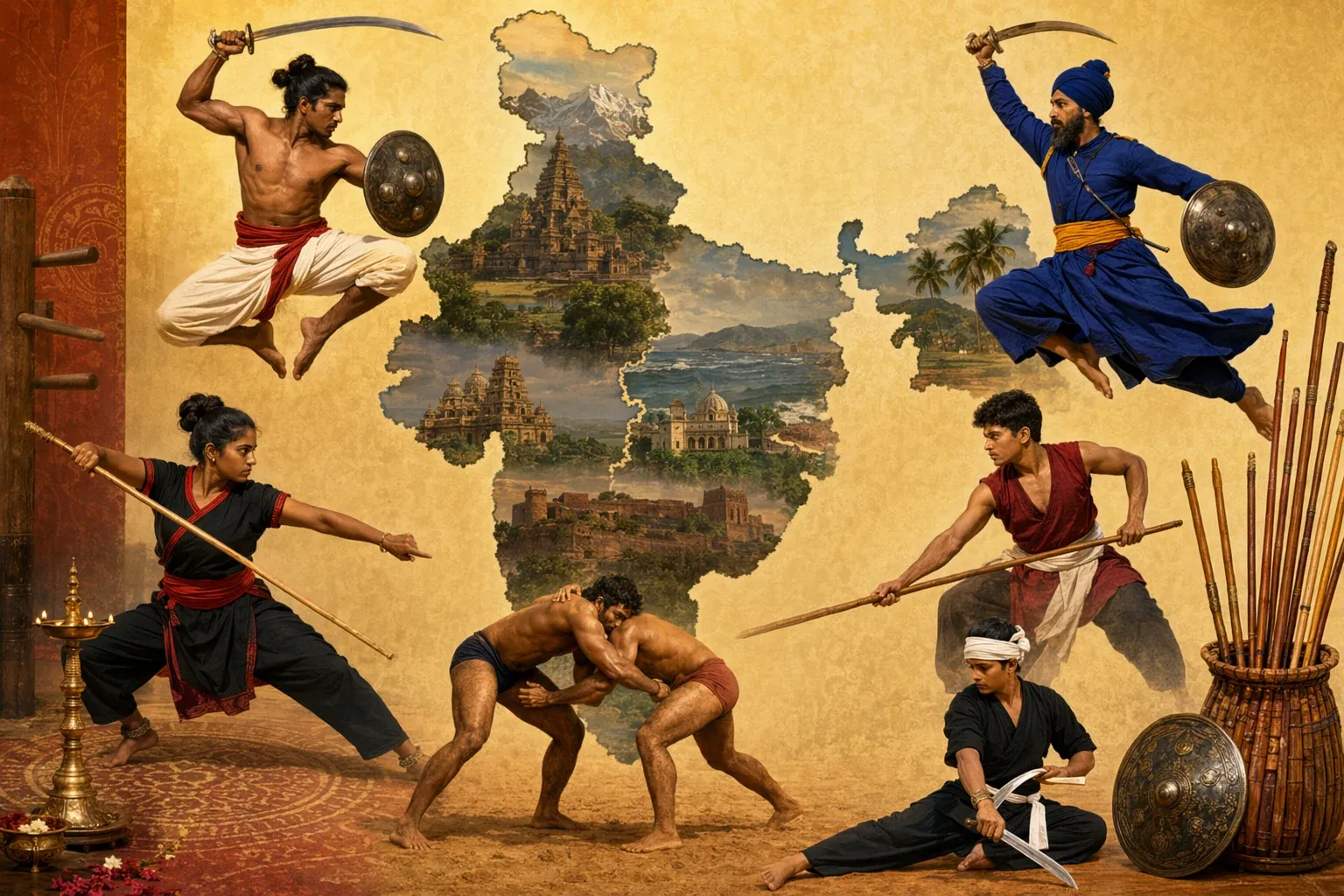
India does not have one martial art with one universal name. It has many regional systems shaped by local languages, teachers, training spaces, weapons, wrestling cultures, festivals and modern sport. The clearest beginner approach is to learn each tradition by its own name and context.
What are Indian martial arts called?
Use the specific name: Kalaripayattu, Gatka, Thang-Ta, Silambam, Kushti, Mardani Khel, Paika Akhada or another regional tradition. “Indian martial arts” is a useful umbrella phrase, but it should not erase differences between a Kerala kalari, Sikh martial practice, Manipuri training, Tamil staff traditions and an akhara for wrestling.
A quick map of major traditions
- Kalaripayattu: a Kerala martial tradition combining progressive body training with armed and unarmed practice.
- Gatka: associated with Sikh martial history and now also seen in organized sport and public demonstrations.
- Thang-Ta: a Manipuri martial tradition whose name refers to sword and spear practice; related unarmed practice is often discussed as Sarit Sarak.
- Silambam: a Tamil martial tradition widely identified with staff practice, with variation between schools.
- Kushti: wrestling practiced in akharas, with physical conditioning and teacher-led discipline.
- Mardani Khel and Paika traditions: regional martial and performance traditions associated respectively with Maharashtra and eastern India; names and present forms vary by community.
Kalaripayattu in Kerala
Kerala Tourism describes Kalaripayattu as a martial art rooted in the Malabar region. Training takes place in a kalari under a gurukkal and may include body-conditioning sequences, sticks, metal weapons and unarmed work. Kerala Tourism’s detailed discipline guide separates Meythari, Kolthari, Angathari and Verumkai.
Popular origin stories are part of the tradition, but exact antiquity is disputed. Kerala Tourism’s own historical introduction says the time of origin cannot be fixed with certainty. Claims that it is definitively the source of every Asian martial art should therefore be treated as legend or promotion, not settled history.
Gatka and Sikh martial culture
The Government of India’s Fit India indigenous-games material describes Gatka as stick fighting associated with Sikh history and the wider practice of Shastar Vidya. Tourism material also records Gatka demonstrations during Sikh religious and cultural events. A public performance, a competition and lineage-based weapons training may use related vocabulary without being identical activities.
Thang-Ta in Manipur
The Manipur Tourism Policy identifies Thang-Ta and Sarit Sarak as Manipuri martial arts passed down across generations. It describes their connection with an older martial culture and their continued practice by adults and children. Fit India likewise includes Thang-Ta among indigenous games.
Silambam, wrestling and other regional traditions
Silambam is strongly associated with Tamil staff practice, while Kushti belongs to a broad wrestling and akhara culture found across regions. Mardani Khel, Paika Akhada, Sqay and other named traditions reflect different histories and present-day forms. A short list can introduce them, but it cannot establish one final count: schools merge, revive, compete, perform and transmit their practice in different ways.
Combat practice, sport and performance are not the same
A tradition may appear as teacher-led training, competitive sport, heritage demonstration, festival performance, fitness practice or historical reconstruction. These settings use different rules and safety controls. Ask which form is being shown before making claims about what the style “really” is.
How to evaluate historical claims
- Look for a named institution, historian, archive or primary text.
- Separate oral tradition and sacred legend from dated documentary evidence.
- Avoid “oldest,” “deadliest” and “mother of all martial arts” unless the claim is clearly attributed and critically discussed.
- Do not infer an unbroken modern lineage from an ancient reference to weapons or wrestling.
- Let practitioners explain living practice while using historical evidence for chronology.
How beginners can learn safely
Choose a teacher who explains progression, supervision, protective rules and what happens if a student is injured. Observe a class before attempting weapon work, sparring, throws or locks. Online articles and videos can explain history, but they are not substitutes for supervised instruction.
- Ask about the instructor’s lineage, coaching experience or sport certification.
- Check whether beginners train separately from advanced weapon practitioners.
- Tell the instructor about injuries or health limits.
- Do not practice weapon movements alone from a video.
Sources and further reading
- Kerala Tourism: Kalaripayattu origin and uncertainty
- Fit India: indigenous games including Gatka, Kalaripayattu and Thang-Ta
- Government of Manipur: tourism policy and indigenous sports
For the ethical side of strength and responsibility, see What Is Dharma?