
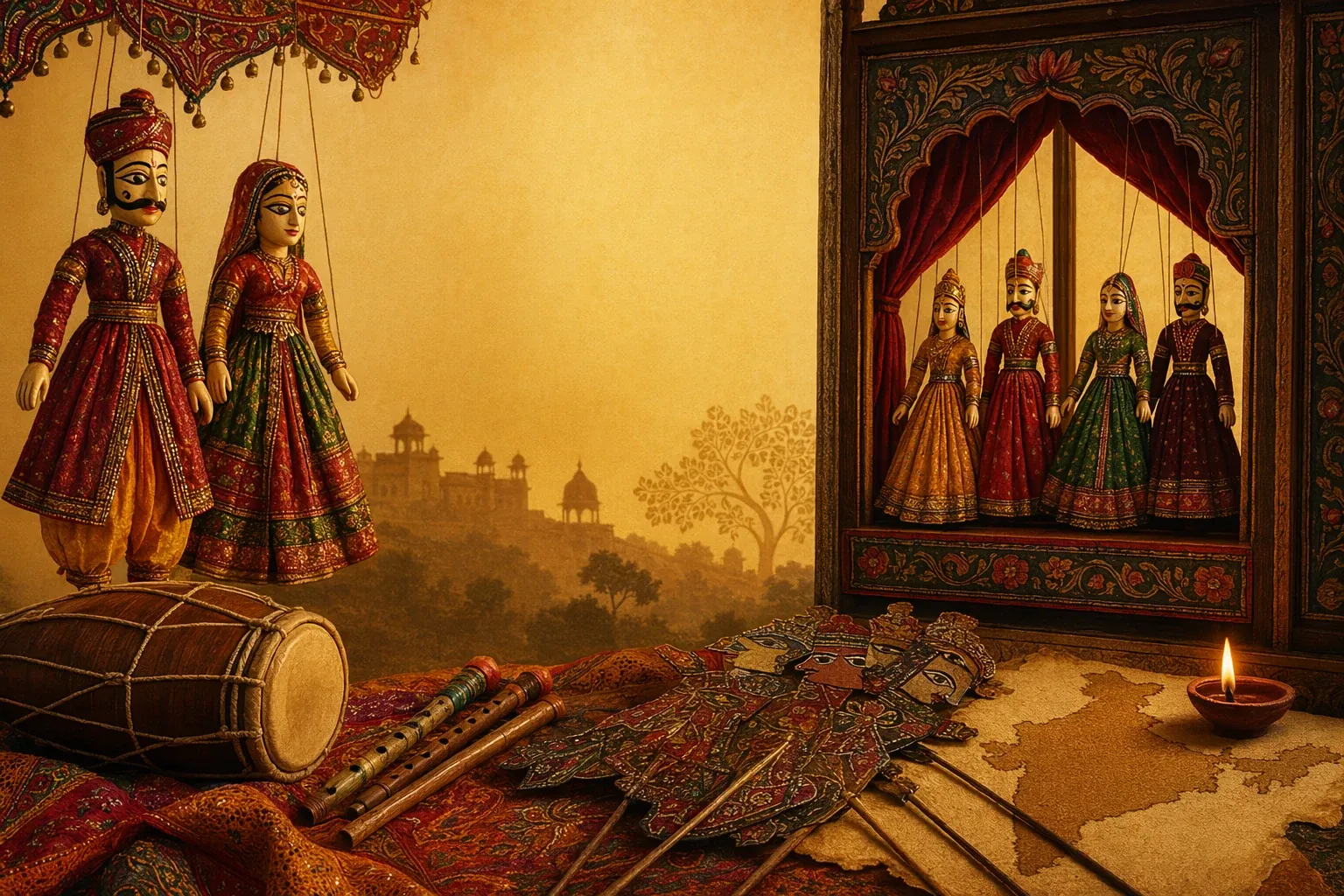
Indian puppetry is the art of telling stories through figures that are moved by strings, rods, hands, or light and shadow. For students, the simplest way to understand it is this: puppetry is a meeting point of theatre, craft, music, dance, oral storytelling, and community memory. A puppet is not only a toy or decoration. In a performance, it becomes a character who speaks, dances, jokes, blesses, warns, teaches, and entertains.
For an exam answer, Indian puppetry can be introduced as a traditional performing art found in many regions of India, especially in folk and ritual settings. It has been used to narrate stories from the Ramayana, Mahabharata, Puranas, local legends, heroic tales, social messages, and moral stories. It also reflects regional costume, painting, music, dialects, religious practice, and local theatre forms. That is why it belongs not only to “art and culture” but also to social history.
Why Indian puppetry matters
Puppetry matters because it made complex stories visible and memorable for audiences who may not have learned through books. Before cinema, television, and short videos, travelling performers brought stories to villages, fairs, festivals, temples, markets, courts, and community gatherings. A puppeteer could carry a portable theatre, a set of characters, a musical style, and an entire world of stories in one travelling tradition.
Many puppet traditions are linked with epics and devotion, but they are not limited to religion. Performers also used humour, satire, clowns, and local references to comment on everyday life. In modern times, puppet shows have been used for school education, health awareness, environmental messages, and children’s theatre. This ability to combine entertainment with learning is one of puppetry’s biggest strengths.
Another important point for students is that puppetry is a living tradition, not only a museum subject. Some forms are endangered because hereditary performers face economic pressure, changing audiences, and competition from digital entertainment. At the same time, many artists, cultural institutions, teachers, and contemporary puppet groups are adapting the form through workshops, festivals, new scripts, and school programmes. A good answer should show both heritage value and present challenges.
The four major types of puppetry in India
Indian puppetry is usually explained through four broad categories: string puppets, shadow puppets, rod puppets, and glove puppets. These categories are useful for revision, but students should remember that real traditions sometimes overlap. For example, some puppets may use both strings and rods.
String puppets
String puppets, also called marionettes, are moved with strings attached to the head, shoulders, arms, waist, or other parts of the puppet. The puppeteer controls the strings from above, creating movements such as turning, dancing, bowing, and fighting. Kathputli of Rajasthan is the most familiar example for many students. These wooden puppets are often brightly dressed, with dramatic faces and flowing costumes. Their performances are associated with storytelling, music, and hereditary performer communities.
Other string traditions include Gombeyatta of Karnataka, which is visually linked with Yakshagana style, and Kundhei or Gopalila Kundhei of Odisha, often connected with Krishna stories. Bommalattam of Tamil Nadu is especially interesting because it can combine string and rod techniques, and its figures may be larger and heavier than many other puppets.
Shadow puppets
Shadow puppetry uses flat figures placed between a light source and a screen. In many Indian traditions, the figures are made from treated leather, cut, pierced, and painted so that the audience sees silhouettes or coloured shadows. The screen becomes the stage. The puppeteer works from behind it, while music, narration, and dialogue create the drama.
Important examples include Tholu Bommalata of Andhra Pradesh and Telangana, Togalu Gombeyatta of Karnataka, Tholpavakoothu of Kerala, and Ravanachhaya of Odisha. Shadow puppetry is strongly connected with the Ramayana in several regions, though local variations and other stories also appear. For exam writing, shadow puppetry is a good example of how visual art, leather craft, music, and epic storytelling come together.
Rod puppets
Rod puppets are controlled by rods or sticks, often from below. They may be larger than glove puppets and can have a strong theatrical presence. Putul Nach of West Bengal is a well-known rod puppet tradition. The puppets may be dressed like characters from regional theatre, and the performer’s body movement can be part of the performance. Kathi Kundhei Nacha of Odisha and Yampuri of Bihar are other examples often mentioned in art and culture notes.
Rod puppetry helps students understand that puppets are not always tiny figures hidden from view. Some forms demand physical skill, rhythm, and dance-like coordination from the performer. The craft of carving, painting, costuming, and balancing the puppet is as important as the narration.
Glove puppets
Glove puppets are worn on the hand. The puppeteer uses fingers to move the head and arms while the palm supports the body. Because the hand is directly inside the puppet, the movements can feel lively and quick. Pavakathakali of Kerala is one of the strongest examples. It adapts the visual world of Kathakali into a puppet form, with rich headgear, make-up style, and dramatic characters. Glove puppetry is useful for student answers because it shows how a classical or regional theatre style can influence puppet design.
Quick comparison for revision
- String puppets: controlled from above with strings; examples include Kathputli, Gombeyatta, Kundhei, and Bommalattam.
- Shadow puppets: flat figures performed against a lit screen; examples include Tholu Bommalata, Togalu Gombeyatta, Tholpavakoothu, and Ravanachhaya.
- Rod puppets: manipulated with rods, often from below; examples include Putul Nach, Kathi Kundhei, and Yampuri.
- Glove puppets: worn and moved by the hand; examples include Pavakathakali and other regional hand-puppet forms.
How to write about cultural importance
A strong answer should not become only a list of names. Add two or three lines explaining why puppetry is culturally important. First, it preserves oral traditions by carrying stories across generations. Second, it connects with regional arts such as painting, costume, music, dance, and theatre. Third, it supports community identity because many forms are tied to particular regions, languages, and performer families. Fourth, it has educational value because puppets can present ethical questions, social messages, and historical memories in a simple form.
You can also mention that puppetry often adapts to its audience. A performance may begin with an invocation, move into an epic story, include comic interludes, and then add local jokes or current concerns. This flexibility is one reason the form survived for so long. It can be sacred, playful, dramatic, and practical at the same time.
Common mistakes students should avoid
Do not write that Indian puppetry is only for children. Children enjoy puppets, but many traditions were developed for community audiences of all ages. Do not reduce every form to Rajasthan’s Kathputli; it is famous, but India has many other traditions. Do not confuse “shadow puppet” with “black-and-white puppet”; several leather shadow forms use colour, perforation, and detailed design. Do not treat puppeteers as anonymous folk entertainers without skill. They are performers, craftspersons, singers, narrators, designers, and cultural memory keepers.
Another mistake is writing a dry list without context. If you mention Tholu Bommalata, add that it is a leather shadow tradition associated with epic storytelling. If you mention Pavakathakali, add its connection with Kerala and Kathakali-style visual design. One sentence of context makes an answer clearer than ten memorised names.
FAQs
What should students know about Indian puppetry?
Students should know that Indian puppetry is a traditional performing art that combines storytelling, craft, music, theatre, dance, and regional culture. It is commonly grouped into string, shadow, rod, and glove puppetry.
What are the four types of puppetry in India?
The four broad types are string puppets, shadow puppets, rod puppets, and glove puppets. These categories are useful for study, though some regional forms combine techniques.
What are some famous Indian puppet names?
Famous examples include Kathputli from Rajasthan, Tholu Bommalata from Andhra Pradesh and Telangana, Togalu Gombeyatta from Karnataka, Putul Nach from West Bengal, Yampuri from Bihar, and Pavakathakali from Kerala.
How can Indian puppetry be explained in exams?
Define it in one or two sentences, mention the four types with examples, explain its role in epic storytelling and folk education, and add a line on living artists and preservation challenges.
Is Indian puppetry still practised today?
Yes. Some traditional forms face difficulty, but puppetry continues through hereditary performers, contemporary puppet theatre groups, museums, festivals, schools, and workshops.