
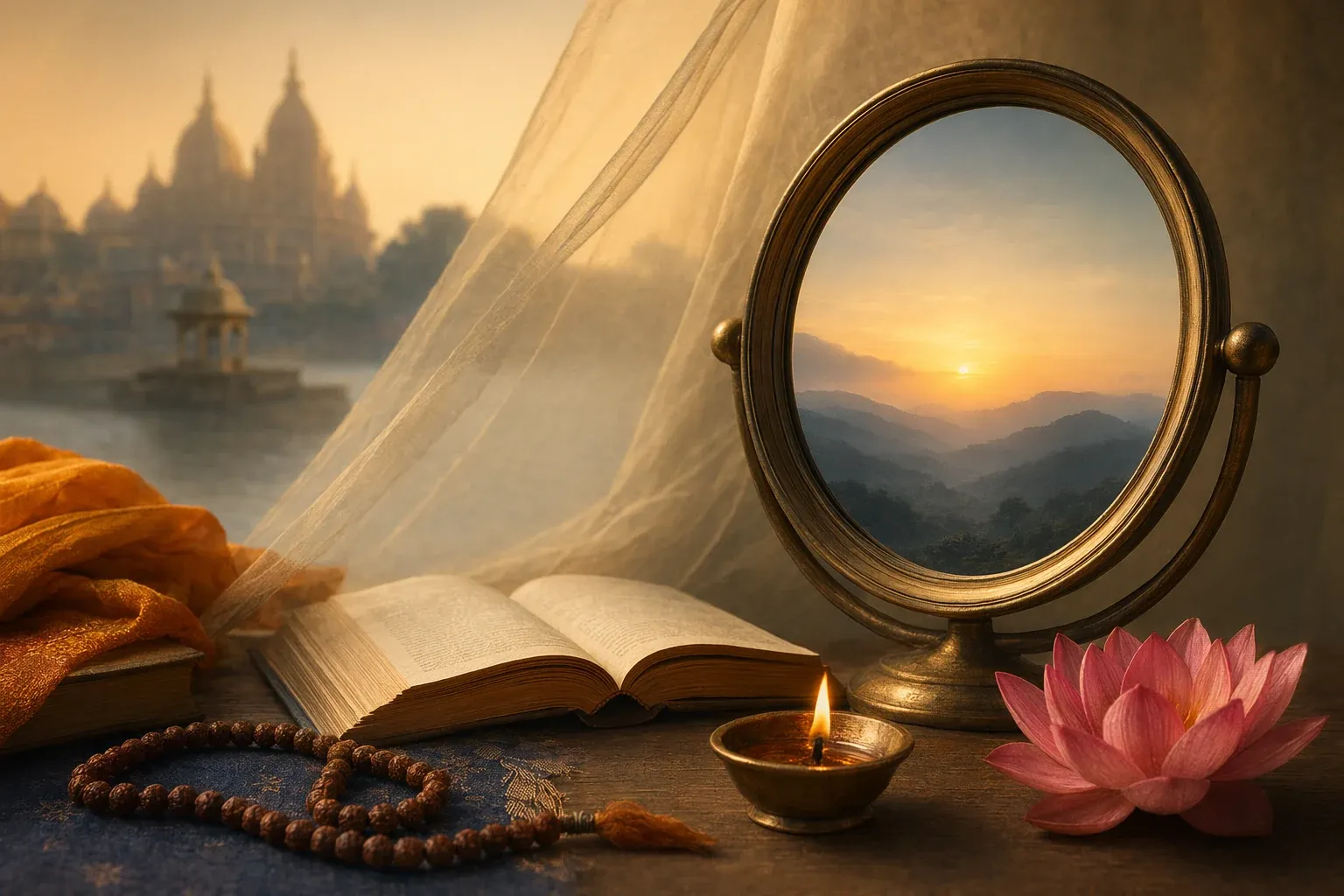
Maya is one of the most discussed words in Hindu philosophy. It is often translated as “illusion,” but that single word can be misleading. Maya does not simply mean that the world is fake or worthless. In many Hindu philosophical discussions, maya points to the way reality is experienced through appearance, limitation, change, desire, memory, and mistaken identification. It asks us to notice the difference between what seems complete and what is ultimately true.
A simple way to begin
Imagine seeing a rope in dim light and mistaking it for a snake. The fear is real to the person who sees it. The racing heart, the step backward, and the alarm all happen. Yet the object was never a snake. When light falls on it, the mistake is corrected. This classic example is often used to explain how appearance can mislead without being completely meaningless.
Maya works in a similar direction. It describes the power by which the changing world appears solid, separate, and final. We respond to names, forms, possessions, praise, blame, and identity as if they define the whole of reality. Philosophy asks whether this is the deepest truth or only a partial view.
Maya does not mean “nothing exists”
A common misunderstanding is that Hindu philosophy teaches that the world does not exist at all. That is too simple. Different schools explain maya differently, but many would say that everyday life has practical reality. People still act, learn, love, suffer, make choices, and follow dharma. The point is not to deny life. The point is to understand its changing and dependent nature.
In Advaita Vedanta, maya is often discussed in relation to Brahman, the ultimate reality. The world of names and forms is experienced, but it is not the final independent truth. This does not make compassion or responsibility unnecessary. In fact, clearer understanding should make a person less trapped by ego and more careful in action. Bhaktilipi’s guide to Brahman in Hindu philosophy gives useful background.
Everyday examples of maya
Maya can be understood through ordinary life. A person may think, “If I get this one achievement, I will be permanently happy.” The achievement comes, joy appears for a while, and then a new worry arrives. Another person may build an identity around status, beauty, anger, or comparison. For some time it feels like the whole self. Later, the feeling changes.
These examples do not prove that life is pointless. They show that the mind often mistakes temporary experiences for lasting security. Maya is the pattern of taking the passing as permanent, the partial as complete, and the role as the self.
Maya and the self
Many Hindu philosophical texts ask: Who am I beneath changing thoughts, roles, and possessions? A child becomes an adult. Opinions change. The body changes. Relationships change. Yet there is a sense of awareness through which these changes are known. Philosophical inquiry uses this observation to question the usual identification with body, mind, and social label.
Maya covers the true nature of the self by making the surface identity feel absolute. This is why teachings about atman, Brahman, and moksha often appear near discussions of maya. The goal is not hatred of the world but clearer seeing.
For a broader entry point, read Bhaktilipi’s introduction to Hindu philosophy for beginners.
Maya in stories and devotion
Maya also appears in devotional and mythological settings. Divine play, cosmic power, and the charm of the world can be described through maya. In some contexts maya is connected with the creative power through which the universe appears. In others it is the veil that keeps beings attached to limited understanding.
This range is why beginners should avoid one rigid definition. Maya can mean illusion, appearance, measuring power, creative display, or ignorance depending on the text and school. The safest method is to ask: In this passage, is maya explaining mistaken perception, cosmic manifestation, attachment, or the limits of ordinary knowledge?
How maya connects with practice
The idea of maya becomes practical when it changes attention. A person may pause before reacting to praise or insult. A student may notice that comparison creates unnecessary suffering. A devotee may remember that possessions and roles are temporary. A seeker may practice meditation, study, service, or devotion to see more clearly.
Yoga, Vedanta, bhakti, and other paths do not all use the same language, but many share a concern with misidentification. They ask people to move from confusion toward steadiness, humility, and insight. Bhaktilipi’s guide to Vedanta for beginners can help connect these ideas.
A balanced definition
For beginners, maya can be defined like this: Maya is the power of appearance and misperception through which the changing world is experienced as final, separate, and fully satisfying, while deeper reality remains hidden. This definition leaves room for daily life while pointing beyond it.
Maya is not a command to reject the world. It is an invitation to see the world with more wisdom. When understood carefully, it teaches that our first impression is not always the whole truth, that identity is deeper than social roles, and that lasting peace cannot be built only on things that change.## Why maya remains relevant
Maya remains relevant because modern life constantly strengthens appearance. Social approval can feel like truth. A profile, title, purchase, or argument can seem to define the whole person. The teaching of maya gently questions that habit. It reminds us that what appears urgent may not be ultimate, and what appears separate may be connected at a deeper level.
This does not require withdrawal from family, study, work, or society. It asks for wiser participation. A person can do duties, enjoy beauty, and care for others while remembering that every changing form is limited. That remembrance is the beginning of freedom from confusion.